49 works in this view — arrow keys or swipe to move between them.
Dance in Art
Annonces
Leon Sault
- Collection:
- Fancy dress costume design
- Source:
- Victoria and Albert Museum
- Rights:
- Rights vary by item — check the source record before reusing this image. Source record ↗
- Recorded as:
- V&A — check rights per item
This work documents a largely invisible form of labor and performance: the street advertiser whose body and costume were deployed to capture attention and draw crowds. For historians of dance and movement, it reveals how non-theatrical performers used gesture, stance, and display to create meaning and command public space. The image also records a specific moment in Parisian urban life when balloon ascents were a major public spectacle, positioning popular entertainment and the bodies that promoted it as worthy of visual recording.
What you are looking at
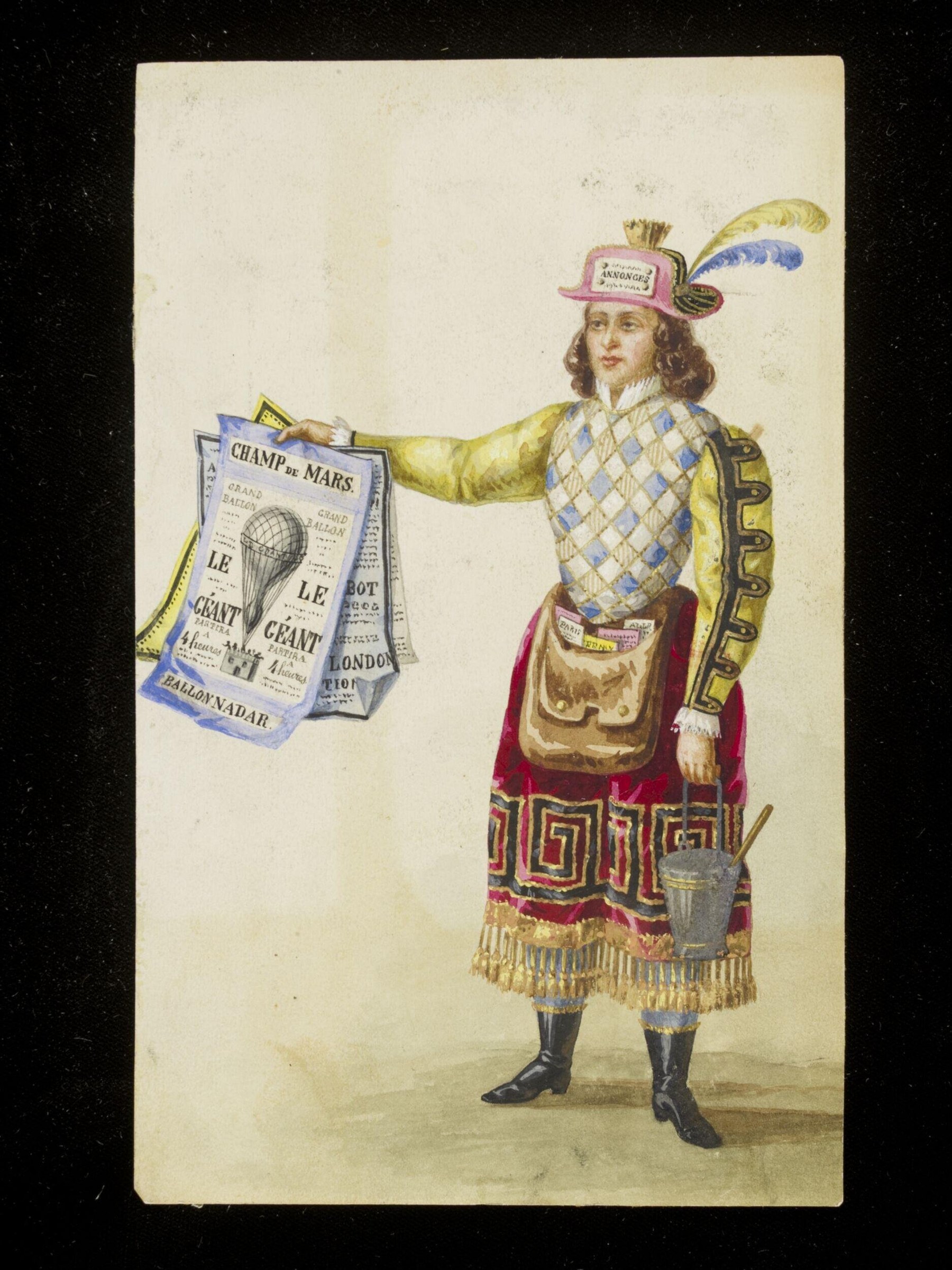
A single figure in fashionable early-19th-century dress stands against a plain background, holding aloft a printed advertising sheet. The figure wears a striking outfit: a yellow silk jacket with blue-and-white quilted diamond patterning, a deep burgundy skirt with gold geometric borders and fringe, and a pink cap adorned with feathers (one yellow, one blue). A decorative belt with a large rectangular buckle sits at the waist, and black boots extend to the knee. The figure's posture is animated and promotional—the left arm extended to display the advertising sheet, the right hand on the hip, the body angled to address an imaginary audience. The printed sheet advertises balloon ascents: text visible includes "CHAMP de MARS," "LE GÉANT," and "BALLONADAR," referring to famous hot-air balloon spectacles and locations in Paris. The overall effect is that of a street advertiser or carnival barker, a figure from popular urban entertainment, rendered in hand-colored fashion-plate style.
The dancing
A single standing figure with weight balanced and body turned three-quarters toward the viewer. The extended left arm is straight and raised to shoulder height, holding the advertising sheet. The right arm bends at the elbow with the hand placed on the hip—a posture of authority and showmanship. The figure's head faces forward with a composed expression. There is no partnering or group dynamic, and no visible footwork or dance vocabulary in the stance; this is the attitude of a performer or promoter rather than an active dancer.
The dance depicted
This is not a depiction of theatrical dance in the strict sense. The figure adopts the pose and demeanor of a *foire* (fair) or carnival entertainer—likely a street performer or advertisement hawker from the popular culture of early-19th-century Paris. The animated gestures and costume recall the exaggerated, attention-grabbing movement vocabulary of street performance and comic theater (such as pantomime), but there is no evidence of codified dance vocabulary. The title "Annonces" (Announcements) and the visible text referring to balloon ascents suggest this documents a real type of urban spectacle—a performer employed to advertise public attractions. The dynamic posture and colorful, slightly grotesque costume are consistent with the mock-heroic character types of boulevard entertainment.
How it was made
This is a hand-colored engraving or etching, identifiable by the fine line work, the thin printed outlines that define the figure and lettering, and the selective application of watercolor or gouache in distinct flat areas. The technique is that of a fashion or entertainment print—the type mass-produced and sold to a popular audience in 19th-century Paris. The hand-coloring appears deliberately crude in places (the geometric patterns on the skirt, the feather details on the cap) which contributes to a caricatural or comic effect. This was a commercial illustration, not a unique work, suggesting the subject had recognizable appeal to contemporary viewers.
About this work
This is a hand-colored engraving documenting a type of popular street performer or fair entertainer from early-19th-century Paris—a figure employed to advertise public attractions such as balloon ascents. The work sits at the intersection of fashion documentation, social observation, and popular entertainment ephemera. It belongs in a dance gallery not because the figure performs codified dance, but because it records the kinetic, performative vocabulary of street entertainment and spectacle—the body language of public display, the exaggerated gesture and costume that made such figures visible and memorable in urban space. The animated pose, colorful dress, and promotional function place this within the broader history of movement and performance in popular culture.
How to look at it
Attend first to the posture of the figure—the slight turn of the body, the extension of the arm, the placement of the hand on the hip. These form a language of confidence and address, not the codified positions of formal dance, but the vernacular gesture of someone trained to be seen and to command attention in public space. Notice the costume's exaggeration: the vivid colors, the geometric patterns, the towering cap with feathers. The contrast between the printed text on the advertisement sheet (which is rendered in miniature, almost illegible) and the enlarged, colorful figure suggests that the performer's body was the primary advertisement—motion, color, and spectacle mattered more than legibility of text.
The artist
Leon Sault is not widely documented in standard references. The signature and style suggest a commercial print maker or illustrator working in Paris in the mid-19th century, likely producing fashion plates, social-type prints, and character studies for the popular market. The hand-coloring and subject matter are consistent with the widespread production of affordable prints for middle-class and working-class consumers.
The period
The early-to-mid-19th century witnessed an explosion of printed entertainment and fashion ephemera in Paris. The Bourbon Restoration and July Monarchy periods saw the growth of popular spectacles, street performance, and public festivals. Hot-air balloon ascents, particularly those of André-Jacques Garnerin and the celebrated balloon "Le Géant," were major public attractions that drew enormous crowds—among them were street performers and hawkers promoting these events. Simultaneously, the print trade expanded dramatically, making images of fashion, celebrity, and social types accessible to a wide audience. This image sits within that culture of commercial visual entertainment.
Where it lives
The work is recorded as a costume or entertainment design in the "Fancy dress costume design" collection, catalogued with the source designation "va" (likely the Victoria and Albert Museum or a similar institutional holding). This suggests it may have been collected as evidence of historical dress or popular entertainment costume rather than as fine art.
Questions about this work
What is this figure advertising?
The printed sheet references "Champ de Mars," "Le Géant," and "Ballonadar," all associated with famous hot-air balloon ascents in Paris during the 18th and 19th centuries. The "Géant" (Giant) was a celebrated balloon that made a spectacular ascent in 1863. Street performers like this figure were employed to draw crowds to such public spectacles by advertising them on the streets.
Is this a dancer?
No, not in the theatrical sense. This is a street performer or carnival figure—a person employed to advertise public attractions. However, the work documents the kinetic and performative vocabulary of popular entertainment, showing how the body was used to create spectacle and attract attention outside formal dance contexts.
Why is the costume so exaggerated?
The bold colors, geometric patterns, and unusual silhouette made the figure highly visible in a crowded street or fair setting. The grotesque or comic quality was intentional—such costumes were designed to be eye-catching and memorable, to amuse potential customers and make them want to follow the performer to the advertised event.
What does the hand-coloring tell us about this print?
Hand-coloring indicates this was a commercial print produced for mass consumption, likely sold cheaply to working-class and middle-class buyers. The selective, sometimes crude application of color suggests a rapid production process, with colors applied by hand after the engraving was printed—a practical but artistic method for making affordable illustrated goods.
More dance artwork





