49 works in this view — arrow keys or swipe to move between them.
Dance in Art
Fancy dress costume design
Charles Frederick Worth
- Collection:
- Fancy dress costume design
- Source:
- Victoria and Albert Museum
- Rights:
- Rights vary by item — check the source record before reusing this image. Source record ↗
- Recorded as:
- V&A — check rights per item
Worth's costume designs shaped how the wealthy appeared in public, and this drawing reveals his commitment to theatrical invention and conceptual wit, not merely elegance. For dance historians, the fancy dress ball was a crucial context for social dancing and the display of wealth and cultural capital; this design shows the level of artifice and expense that accompanied dancing in fashionable circles.
What you are looking at
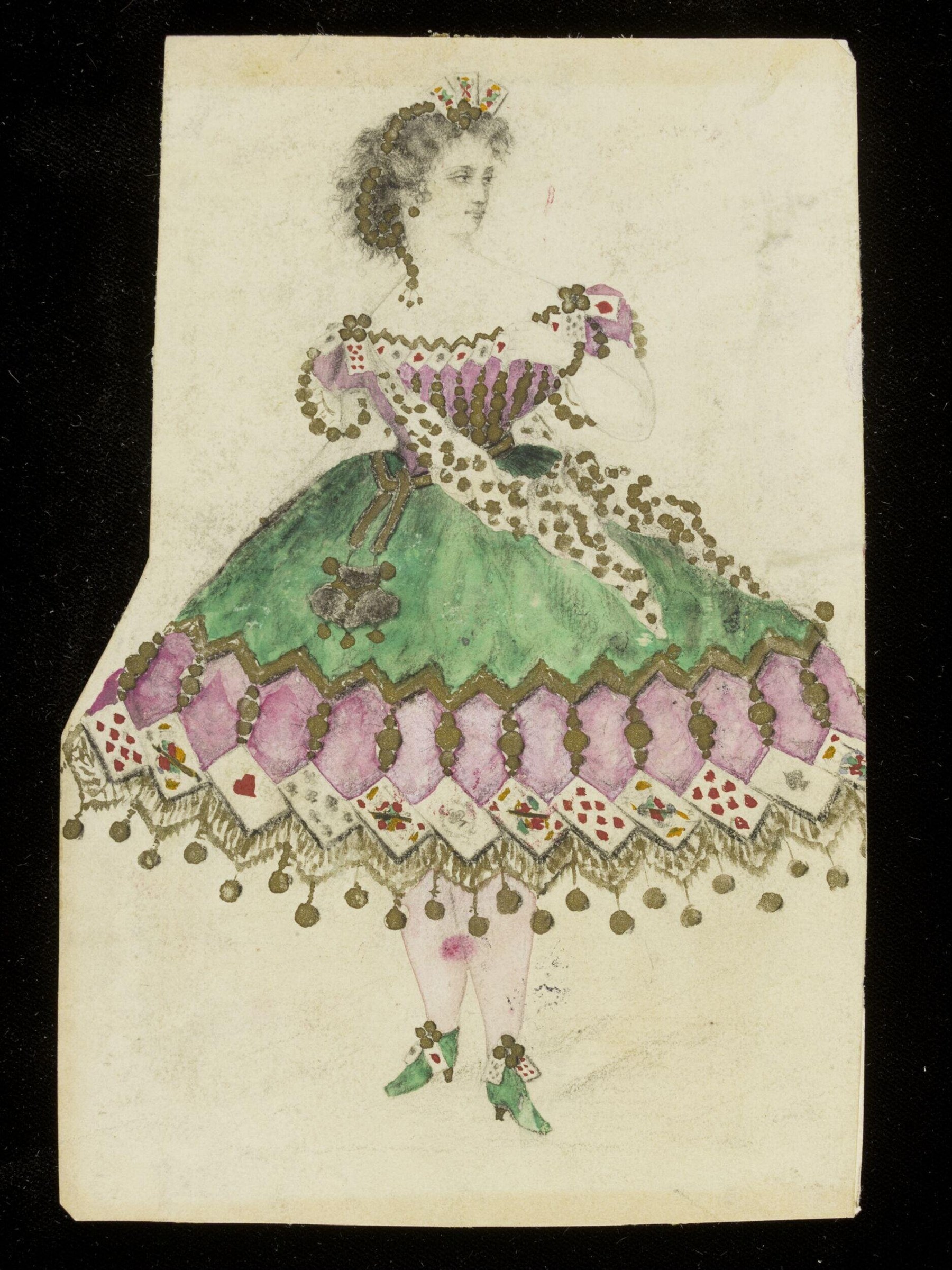
A woman in an elaborate fancy dress costume stands in three-quarter view against a plain background. Her costume is constructed from playing cards and textile scraps, deliberately theatrical and surreal: the skirt is engineered from overlapping rectangular fabric pieces (pink, green, cream, and patterned cottons) hung in scalloped tiers from a white card base, with spherical metal ornaments (likely brass curtain weights or similar) suspended from their lower edges to create volume and movement. The bodice is fitted and decorated with striped purple and white fabric appliqué and spotted patterns, with long sleeves extending downward. A jeweled tiara or small crown sits atop her elaborately arranged curled hair. She wears green shoes or slippers decorated with cards or card patterns. The costume reads as both whimsical and grotesque—highly constructed artifice rather than naturalistic dress. Her posture is upright and formal, as if presenting the costume for inspection or admiration rather than mid-performance. The pale background allows the costume to dominate entirely.
The dancing
The woman stands at full height in a frontal or near-frontal stance, weight evenly distributed, with no suggestion of active movement or a particular dance hold. Her arms hang or are slightly extended, showing the costume rather than engaging in gestural movement. Her body is elongated and attenuated, almost doll-like in proportion. There is only one figure. The emphasis is entirely on static display: the costume is the subject, not the body's movement or dance action.
The dance depicted
This is not a depiction of dance in motion, but rather a costume design for fancy dress, likely for a masked ball, theatrical entertainment, or carnival event. The card-based construction and whimsy suggest this may have been created for a specific costume ball or theatrical masquerade in fashionable society. While fancy dress and masquerade were often accompanied by ballroom dancing—particularly quadrilles, cotillions, or galops—there is no evidence in the image of active dance. The work documents the costume as a constructed object for display, not its use in movement.
How it was made
This appears to be a watercolor or mixed-media drawing on cream-colored paper, using pencil for underdrawing, watercolor or gouache for the flesh tones and larger color fields, and what may be collage or carefully painted trompe-l'oeil effects to represent the playing cards and textile elements. The technique is precise and delicate, suggesting this is a working design or presentation drawing for a costumer or dressmaker, not a finished artwork for exhibition. The medium was well-suited to fashion and costume design in the 19th century: portable, quick to produce, and able to convey color and construction with sufficient clarity for a maker to work from. The inclusion of actual card images (or careful simulation of them) suggests the artist was documenting the literal materials of the costume.
About this work
This is a costume design drawing by Charles Frederick Worth, the preeminent fashion designer of the mid-19th century, for an elaborate fancy dress. The costume is constructed as a conceptual joke or witty artifice: a woman's gown built from playing cards and fabric scraps, with suspended metal ornaments creating sculptural volume. The drawing is a working design, likely made for a client planning to wear this costume to a masquerade ball or fashionable fancy dress event. It documents both Worth's influence over theatrical costume and the culture of elaborate, inventive dress among wealthy Parisians in the 1860s. While not itself a dance scene, the costume was created for an event context—the fancy dress ball—where dancing was a central activity.
How to look at it
Attend first to the construction of the costume: the way the skirt is engineered from discrete rectangular elements, the suspended ornaments, and the playing cards as literal or simulated material. The costume is not naturalistic but clearly artificial and conceptually driven. Notice the woman's static, presentation pose—she is not caught mid-movement or in a dance hold, but displayed frontally as an object. This is a designer's presentation drawing, meant to communicate both the visual effect and the practical construction. The playfulness of the design (cards, theatrical ornament, exaggerated scale) reflects the wit and invention valued in fancy dress at the time.
The artist
Charles Frederick Worth (1825–1895) was an English-born fashion designer who became the dominant figure in Parisian couture from the 1860s onward. He founded the House of Worth in Paris and was known for his innovation, his ability to dictate rather than merely respond to fashion trends, and his theatrical sensibility. He designed not only day wear and evening dress but also costume for theater and fancy dress events. His designs were marked by dramatic silhouettes, rich materials, and often a playful or surreal quality, as seen here. Worth's reputation rested on bespoke commission work for the wealthy, and he produced or supervised numerous costume and design drawings.
The period
In the 1860s, the fancy dress ball was a central entertainment for wealthy European society, particularly in Paris. These events, often masquerades or themed costume parties, were occasions for theatrical display and social dancing. Ballroom dancing in this period centered on quadrilles, cotillons, galops, and waltzes—forms that were fully codified and danced in the formal setting of the ball. The costume design itself reflects the Second Empire fascination with historical pastiche, orientalism, theatrical artifice, and wit. Worth was working at the height of this culture, and his designs for fancy dress show how the boundary between fashion, theater, and fine art was deliberately blurred by wealthy clients and designers alike.
Where it lives
The work is held in the collection noted as 'Fancy dress costume design' and is sourced from the VA (Victoria and Albert Museum). It is part of the museum's fashion and design collection, which includes extensive holdings of costume designs, fashion drawings, and related material from Worth and his contemporaries.
Questions about this work
Was this costume actually made and worn?
The record does not indicate whether this design was executed or remained a drawing only. Worth's design drawings were sometimes presented to clients as proposals; some were realized in full, others modified or abandoned. The precision and detail suggest it was a serious commission, but the fantastical construction (suspended ornaments, card materials) may have been partially theatrical or may have employed lighter materials in practice.
What is the significance of the playing cards?
The playing cards are almost certainly a deliberate visual conceit—a pun or witty reference to gambling, chance, or the theatricality of the masquerade itself. Fancy dress often employed conceptual or parodic themes. The cards may have been literal (sewn or glued onto the costume) or painted in trompe-l'oeil effect on the design drawing to suggest them. Either way, they communicate artifice and wit.
Who would have worn this costume?
The client would have been a wealthy woman in Parisian high society, likely someone who moved in court or artistic circles where Worth's reputation and high prices were affordable and acceptable. The costume was made for a specific fancy dress event—probably a named masquerade or themed ball—where such elaborate and expensive costumes were de rigueur.
What kind of dancing would have happened in this costume?
If the costume was worn to a ball, the wearer would have participated in quadrilles, cotillons, galops, or possibly waltzes—the standard ballroom dances of the 1860s. The heavy construction and suspended ornaments would have created movement and sound with every step, making the costume itself a kind of kinetic display. The rigidity of the skirt structure would have constrained the dancer's movement, making the dance itself part of the costume's theatrical effect.
More dance artwork





