49 works in this view — arrow keys or swipe to move between them.
Dance in Art
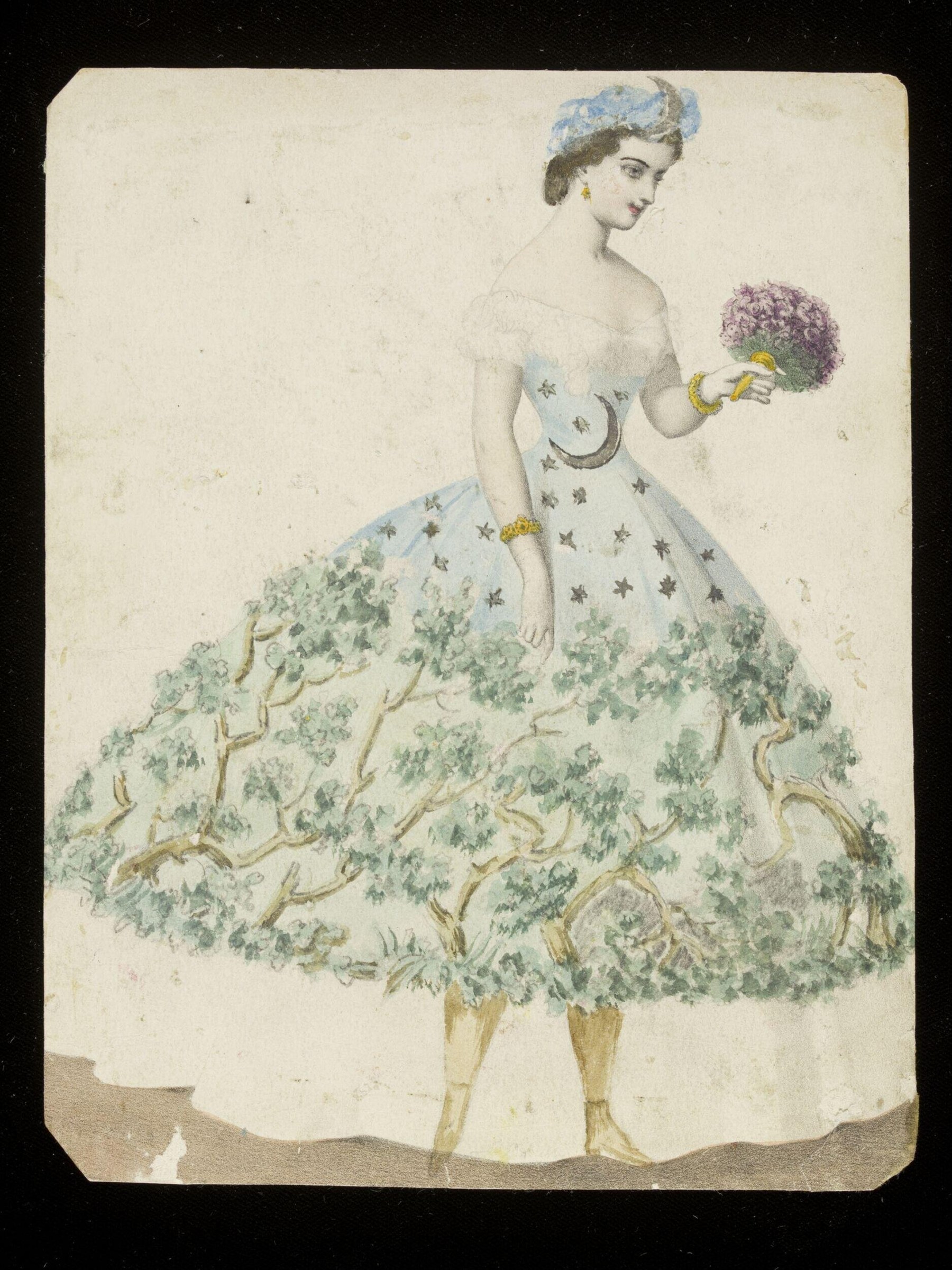
Fancy dress costume design
Jules Helleu
- Collection:
- Fancy dress costume design
- Source:
- Victoria and Albert Museum
- Rights:
- Rights vary by item — check the source record before reusing this image. Source record ↗
- Recorded as:
- V&A — check rights per item
This work captures the intersection of dance, fashion, and spectacle at the apex of the Gilded Age. Fancy dress balls were major social performances, and the costume was as much a work of art as the choreography or music. The design demonstrates how elite 19th-century culture understood the body as a frame for elaborate narrative and fantasy—here, a woman-as-garden—and how fashion served as a medium for allegory and wit in aristocratic social life.
What you are looking at
A single figure in three-quarter profile stands against a pale ground, her body turned leftward. She wears an elaborate ball gown whose skirt is constructed entirely from delicate green foliage—rendered in pale and darker greens with fine gold outlines suggesting branches and leaves. The bodice is pale cream or white, decorated with a crescent moon and scattered stars in gold and dark pigment, cinched at the waist with a gold band. Her bare shoulders and low neckline are in the neoclassical mode. She wears a blue hat or headdress with what appears to be white or pale plumage. Her right arm is raised and bent, holding a bouquet of small purple flowers (likely violets or lilacs) with a gold stem. Her left arm hangs at her side. The figure's posture is graceful and elongated, her gaze directed away from the viewer—a pose typical of fashion illustration rather than narrative scene.
The dancing
A single standing female figure with elongated proportions and refined, upright carriage. Her weight appears evenly distributed, the body held in a gentle contrapposto. The raised right arm cradles flowers against her body in a pose of presentation or display rather than active movement. There is no suggestion of dancing posture or athletic frame—the figure is posed for admiration rather than captured in motion. The elongation and delicacy of the limbs, and the refinement of the hand gestures, are consistent with fashion plate conventions rather than dance documentation.
The dance depicted
This is not a depiction of dance but a costume design for a fancy dress ball or masquerade. The 'costume' is a novelty or allegorical design: a gown whose skirt represents a topiary garden or living vegetation. The pose and presentation are those of a fashion plate or costume scheme, not a dancer in action. The figure stands still, modeling the garment. While fancy dress balls often featured choreographed dances and the gown was presumably worn at such an event, the image itself documents costume rather than movement or dance practice.
How it was made
This appears to be a hand-colored lithograph or chromolithograph: the delicate color work—the pale washes of green and blue, the careful gold-leaf or gilt detailing, and the fine line work—are characteristic of mid-19th-century color lithography. The paper is aged cream, consistent with period practice. The technique allowed for fine detail and soft color gradation essential to fashion illustration, and the hand-coloring permitted small print runs of luxury costume designs intended for a wealthy audience planning their costume selections.
About this work
A costume design for a fancy dress ball, likely created for a client or patron to select or commission from. The gown is an elaborate fantasy: the skirt constructed as a flowering shrub or garden in miniature, with the bodice decorated in celestial imagery. The figure is presented in the conventions of mid-19th-century fashion illustration—elegant, elongated, still, and posed for visual inspection rather than captured in action. This belongs in a dance collection because fancy dress balls were choreographed social events and because the garment would have been worn by a dancer at such an occasion. Yet the image itself is a document of fashion design and courtly display rather than of dance technique or performance.
How to look at it
The viewer should note the illusionistic detail of the skirt: each element of the topiary is rendered individually, creating a fantastic but botanically plausible costume. Observe also the symbolic language of the bodice—the crescent and stars invoke the night sky and romantic melancholy typical of 19th-century aesthetic taste. The figure's stillness and presentation pose are deliberate: she is not a dancer but a model, and the composition invites the eye to survey the garment as one would examine a precious object. The gold detailing draws the eye through the composition and emphasizes the luxury of the commission.
The artist
Jules Helleu was a French fashion illustrator and designer active in the mid-to-late 19th century, working in the tradition of fashion plate design that flourished in Paris. He was part of the thriving commercial culture of costume design and elite fashion documentation, creating works intended for wealthy clients, fashion houses, and collectors of fine illustrated documents.
The period
The mid-19th century saw an explosion of elaborate fancy dress balls in European aristocratic and wealthy bourgeois society. These events were major social occasions, often featuring choreographed tableaux vivants, dances, and processions. Fashion illustration reached a peak of refinement and technical sophistication in this period, with hand-colored lithographs serving as both working documents for dressmakers and luxury art objects for collectors. The celestial and botanical imagery in this design reflects broader aesthetic currents of Romanticism—the symbolic use of nature, the elevation of the feminine form, and the taste for whimsy and fantasy in aristocratic entertainments.
Where it lives
The catalogue record lists this as held in 'va' (Virginia, likely the University of Virginia or a Virginia-based collection) but provides no accession number, acquisition date, or condition notes. It is classed as a costume design document, part of the archival or print collection rather than fine art holdings.
Questions about this work
Is this a real dress or a fantasy design?
Almost certainly a fantasy design created for a specific fancy dress ball. The skirt made entirely of living or simulated vegetation would have been technically challenging but not impossible—such costume innovations were commissioned for elite balls. However, the image documents the design concept; we cannot know from this image alone whether it was constructed and worn, or remained a paper fantasy.
What does this tell us about 19th-century dance?
It shows that dance in aristocratic society was inseparable from costume, spectacle, and visual design. Fancy dress balls were major choreographic occasions, and the costume was as much a work of art as the movement. The image also demonstrates the role of fashion illustration in creating the visual culture of dance and social performance.
Who was Jules Helleu?
A French fashion illustrator and costume designer of the mid-19th century. He worked in the tradition of haute couture and luxury costume design, creating illustrated documents for wealthy patrons and the fashion industry. His work exemplifies the technical and artistic sophistication of mid-century French fashion illustration.
What is the significance of the botanical and celestial imagery?
The combination of a garden skirt and starry bodice creates an allegorical image: a woman as nature and night, combining earthly and celestial symbolism. This reflects Romantic aesthetics and the 19th-century taste for poetic fancy and symbolic meaning in costume and decoration.
More dance artwork





