49 works in this view — arrow keys or swipe to move between them.
Dance in Art
Fancy dress costume design
Charles Frederick Worth
- Collection:
- Fancy dress costume design
- Source:
- Victoria and Albert Museum
- Rights:
- Rights vary by item — check the source record before reusing this image. Source record ↗
- Recorded as:
- V&A — check rights per item
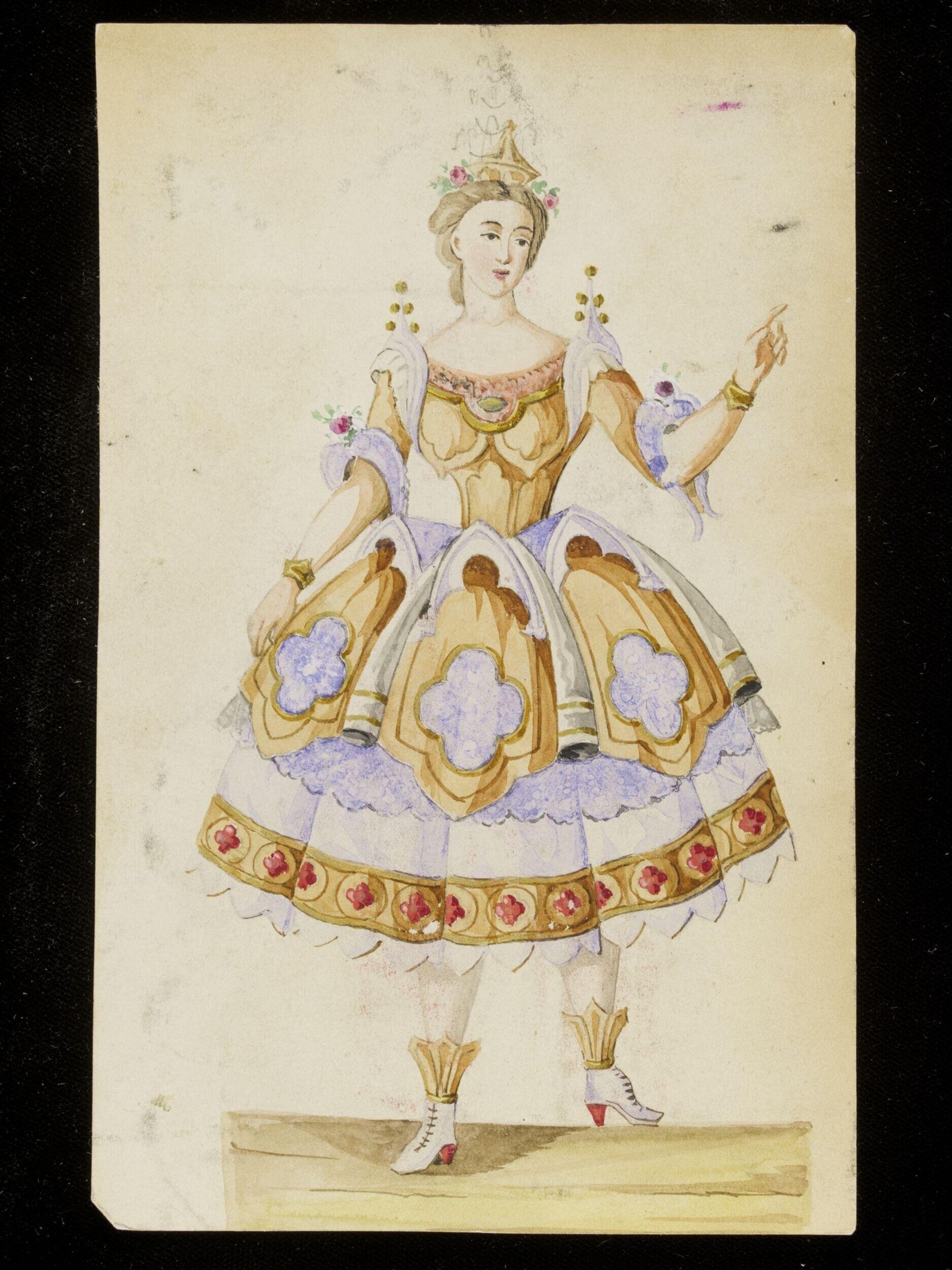
This design document reveals how 19th-century costume was engineered to move: the scalloped panels, the layered construction, and the floating draperies were all calculated to create specific visual effects in motion and on the dance floor. For historians of dance costume and fashion, it shows the interplay between couture and ballroom culture at the moment when Worth was establishing himself as the definitive arbiter of luxury dress.
What you are looking at
A single female figure in elaborate fancy dress costume stands in a frontal pose against a plain background. She wears a golden corset-style bodice with an ornate neckline and jeweled trim, paired with an extraordinarily voluminous skirt constructed in tiers of scalloped golden panels with blue-purple shading and white lace underskirts visible beneath. The skirt appears almost architectural in its structured, flared construction. Attached to the shoulders are long, flowing draperies of pale lavender silk that cascade behind the arms, creating an airborne effect. She wears a tall golden star-topped headdress adorned with pink flowers and long golden drop earrings. The costume is completed with white stockings and heeled shoes with red accents. The figure's pose is upright and composed, with arms raised in a welcoming gesture, and her expression serene. The watercolor technique creates soft washes of color with delicate detail work, and the paper's aging and spotting are visible, indicating the age of the work.
The dancing
The single figure occupies the full height of the composition. Her arms are raised to roughly shoulder height in an open, welcoming gesture with hands extended, neither in a closed ballroom frame nor in the tensioned positions of classical ballet. Her posture is upright and relaxed rather than the turned-out, elongated carriage of ballet training. Her weight appears evenly distributed and stationary rather than caught in motion or rotation. The body is presented frontally rather than in profile or three-quarter turn, suggesting display or presentation rather than the dynamic integration of the body seen in dance technique.
The dance depicted
This appears to be a costume design for a fancy dress ball or masquerade rather than a depiction of an actual dance being performed. The figure is not executing dance steps or movements; she is posed for costume presentation. The raised-arm gesture and frontal stance are typical of fancy dress display in 19th-century fashion illustration, where the costume itself—its construction, ornament, and theatrical impact—is the subject rather than the dancer's technique or the movement of dance. The lavender draperies are designed to create visual drama when the wearer moves, but the image freezes the figure in a moment of stillness and presentation rather than capturing action.
How it was made
This is a watercolor and ink design on paper, executed with the delicate precision typical of haute couture costume sketches of the mid-19th century. The artist has used transparent watercolor washes for the soft shading and volume of the draperies and skirt, combined with fine pen line work for definition and ornamental detail. The technique allows for both architectural clarity in the skirt construction and atmospheric softness in the floating fabrics. The survival of the original paper and the hand-drawn character of the work indicate this is a design document created for presentation to a client or maker—a single, precious artifact rather than a mass-produced print.
About this work
This is a costume design drawing by Charles Frederick Worth, the preeminent couturier of the mid-19th century. It depicts fancy dress in the mid-Victorian mode: an elaborate confection designed for a ball or theatrical occasion, emphasizing volume, ornament, and theatrical spectacle. The work belongs in a dance gallery not because it documents a specific dance style or technique, but because fancy dress balls and masquerades were central occasions for social dancing in the 19th century, and because the design of costume—its movement, drape, and visual impact—was inseparable from the experience of dancing. Worth was revolutionizing European fashion during this period, and this sketch shows his approach to costume as theater and architecture.
How to look at it
This image requires viewing as a design document rather than a finished artwork. Notice the careful notation of construction: the scalloped seams that allow the skirt to flare, the layering of fabrics (golden silk over blue-tinted lace), the way the draperies are cut and attached. The raised-arm pose shows the wearer presenting the costume rather than dancing, but the floating draperies are designed to move. Imagine this figure on a dance floor in motion—how the panels would swing and catch light, how the draperies would trail and flutter. The design is fundamentally about movement and spectacle, even though the drawing itself is static.
The artist
Charles Frederick Worth (1825–1895) was an English-born couturier who founded the House of Worth in Paris and became the most influential fashion designer of the Victorian era. He revolutionized the business of fashion by establishing the concept of the designer as artist and brand, signing his creations and building a clientele of royalty and aristocracy across Europe. He was known for his innovative use of structure, ornament, and theatrical effect in costume design. His sketches and designs, executed in watercolor and ink like this one, were design documents created for clients and manufacturers, and they provide crucial evidence of how 19th-century couture was imagined and constructed.
The period
Mid-Victorian fancy dress balls and masquerades were major social events, especially among the aristocracy and wealthy merchant classes. The 1860s saw an intensification of the Victorian taste for ornament, volume, and historical or theatrical reference in costume. At the same time, Worth's rise was establishing fashion design as a fine art rather than mere garment-making. The fancy dress tradition, with its emphasis on spectacle and transformation, created demand for increasingly elaborate and inventive costumes. Ballroom dancing during this period—quadrilles, waltzes, polkas—was the primary context for displaying such costumes in motion.
Where it lives
This work is held in the collection of the Victoria and Albert Museum (indicated by source: va in the record). It is part of the museum's extensive holdings of costume design drawings, which document the history of fashion and fashion illustration from the 18th century onward. As a design document from the workshop of a major couturier, it represents a category of object that is both fine art and functional document.
Questions about this work
Is this person dancing?
No. This is a costume design presented for display and approval, not a record of dancing in progress. The pose is one of presentation—the figure is shown frontally and statically so that the costume design can be evaluated in all its aspects. The raised arms and open stance are characteristic of fashion illustration, not of any dance position or technique.
Who was Charles Frederick Worth?
Worth (1825–1895) was the founder of haute couture. Born in England, he established his house in Paris in 1858 and became the most celebrated couturier of the Victorian era, dressing royalty and aristocracy across Europe. He was innovative in establishing the fashion designer as a named artist and brand, a revolutionary business practice. His hand-drawn costume designs like this one were created for clients and manufacturers.
What was fancy dress in the 1860s?
Fancy dress balls were costumed social events, often themed around historical periods or theatrical characters. They were major occasions in aristocratic and wealthy merchant-class society, and they centered on social dancing: waltzes, quadrilles, and other ballroom forms. The costumes were designed to be spectacular and to move well on the dance floor.
Why is the skirt built in those scalloped panels?
The scalloped seams and panels create structure and allow the skirt to flare dramatically when the wearer moves. The layering of golden silk over paler lace creates depth and movement. This construction was both functional—allowing for the volume and swing necessary for dancing—and aesthetic, creating visual interest and catching light as the fabric moved.
More dance artwork





