49 works in this view — arrow keys or swipe to move between them.
Dance in Art
Fancy dress costume design
Jules Helleu
- Collection:
- Fancy dress costume design
- Source:
- Victoria and Albert Museum
- Rights:
- Rights vary by item — check the source record before reusing this image. Source record ↗
- Recorded as:
- V&A — check rights per item
The costume reveals the Romantic imagination at work: the conflation of human and natural form, the fantasy of total theatrical transformation, and the belief that beauty and wonder could be achieved through elaborate costume and deportment rather than through dance technique alone. For historians of theatrical dance and dress, the design documents the aesthetics and construction methods of mid-nineteenth-century fancy dress, and shows how the visual language of ballet—the extended line, the ethereal silhouette, the connection to nature—was adapted for entertainment outside the professional stage.
What you are looking at
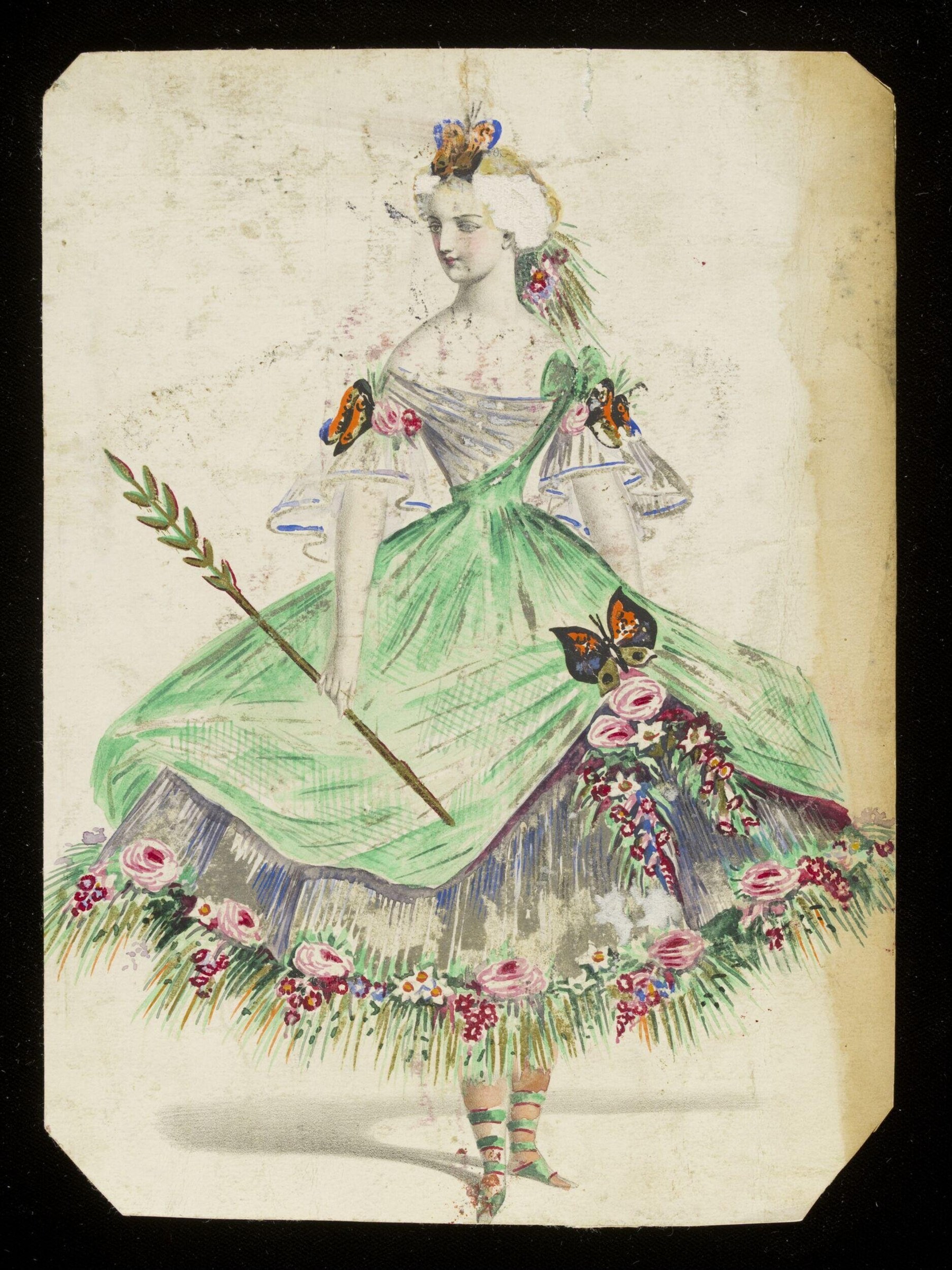
A delicate watercolor and ink design for a fancy dress costume depicting a young woman in an exuberant theatrical gown. The figure stands in a graceful contrapposto pose, her weight on one leg, her upper body angled slightly. The costume is dominated by a sweeping skirt constructed from enormous green silk panels suggesting a butterfly's or insect's wings, layered with sheer blue-grey underskirts and a deep border of dense floral embroidery—roses, peonies, and small flowering plants in pink, red, and white. The bodice is a pale grey silk draped off the shoulders. Her hair is crowned with an ornamental headdress featuring blue and gold elements, from which extends a green stem or antenna topped with a butterfly perched at the apex of the design. Additional butterflies and insects are scattered across the skirt and bodice. A single laurel branch extends from her hand. The figure wears striped stockings and delicate shoes, and gazes downward in a languid, dreamy expression. The composition suggests movement frozen mid-stride, with the enormous skirt panels seeming to billow and sweep as if she has just turned.
The dancing
A single female figure stands alone, displaying the refined posture and elongated line of Romantic-era theatrical performance. Her weight is shifted onto the back leg in a gentle relevé or flat-footed stance, with the other leg extended slightly forward. The arms are held softly at the sides and gesture, one hand holding the decorative laurel branch. Her head is tilted downward in a contemplative expression characteristic of Romantic ballerinas. The extreme weight and volume of the skirt dominates the composition, suggesting this is a costume designed for visual spectacle rather than technical virtuosity—the dancer would move through space supported by the elaborate construction rather than by athletic facility.
The dance depicted
This is a fancy dress costume design, likely for a theatrical ball or themed entertainment rather than a formal staged ballet, though the silhouette and deportment reflect the aesthetic vocabulary of mid-nineteenth-century Romantic ballet. The metamorphic insect and botanical imagery—butterflies, flowers, the laurel branch—suggests either a carnivalesque fantasy or a scene from a narrative ballet with a nature or dream sequence. The design prioritizes visual transformation and spectacle over the demands of technical dance vocabulary. A performer wearing such a costume would move with the stylized grace expected of theatrical amateurs or fancy-dress participants, rather than the codified technique of professional dancers.
How it was made
This is a hand-colored drawing combining ink or pen work with watercolor pigments on paper. The technique allows for minute detail in the embroidered floral border—each flower is individually rendered—and for the translucent quality of the draped silk. The watercolor wash creates soft transitions in the drapery and flesh tones, while the ink provides crisp definition to the figure's contours and the decorative elements. This is a finished design drawing, not a preliminary sketch, made for presentation to a client or patron commissioning the costume, and therefore intended for circulation among the theatrical or aristocratic classes who would commission such elaborate disguises.
About this work
This is a mid-nineteenth-century fancy dress costume design for a theatrical or carnival entertainment, depicting an elaborate insect-woman figure constructed from massed botanical and zoological imagery. The design belongs to the visual culture of Romantic theatricality, when the distinction between ballroom fancy dress and staged ballet was fluid and porous. Professional and amateur performers inhabited the same aesthetic language of metamorphosis, natural beauty, and theatrical grace. The work is significant as a document of how dance was imagined and staged in the era: not as a display of individual technical virtuosity, but as the animated embodiment of fantasy—a woman transformed into a living butterfly, her skirts becoming wings, her body becoming a platform for visual spectacle.
How to look at it
Attend to the sheer elaboration of the skirt construction: the way the enormous green panels are engineered to suggest movement and lightness despite their weight, and the precision with which every flower in the embroidered border is rendered. Notice how the figure's downward gaze and gentle stance create a sense of reverie or enchantment, as if she has been transformed and is discovering her new form. The overall composition suggests a moment of suspension—the costume has transformed the dancer into a living artwork, and she moves (or appears about to move) through this fantasy with grace and delicacy. The design shows the artist's understanding of how costume and posture together create theatrical meaning.
The artist
Jules Helleu was a French designer active in the mid-nineteenth century, known for his delicate and detailed costume and theatrical designs. His work exemplifies the fashion and theatrical aesthetics of the Second Empire and early Third Republic, when elaborate fancy dress entertainment was a fixture of aristocratic and bourgeois social life. Helleu's designs are characterized by meticulous attention to decorative detail, refined color harmony, and the integration of naturalistic ornament—flowers, insects, foliage—into costume design.
The period
The design dates to 1860, a moment when European ballet was entering the decline of the Romantic era. The technical innovations and emotional intensity that had defined Romantic ballet in the 1830s and 1840s were giving way to a new emphasis on visual spectacle and virtuosity, but the aesthetic of ethereal transformation and connection to nature remained powerful. Simultaneously, the fancy dress ball was at the height of its fashion among the European aristocracy and wealthy bourgeoisie; elaborate costumes representing fantastical beings—nymphs, insects, allegorical figures—were commissioned from professional designers. This design sits at the intersection of professional theatrical costume design and amateur fancy dress entertainment.
Where it lives
The work is held in the Victoria and Albert Museum, London, part of the institutional collection of theatrical and costume design drawing. It represents the type of finished design drawing commissioned by wealthy patrons or prepared for exhibition and publication among designers and makers.
Dance in this work
Questions about this work
Was this costume actually worn, or is it a fantastical design?
The costume was most likely designed for an actual fancy dress ball or theatrical entertainment, and may well have been made and worn. However, the extent of the elaborate floral embroidery and the sculptural silhouette suggest that the final costume would have required significant structural engineering to be wearable—perhaps a framework of hoops and wires to support the green panels as wings. Costume designs of this era often show the ideal version of a costume, which the maker would adapt for practical wear.
What does the butterfly and flower imagery mean?
In mid-nineteenth-century theatre and design, insects and flowers were symbols of natural beauty, transformation, and the ephemeral qualities associated with Romantic aesthetics. The costume transforms the wearer into a hybrid human-insect figure, a common fancy dress theme. The laurel branch she holds suggests victory or classical allusion, adding a note of dignity to the fantastical conceit.
How is this related to ballet?
This is not a ballet costume, but a fancy dress design. However, it shares the visual aesthetic of Romantic ballet—the ethereal silhouette, the soft color palette, the connection to nature, the graceful posture. The design shows how the theatrical language of professional ballet had become a model for theatrical costume and movement more broadly in the nineteenth century.
More dance artwork





