49 works in this view — arrow keys or swipe to move between them.
Dance in Art
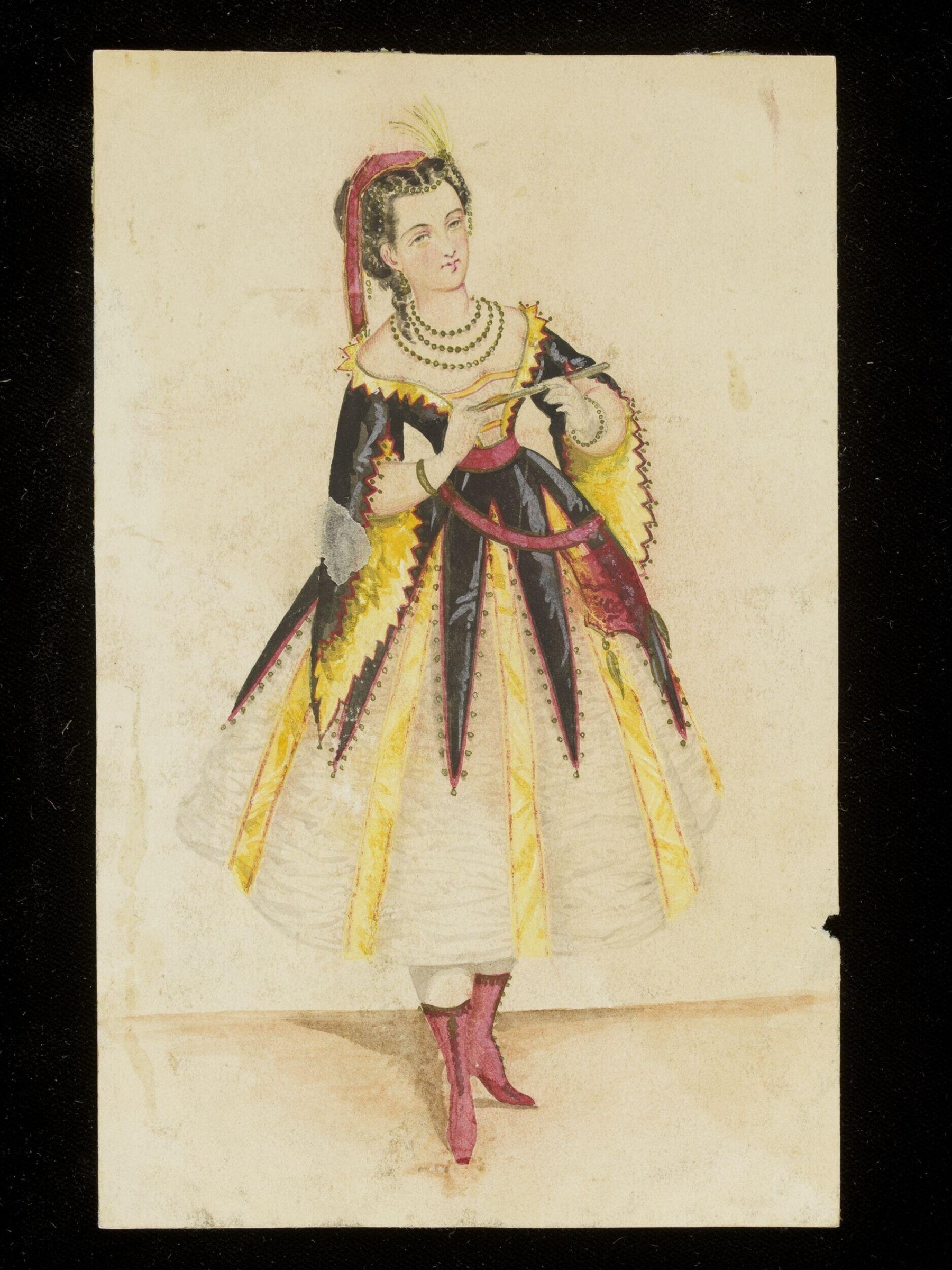
Fancy dress costume design
Jules Marre
- Collection:
- Fancy dress costume design
- Source:
- Victoria and Albert Museum
- Rights:
- Rights vary by item — check the source record before reusing this image. Source record ↗
- Recorded as:
- V&A — check rights per item
Costume design drawings like this one are windows into how theatrical dance was framed and presented in its historical moment. They show the imaginative excess and labour that went into theatrical spectacle in the Second Empire—the commitment to visual display that made theatre a dominant form of public entertainment, including the dance performances embedded within it.
What you are looking at
A young woman stands against a neutral background in an elaborate fancy dress costume of the mid-nineteenth century. She wears a striking black corseted bodice with a deep neckline and gold scalloped edging at the shoulders, paired with a voluminous skirt composed of alternating yellow and white panels—the yellow panels appear to be silk or satin, while the white sections are likely linen or cotton. Over her shoulders drapes a decorative cloak or mantle in deep crimson and black with gold geometric trim. She wears a red headband with a yellow feather plume, pearl drop earrings, and multiple strands of beaded necklace. Pink or red stockings and shoes complete the ensemble. The figure is drawn in a three-quarter pose, weight balanced and turned slightly as if presenting the costume for inspection, her gaze directed off to the side. The watercolour or gouache rendering shows careful attention to the crisp geometry of the skirt panels and the texture of the fabrics.
The dancing
The figure stands in a poised, upright position with controlled posture—the back is straight, the head held upright, and the arms positioned to display the costume. The left arm hangs at the side while the right arm is raised slightly, hand gesturing across the body. The stance is presentational rather than active or in motion; this is a costume on display rather than a figure captured mid-movement. The weight appears evenly distributed, and there is no indication of the fluidity or weight transfer characteristic of a dancer in action.
The dance depicted
This is not a record of a dance in progress but rather a costume design for fancy dress or theatrical wear—likely for a carnival, masquerade, or theatrical performance. The design does not depict a specific named dance, nor does the pose reveal anything about the technical practice of a particular dance form. The costume's exuberant colour and eclectic assembly of elements (the mixed black, gold, and red; the contrast of sleek bodice and gathered skirts; the dramatic feathered headpiece) suggest theatrical fantasy rather than the codified dress of any established social or theatrical dance. It is a creation meant to be striking and memorable rather than rooted in dance tradition.
How it was made
The work is executed in watercolour and gouache on paper, a medium well suited to costume design documentation of the period. The application is precise in the rendering of the costume's construction—the repeating panels of the skirt are painted with ruler-sharp edges, and the gold embellishment is rendered in fine detail. This technique allowed for rapid iteration and clear communication of design intent to makers and performers; such sheets were working documents for theatre and costume workshops. The paper support and the quality of the rendering suggest this was a professional design sketch rather than a casual study.
About this work
This is a costume design drawing attributed to Jules Marre, a nineteenth-century theatre and opera designer whose work was central to the visual spectacle of French theatrical production. The drawing shows a fancy dress or carnival costume of the 1860s—an exuberant assembly of contrasting fabrics, colours, and ornaments in the style that characterised fashionable theatrical dress during the Second Empire. While not a depiction of dance itself, it documents the visual language of costume for entertainment and performance in an era when theatre, opera, and carnival were primary venues for public dance. The drawing is a record of how theatrical bodies were dressed for display and movement on stage.
As a working document for costume construction, it belongs to the material culture of nineteenth-century theatre production. Such designs were essential to the realisation of opera and theatrical spectacles that incorporated dance, and they give us insight into the deliberate artifice and visual invention that framed the body in performance.
How to look at it
Study the construction of the skirt: the alternating panels are not a naturalistic rendering of gathered fabric but a deliberate geometric design, suggesting that the costume was meant to have visual impact in motion—the contrasting colours would create rhythm as the wearer moved. Notice the hierarchy of ornament: the plain-coloured panels are interrupted by the densely decorated bodice and cloak, which draw the eye upward. The pose is static and frontal, presenting the costume as an object for inspection; this was standard for professional costume designs, which needed to communicate the design to makers and wearers before the figure moved on stage.
The artist
Jules Marre (1828–1885) was a prolific French theatrical designer and scenographer whose work dominated French opera and theatre production through the mid-nineteenth century. He served as principal designer for the Opéra and created costumes and sets for the most celebrated theatrical productions of his era, including works at the Théâtre de l'Opéra-Comique. His designs are characterised by precise draughtsmanship, rich colour, and careful attention to the construction and detail of costume. His archive contains hundreds of costume designs, of which this is one example.
The period
In the 1860s, French theatre—particularly opera and the ballet spectacles mounted at the Opéra—was at a height of technical ambition and visual excess. The Second Empire encouraged elaborate theatrical production as a form of state spectacle and public entertainment. Costume design had become a recognised speciality; designers like Marre were celebrated artists whose work was as crucial to a production's success as the performance of the singers or dancers. Fancy dress and carnival costume drew on the visual vocabulary of opera and theatre, so designs like this one shaped not only what appeared on stage but also how people dressed for entertainment and public celebration.
Where it lives
The work is held in the Victoria and Albert Museum collection, where it is part of an extensive archive of theatrical design drawings from the nineteenth century. It is catalogued as a costume design and represents the professional practice of theatrical designers working for major opera and theatre houses in Paris.
Questions about this work
Is this a design for a specific ballet or opera?
The record does not identify a specific production. The costume is described simply as a fancy dress design, suggesting it may have been created as a design for carnival, masquerade, or general theatrical use rather than for a named work. Many costume designers in this period created generic designs that could be adapted for multiple productions.
What is the yellow-and-white striped skirt made from?
The design does not explicitly state the materials, but the rendering suggests the yellow panels are a lustrous fabric like silk or satin, while the white sections appear to be a lighter, matte linen or cotton. The contrast between them would have created visual interest and movement as the wearer danced or walked.
Who was Jules Marre?
Marre (1828–1885) was one of the most prolific costume and scenic designers of the French Second Empire. He worked primarily for the Opéra and created designs for countless opera and theatrical productions. His designs are celebrated for their precision, colour, and theatrical impact.
How was a design like this used in practice?
Professional costume designs were working documents. This drawing would have been shown to a costume maker who would construct the garment based on the design. The precision of the drawing—the clear indication of the skirt panels, the placement of ornament, the colour specification—made it a detailed instruction for manufacture.
More dance artwork





