49 works in this view — arrow keys or swipe to move between them.
Dance in Art
Alphabet
Jules Helleu
- Collection:
- Fancy dress costume design
- Source:
- Victoria and Albert Museum
- Rights:
- Rights vary by item — check the source record before reusing this image. Source record ↗
- Recorded as:
- V&A — check rights per item
For historians of theatrical costume and fancy dress, this design document is a rare surviving record of the detailed visual wit and technical execution that went into Gilded Age masquerade costumes. It demonstrates how costume design operated at the intersection of tailoring, graphic design, and visual pun—and how the female body was used as a canvas for conceptual and textual play.
What you are looking at
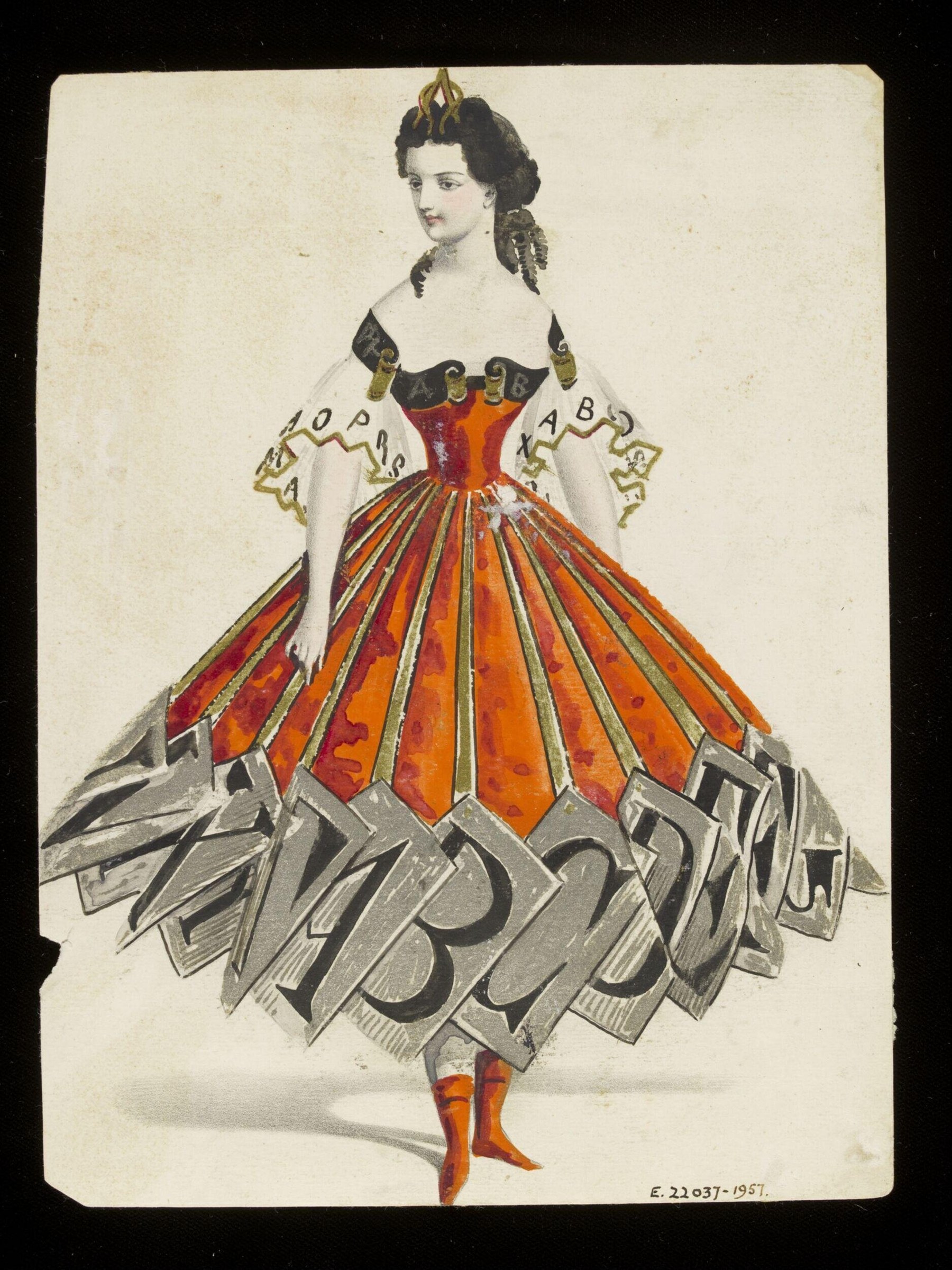
A young woman in fancy dress costume stands alone against a plain background, dressed as an anthropomorphic letter or numeral. Her upper body wears a fitted black corset with ornate gold clasps at the shoulders, paired with short white puffed sleeves trimmed in gold lace. Below the corset, a vast skirt of radiating panels in deep red, orange, and gold creates a shell or fan shape, each panel outlined in gold leaf or gilt. The panels are inscribed with large numbers and letterforms—creating the visual joke that her skirt is literally composed of alphabet and numerals. She wears orange-red stockings and shoes. Her dark hair is pulled back and adorned with a gold ornament and two long ringlets. Her posture is upright and frontal, arms at her sides with palms facing forward, presenting herself for inspection in the manner of a fashion plate or theatrical costume design. The entire composition is rendered in colored ink or watercolor on cream paper, with careful attention to the lettering and gilding.
The dancing
The figure is stationary and posed rather than in motion. Her stance is symmetrical and centered, with weight evenly distributed and no suggestion of weight transfer or dance technique. Her arms hang passively; there is no frame, hold, or arm vocabulary visible. The formal, static presentation mode is closer to a costume design or masquerade sketch than to a depiction of a dancer in movement.
The dance depicted
This is not a depiction of dance but of fancy dress costume design, likely for a costume ball or theatrical masquerade. The suit transforms the wearer into a living alphabet or number—a visual and witty conceit popular in 19th-century fancy dress. While such costumes might appear at balls where social dancing occurred, this image shows no dance vocabulary, choreography, or movement. It is a design document rather than a dance scene.
How it was made
The work appears to be hand-colored watercolor or gouache with gilt or gold leaf on paper, a standard technique for costume design documentation of the 19th century. The careful application of gold to both structural elements (the corset clasps and panel borders) and to the letterforms themselves suggests professional execution intended for transmission to a seamstress or client. The precision of the lettering and the legibility of the inscribed numbers indicate that the alphabetic content was as important as the garment itself.
About this work
This is a fancy dress costume design by Jules Helleu from around 1860, depicting a living costume in which the wearer becomes a walking advertisement or visual pun. The skirt itself is composed of oversized letters and numerals in gold and bright colors, transforming the female body into a text. It sits at the intersection of fashion, masquerade, and graphic design rather than dance, though such costumes would have appeared at social dancing events. The work exemplifies the 19th-century enthusiasm for wit, novelty, and ingenious costume design that characterized the grande masquerade and fancy dress balls of the Gilded Age.
How to look at it
Notice first the optical impact of the radiating panels: they create a massive skirt that dwarfs the modest corseted bodice, a silhouette typical of the 1860s crinoline era. Then attend to the lettering: read the numbers and letters inscribed on each panel. The costume works on two levels simultaneously—as a garment to be worn and as a visual text to be read. The gilt outlining not only frames each panel but also draws the eye to follow the alphabet sequence around the skirt, making the costume itself a interactive reading experience.
The artist
Jules Helleu (1821–1884) was a French painter and illustrator known for society portraits and theatrical costume designs. He worked in the mid-to-late 19th century and was well-positioned to receive commissions from the Parisian aristocracy and theater world, both of whom demanded elaborate fancy dress designs. His watercolors are characterized by refined technique, careful attention to fabric and ornament, and a keen eye for the theatrical and the fashionable.
The period
The 1860s were the height of the fancy dress ball in Paris and London, when elaborate masquerade costumes and themed costume events were central to elite social life. The concept of costume as visual wit—puns, plays on words, transforming the body into an object or text—was a defining feature of this culture. Simultaneously, this was the period of the Second Empire in France (1852–1870), when conspicuous display and theatrical elegance in dress reached their apex. The Gilded Age obsession with novelty, luxury, and the marriage of fashion and art made costume design a respected and well-documented practice.
Where it lives
The work is held as part of a fancy dress costume design collection, catalogued as E.22037-1957. It is a drawing or watercolor intended as a design document to communicate the costume's appearance to a client or maker, rather than a finished art object.
Questions about this work
Is this a dancer?
No. This is a costume design for a fancy dress ball, not a depiction of a dancer or a dance. The figure is posed statically for design purposes, not captured in motion or showing any dance technique.
What is the costume supposed to be?
The costume is a visual pun: it transforms the wearer into a living alphabet and numeral chart. Each panel of the skirt is inscribed with a letter or number, making the garment itself readable as text. This kind of witty, conceptual costume was popular at 19th-century masquerade balls.
Why is there gold leaf on the design?
The gold leaf indicates both luxury and visibility. It would have been sewn onto the actual costume as gilt trim or gold thread, making the garment glitter under ballroom light. It also highlights the lettering, ensuring the alphabet was readable.
Who would have worn this?
This costume was designed for a woman of the Parisian or European aristocracy or upper bourgeoisie attending a fancy dress ball or masquerade. The expense and novelty of the design indicate a commission by a woman of wealth and social standing.
More dance artwork





