49 works in this view — arrow keys or swipe to move between them.
Dance in Art
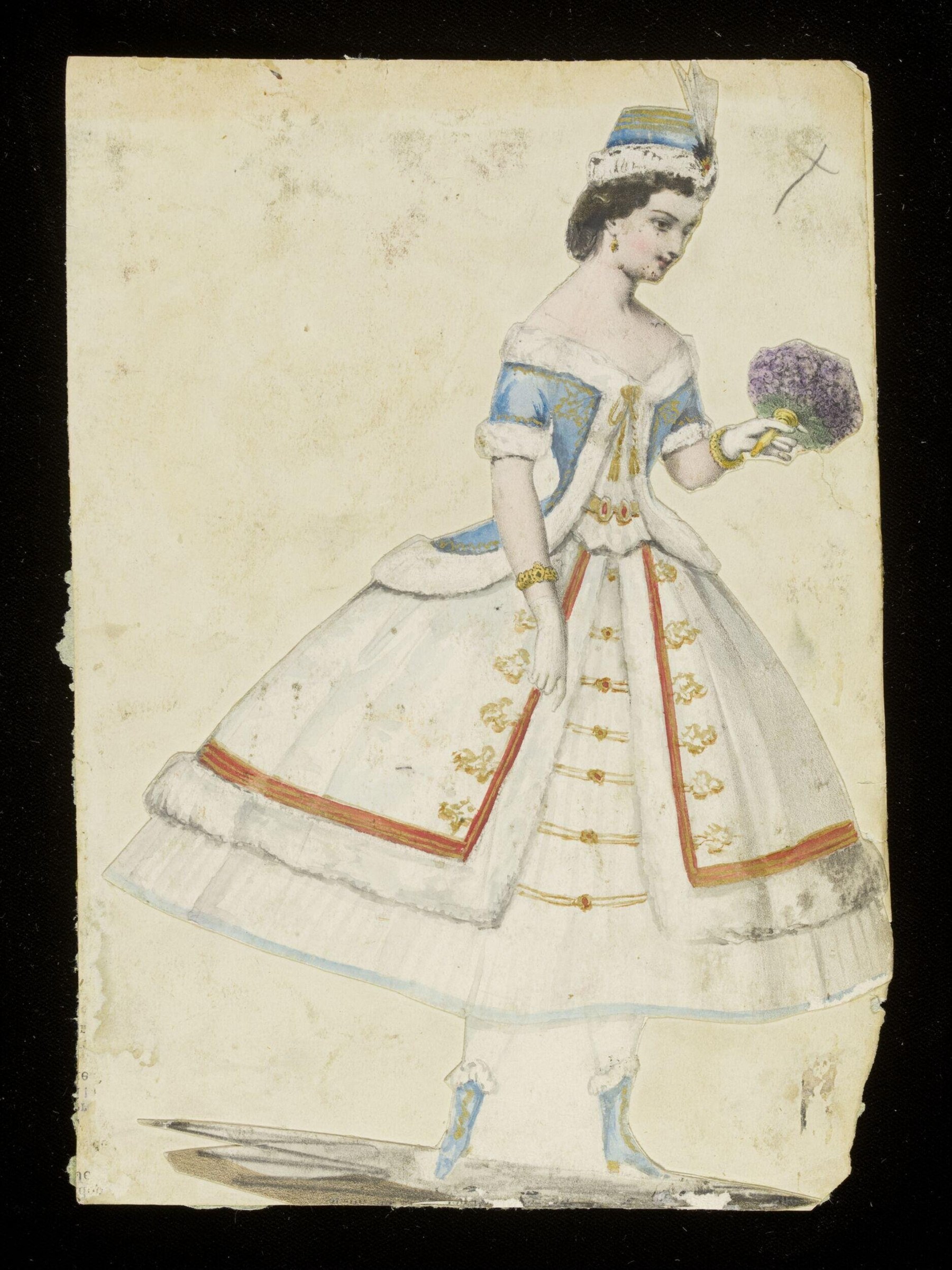
Fancy dress costume design
Jules Helleu
- Collection:
- Fancy dress costume design
- Source:
- Victoria and Albert Museum
- Rights:
- Rights vary by item — check the source record before reusing this image. Source record ↗
- Recorded as:
- V&A — check rights per item
This drawing is valuable evidence of mid-19th-century ballroom costume and the construction methods used by high-end dressmakers. For dance historians, it documents the exact silhouette, mobility, and visual effect of formal dress during the height of the waltz and quadrille era—knowledge essential to understanding how dancers moved in these garments. The meticulousness of the design also illustrates the status of costume as a serious artistic and technical discipline.
What you are looking at
A single female figure stands in three-quarter view against a plain cream background, wearing an elaborate mid-19th-century ball gown. The dress is the visual focus: the bodice is sapphire blue with white fur trim at the shoulders and neckline, laced with gold cords down the front. The voluminous skirt is cream or pale silk, decorated with vertical bands of gold embroidery and red silk ribbon, with white fur trim at the hem. A matching gold bracelet adorns her wrist. She wears a decorative headdress or tiara in blue and gold, with a single feather or plume rising from it. Her dark hair is styled in the fashionable mode of the 1860s, parted and swept back. In her right hand she holds a large purple nosegay or bouquet of flowers. Her posture is graceful but static—she stands in an elegant pose suitable for display rather than movement, with her body angled to show the dress to advantage. The figure wears blue stockings and shoes. The composition is a fashion plate or costume design study rather than a narrative scene.
The dancing
The single figure is posed in a formal, stationary stance with weight evenly distributed—this is presentation posture rather than dance posture. The body is angled to the viewer's left in a three-quarter view. Her arms are held naturally at her sides, with the bouquet presented in the right hand at waist height. There is no evidence of weight transfer, turn-out, or the frame and hold characteristic of partnered dance. The figure's bearing is upright and dignified, suited to standing or processional movement, not the active engagement of the body required in ballroom dance.
The dance depicted
This is not a depiction of dance in action. The work is a costume design or fashion plate—a study of how formal ball dress was constructed and worn in the 1860s. The dress itself is appropriate to formal court or ballroom settings where dances like the waltz, quadrille, or galop would have been performed, but the figure is static and posed for inspection of the garment rather than captured in the act of dancing. The purpose of the drawing is to document elite fashionable dress, not to represent dance itself.
How it was made
This is a hand-colored drawing or watercolor on paper, made with fine detail and careful attention to fabric and trim. The blue, gold, and red of the dress are rendered in translucent watercolor or gouache over pencil or ink underdrawing, while the face and flesh tones are handled with delicate stippling or light wash. The paper shows age and foxing consistent with 19th-century storage. The technique is that of a fashion illustrator or costumier's working drawing—intended for circulation among dressmakers, clients, or as part of a design portfolio rather than for exhibition or fine art sale. The relative finish and refinement suggests this may be a presentation drawing for a client or costume maker.
About this work
This is a costume design study from the 1860s depicting the formal ball gown of the period in meticulous detail. Although the dress would have been worn for dancing—particularly in court or ballroom settings—the drawing is not a representation of dance itself but rather a fashion plate documenting garment construction, trim, color, and silhouette. It belongs in a dance art gallery as evidence of how dance costumes were designed, documented, and preserved in the 19th century, and as a record of what dancers and ballgoers wore. The work shows the close relationship between fashion illustration and dance costume design in elite circles of the 1860s.
How to look at it
Observe the precision with which the trim and construction are rendered: the gold cords, the bands of ribbon, the placement of the fur. These details tell you how the dress was actually built and what visual effect was intended. Notice how much of the figure's mobility would have been constrained by the skirt's width and weight—the pose itself, though graceful, suggests the upright carriage and limited stride required in formal dress of the period. The care taken with the headdress and bouquet indicates that every element of appearance was choreographed as part of the formal ball presentation, not merely as clothing.
The artist
Jules Helleu was a French costume and fashion designer active in the mid-to-late 19th century. He worked in the tradition of fashion illustration and theatrical costume design, producing detailed working drawings and presentation sketches for clients. The precision and elegance of his line work, and the sophistication of his color work, mark him as a professional designer working at the higher end of the market—likely serving wealthy private clients, couturiers, or theatrical establishments. His work exemplifies the French dominance in fashion and costume design during this period.
The period
The 1860s were the height of the crinoline era in European fashion, and formal ball dress had become increasingly elaborate and sculptural. The wide skirts supported by crinolines or bustles required considerable space on the dance floor; quadrilles and contredanses accommodated the width, while the waltz—danced in closed position—required skill and trust from both partners to execute successfully in such bulk. Costume design as a discipline was professionalized during this period; fashion illustration became a distinct art form, and designers like Helleu created working drawings not merely as sketches but as finished documents for clients and as records of their own designs. The 1860s also saw growing interest in 'fancy dress' and historical costume, particularly in aristocratic and upper-middle-class circles; this design may be for such a fancy-dress ball rather than everyday formal wear.
Where it lives
The work is recorded as part of the V&A (Victoria and Albert Museum) collection, one of the world's most comprehensive repositories of fashion and costume design drawings. It is catalogued as a fancy dress costume design rather than as an everyday fashion item, suggesting it may have been created for a specific theatrical or aristocratic fancy-dress occasion.
Questions about this work
Is this a ballet costume?
No. This is formal ballroom or court dress of the 1860s, suitable for social dancing (waltz, quadrille, polka) but not for theatrical dance. The dress is too heavy and the construction too rigid for the trained movement of ballet, and there is no sign of ballet pointe work or the characteristically different aesthetic of stage costume for classical dance.
Could someone actually dance in this dress?
Yes, but with difficulty. The wide skirt would have required careful partnering, especially in the waltz, where the couple dances in close proximity. The weight and bulk of the fabric would have limited stride length and speed of footwork. The dress was designed to display wealth and status, and the wearer's ability to dance gracefully despite these constraints was itself a mark of refinement and training.
Why is this in a dance gallery if it is not a picture of dancing?
Costume design is part of dance history. Understanding what dancers wore—how it was constructed, what it weighed, how it moved, what it signaled about status and occasion—is essential to understanding how dance was performed and experienced. Fashion plates like this are primary sources for dance historians reconstructing the material reality of past dance practice.
More dance artwork