49 works in this view — arrow keys or swipe to move between them.
Dance in Art
Butterfly
Jules Helleu
- Collection:
- Fancy dress costume design
- Source:
- Victoria and Albert Museum
- Rights:
- Rights vary by item — check the source record before reusing this image. Source record ↗
- Recorded as:
- V&A — check rights per item
For dance historians, this work illustrates how mid-nineteenth-century ballroom and theatrical entertainment extended beyond structured dance technique into visual spectacle and costume performance. It shows how professional costume design functioned as a skilled trade and an art form in its own right, central to social dance culture and theatrical entertainment of the era.
What you are looking at
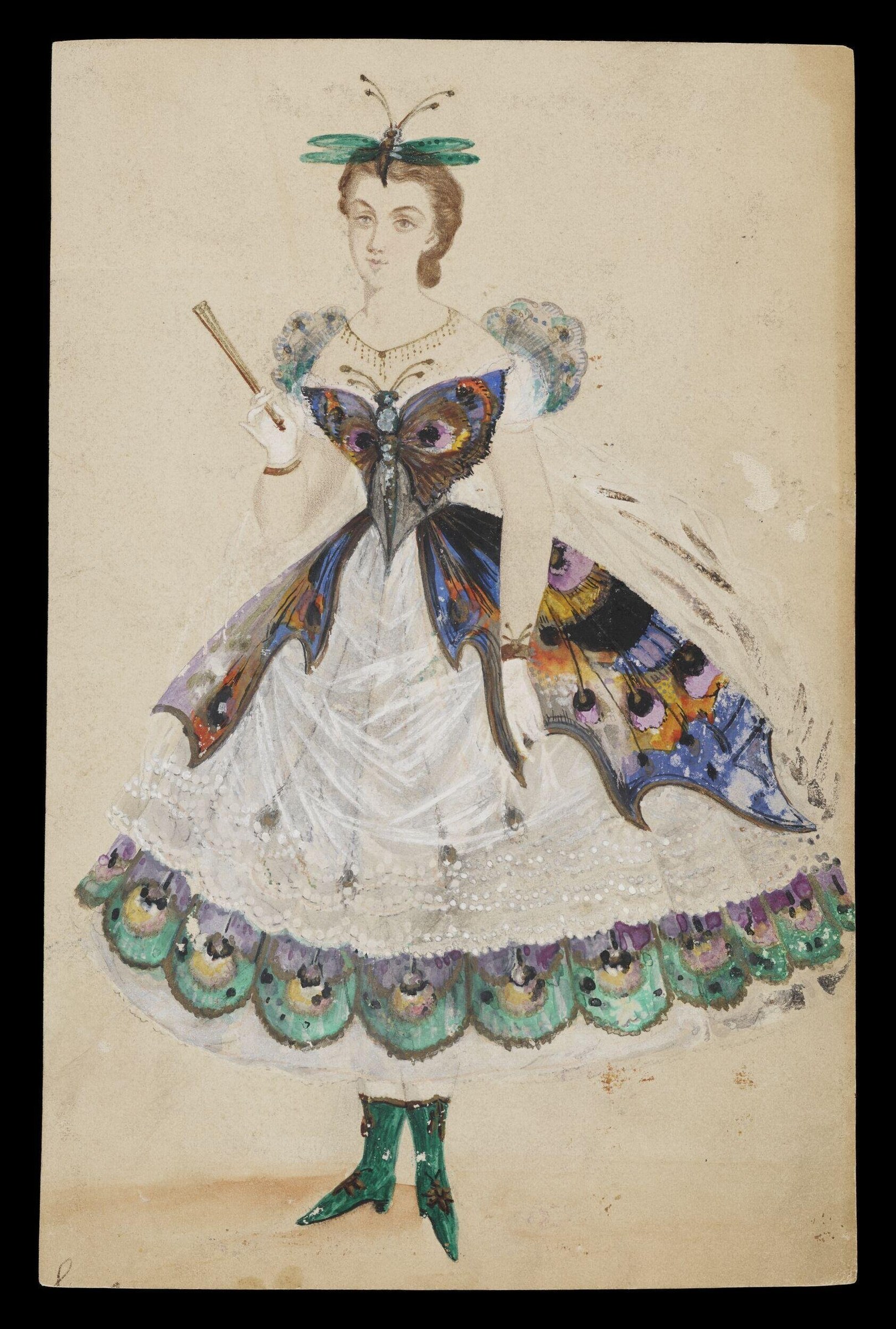
A woman in an elaborate fancy-dress costume stands centered against a plain cream background. She wears a white gown with puffed shoulders trimmed in pale blue or green, and a fitted bodice ornamented with a large butterfly brooch in rich blues, browns, and oranges—the butterfly appears three-dimensional, possibly a removable ornament. Her skirt is white with horizontal gathered detail, and its hem is trimmed with a deep scalloped border in alternating green and purple, each scallop decorated to resemble eyes or spots in the manner of butterfly wing patterns. She holds a white fan or small parasol in her left hand. A smaller dragonfly with turquoise wings is positioned above her head, and she wears matching green slippers with ornamental detail. The entire composition treats the figure as a living embodiment of an insect, with careful attention to the naturalistic coloring and patterning of butterfly and dragonfly wings.
The dancing
The woman stands in an upright, frontal pose with minimal implied movement—her stance is presentational rather than active, suitable for a costume display or parade. Her weight is evenly distributed, her posture formal and composed. The pose suggests stationary display rather than the execution of any specific dance steps or hold. Her arms are unconstrained by a partner, and her body presents no counterbalance or directional impetus typical of dance in motion.
The dance depicted
This is costume design for fancy dress or theatrical masquerade rather than a depiction of dance technique. The work documents a historical costume convention—the personification of natural creatures through wearable ornament—that would have been worn at balls, carnivals, or costume theatrical entertainments in the mid-nineteenth century. No specific dance form is depicted; the image records the visual presentation of the costume worn by a performer, not the movement or technique of any particular dance style.
How it was made
This is a watercolor and gouache sketch on paper, with fine pen-line work for contour and detail. The medium allowed rapid, fluid application of pigment with delicate layering for the translucent insect wings and the patterned details of the costume trim. The sketch format and relatively small scale suggest this is a costume design document or proposal for a costumier or dressmaker, intended for fabrication rather than fine-art display. The technique shows the hand of a trained theatrical designer skilled in rendering textile and ornament.
About this work
This is a costume design document by Jules Helleu dated 1860, recording a woman's fancy-dress costume in the form of a butterfly. The figure wears an elaborate white gown transformed by a large three-dimensional butterfly ornament on the bodice and a skirt trim patterned to echo butterfly wing spots and coloring. Rather than depicting dance movement, the work documents the Victorian-era convention of embodying nature through wearable art—a practice integral to masquerade balls, quadrille divertissements, and theatrical amusement. The careful naturalism of the insect imagery and the high quality of the design work indicate this was a costume for an important occasion or a commissioned design for a society figure.
The drawing belongs to a tradition of theatrical and ballroom costume design in which performers became living artworks, animated scenery for social entertainment. In the mid-nineteenth century, fancy-dress galas and themed balls were major events, and prominent designers would create elaborate costumes for society hostesses and performers. Helleu's design shows the level of detail and technical skill required to construct such pieces, and the image itself would have served as a blueprint for seamstresses and ornament makers.
How to look at it
Examine the three-dimensional quality of the butterfly ornament on the bodice—Helleu has rendered it with sufficient specificity that it appears to be an actual pinned or sewn ornament, possibly removable, rather than a painted illusion. Notice how the scalloped hem of the skirt is decorated to mimic the eye-spots and coloring of butterfly wings; the designer has made the entire costume into a unified insect form. The dragonfly positioned above the head, similarly rendered in naturalistic color, suggests this was one figure in a larger themed spectacle—perhaps a group of performers dressed as insects, or a solo 'butterfly' figure in a ballet divertissement or quadrille.
The artist
Jules Helleu (1821–c.1882) was a French theatrical and society costume designer and watercolorist. He was active in Parisian theater and high society during the Second Empire and was known for his refined designs for costumes, particularly for fancy-dress balls, opera, and theatrical productions. His work is characterized by delicate draftsmanship, attention to pattern and ornament, and an ability to render fabric and texture convincingly in watercolor. His costume designs were produced for wealthy patrons and theatrical producers.
The period
The mid-nineteenth century saw a flourishing of elaborate costume balls and fancy-dress entertainments among European high society, particularly in Paris. These events were opportunities for performers and attendees to wear imaginative, often fantastical costumes designed by professional artists. The 1860s were a period of relative peace and prosperity in France under the Second Empire (1852–1870), when such entertainments were frequent and lavishly staged. In parallel, Romantic ballet was declining while new forms of theatrical dance—including the Cancan and music-hall performances—were emerging; fancy-dress balls remained a significant arena for costume spectacle and social dance. The naturalistic representation of insects and natural forms in costume became particularly fashionable in the 1850s–1860s, influenced by the period's fascination with natural history, entomology, and the decorative arts.
Where it lives
The work is recorded as a fancy-dress costume design in the collection identified as "va" in the holdings record, suggesting it may belong to a theatrical or costume archive. The format and style indicate it was a working design document rather than a finished artwork for sale or exhibition.
Questions about this work
Is this a painting of a real dance, or just a costume?
It is a costume design document, not a record of a specific dance performance. The image shows what a performer would wear, not how they would move. Fancy-dress costumes were worn at masquerade balls and some theatrical entertainments, where social dances like quadrilles might be performed in costume, but the costume itself was the primary visual event.
Could someone actually dance in this costume?
Yes, though with limitations. The gown is a ballroom dress of the 1860s, suitable for social dance—walking, simple turns, and the figure movements of a quadrille. The ornaments, particularly the large butterfly brooch, would not impede arm movement or partner contact in a standard ballroom hold. However, the costume was designed for visual impact and display rather than athletic movement.
Why are there insects on the costume?
Fancy-dress balls of the mid-nineteenth century often had themes—historical periods, natural phenomena, literary characters, or creatures from nature. A woman dressed as a butterfly or other insect would be participating in a themed entertainment. The naturalistic rendering of the insects suggests this was an expensive, bespoke costume made for someone of means.
Who is this woman?
The catalogue record does not identify her, and the signature on the sketch (if present) would belong to Jules Helleu, the designer. She was almost certainly a society figure or performer who commissioned or was assigned this costume for a specific ball or theatrical event.
More dance artwork





