49 works in this view — arrow keys or swipe to move between them.
Dance in Art
Evening dress
Zandra Rhodes
- Collection:
- Evening dress
- Source:
- Victoria and Albert Museum
- Rights:
- Rights vary by item — check the source record before reusing this image. Source record ↗
- Recorded as:
- V&A — check rights per item
Evening wear like this dress contextualizes how dancers and their audiences moved, dressed, and presented themselves within formal social and theatrical spaces. Fashion archives document the material culture of dance, even when they do not depict dancing itself.
What you are looking at
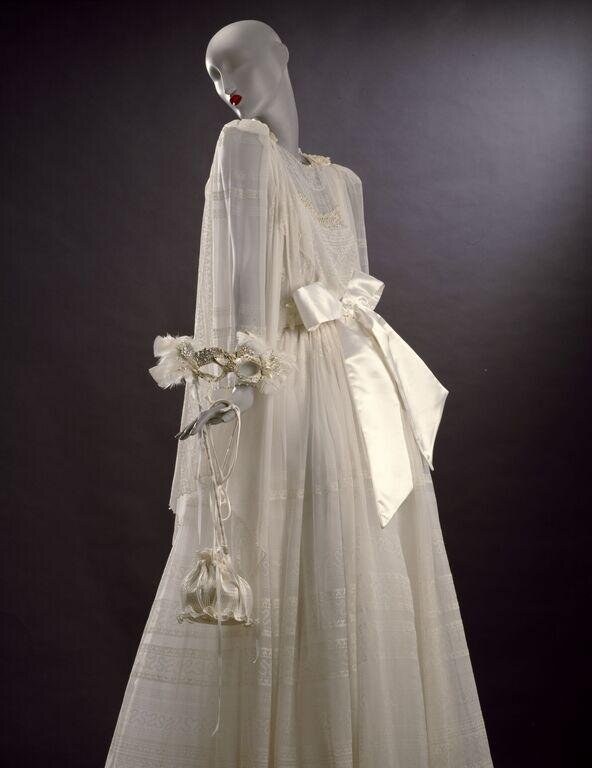
A mannequin wearing a 1983 evening dress stands in three-quarter view against a dark, neutral background. The figure is depicted from behind and the side, displaying the garment's back and silhouette. The dress is constructed in layers of sheer, pleated ivory or pale cream fabric that creates a voluminous, ethereal quality. A large cream silk bow is fastened at the waist, emphasizing the back seam. The mannequin holds a spray of white flowers—appearing to be gardenias or similar blooms—in one hand, suggesting bridal or formal occasion wear. The lighting is theatrical, with a spotlight effect that illuminates the figure against the darker background, creating dramatic contrast and emphasizing the texture and movement of the layered fabrics. The overall composition is one of studied elegance, presenting the dress as a sculptural object.
The dancing
The figure is a dress form rather than a dancing body; no human dancer is present. The pose is static and formal, angled to display the garment's construction and back detail. The mannequin's posture is upright and still, with one arm held to display the floral accessory. This is couture presentation rather than movement documentation.
The dance depicted
This is not a depiction of dance. It is a fashion photograph or museum documentation of an evening dress object, presented on a mannequin in the manner of a fashion house or museum collection archive. No dancing occurs and no dance vocabulary is visible.
How it was made
This appears to be a colour photograph, likely taken in a museum or fashion archive setting. The controlled lighting, neutral background, and technical precision suggest professional documentation photography rather than snapshot or artistic interpretation. The photograph is a record of the object's construction and design rather than an attempt to capture movement or narrative.
About this work
This is a museum documentation photograph of an evening dress designed by Zandra Rhodes in 1983. The image shows the garment as a sculptural object, emphasizing its fabric construction, layering, and back detail through careful studio lighting and composition. It belongs in the Gallery of Dance in Art not as a depiction of dance itself, but as evidence of fashion design and formal dress practice during a specific period—the context in which dancers and dance-goers were dressed.
How to look at it
Observe the construction method: the layered pleating creates volume and movement potential without structural boning or stiffness. The placement of the bow at the back seam, and the way the sheer layers catch light, show a designer thinking about how fabric moves around a body in stillness and in motion. The floral accessory places the dress within the tradition of bridal and formal evening wear, contexts where movement is choreographed and constrained.
The artist
Zandra Rhodes (1940–) is a British textile designer and fashion designer known for her bold printed textiles and innovative evening wear. She founded her own house in the 1970s and became recognized for fluid, dramatic designs often featuring layered silks, intricate draping, and hand-finished details. Her work bridges avant-garde textile design and wearable couture.
The period
The early 1980s saw a resurgence of romantic, dramatic evening wear as a counterpoint to minimalist and punk aesthetics that had dominated the late 1970s. Designers like Rhodes drew on historical references—particularly Romantic ballet and historical draping—while employing contemporary textile techniques. This dress sits within a broader late-twentieth-century fashion practice of reviving theatrical, movement-conscious silhouettes for evening and special occasion wear.
Where it lives
The object is held in the Victoria and Albert Museum (noted as 'va' in the source field). This is a museum accession and documentation photograph from the V&A's fashion and textiles collection.
Questions about this work
Why is an evening dress in a gallery about dance?
Fashion and dance are inseparable. Dancers and audiences moved, danced, and presented themselves in dresses like this one. Fashion photography documents the material conditions in which dance happened, the silhouettes performers worked within, and the aesthetic values of a period.
Is this dress wearable as an actual garment?
Yes. Despite its sculptural presentation on a mannequin, this is a finished evening dress designed to be worn. The layering, pleating, and silk construction suggest it was made to move with the wearer's body while maintaining formal elegance.
What is the significance of Zandra Rhodes?
Rhodes was a pioneering fashion and textile designer who elevated print and hand-finishing to art status. Her evening wear often referenced historical and theatrical aesthetics, making her work relevant to understanding how late-twentieth-century formal dress engaged with ideas of movement and presentation.
More dance artwork





