49 works in this view — arrow keys or swipe to move between them.
Dance in Art
Witch or Sorceress
Leon Sault
- Collection:
- Fancy dress costume design
- Source:
- Victoria and Albert Museum
- Rights:
- Rights vary by item — check the source record before reusing this image. Source record ↗
- Recorded as:
- V&A — check rights per item
The work is a valuable artifact of nineteenth-century costume and theatrical design practice, showing the ambition and ornamental excess of the fancy dress and masquerade traditions. For dance historians, it documents the material culture of performance—the engineering of spectacular costumes intended for movement, even though this particular image does not show movement itself.
What you are looking at
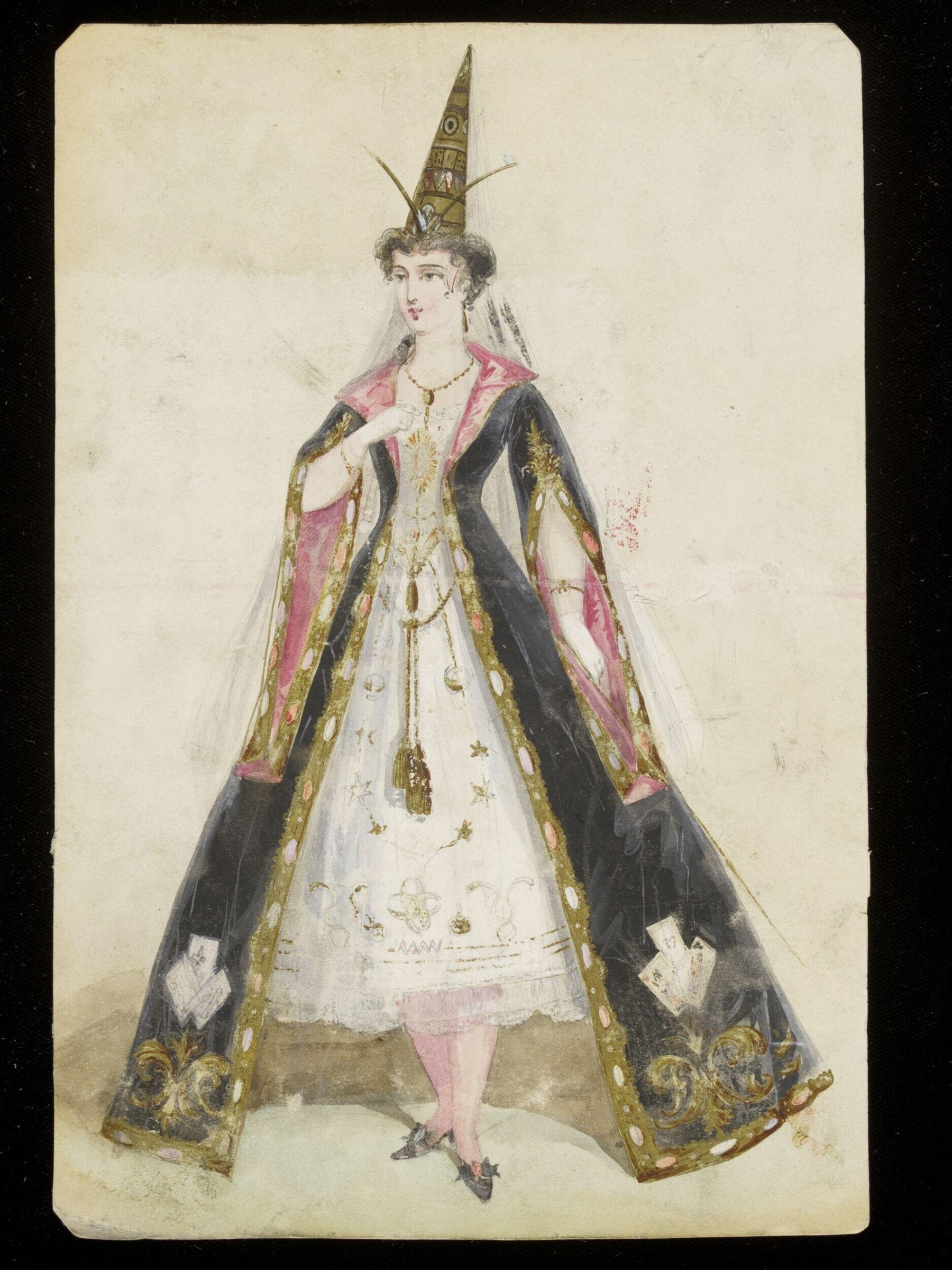
A single figure in elaborate fancy dress stands against a plain ground, posed frontally with the weight evenly distributed. The costume is theatrical and ornate: a tall conical headdress decorated with a clock face and radiating spires rises above the head; a long white chemise forms the base layer, decorated with scattered gold embroidery; over this sits a pink and gold brocaded bodice; and an enormous cloak dominates the composition, constructed in black silk with pink silk lining and edged throughout with gold passementerie and ornamental fringe. The cloak pools dramatically at the figure's feet. The sleeves are pushed back to reveal the inner lining. A pearl necklace and dangling ornamental tassels hang from the waist. The figure's expression is calm and composed, with the head tilted slightly, gaze directed neither directly forward nor aside but into the middle distance. The pose is static and formal—this is a presentation of costume rather than action.
The dancing
The single figure stands in a neutral posture with feet together, shoulders relaxed, and the body upright without weight shift or arabesque. The arms hang at the sides, one slightly advanced. There is no partnering, no turn, no spring or extension—no indication of active movement. The pose reads as that of a model displaying costume, typical of fashion or costume design illustration rather than dance documentation. No footwork is visible beneath the hem.
The dance depicted
This image does not depict a dancer in motion or a recognisable dance form. The title 'Witch or Sorceress' suggests a theatrical or fancy dress character—a masquerade or entertainment costume rather than a dance style. The figure's stillness and the systematic presentation of the garment's construction (the visible linings, the drape, the interior structure) indicate this is a costume design drawing, intended to communicate the construction and visual impact of an elaborate outfit for dramatic or festive wear. The conical headdress topped with a clock mechanism is a fantasy element with no basis in any historical or contemporary dance tradition.
How it was made
The work is a hand-coloured sketch, likely watercolour or watercolour and gouache on paper. The artist has used pencil for fine linear detail (especially the clock face and architectural elements of the headdress), then applied translucent washes of pink, gold, black, and cream to render the textile surfaces and depth. The technique allows for precise rendering of decorative detail and pattern—the embroidered stars, the tassels, the ornamental edges—while maintaining the fluidity necessary to show how fabric drapes. This method was standard for fashion and costume design from the eighteenth century onwards, allowing rapid communication of a design to makers and performers without the time or expense of an oil painting.
About this work
This is a costume design drawing by Léon Sault dated to 1860, depicting an elaborate fancy dress or theatrical costume for a character titled 'Witch or Sorceress.' The work is purely illustrative of garment construction and visual presentation, not a document of dance practice or a theatrical dance scene. It belongs in a gallery of dance imagery only in the broad sense that theatrical costumes are sometimes part of stage performance, but the work itself does not depict dance, dancers, or a dance form. The figure is static and posed for the purpose of display; no movement, weight distribution, or bodily knowledge specific to dance is communicated.
How to look at it
Attend to the construction of the costume as a technical object: the cut and fall of the cloak, the way the lining is revealed, the relationship between the heavy outer fabric and the delicate chemise beneath. Notice how the artist has rendered different textile surfaces—the matte finish of the silk cloak versus the lustre of the brocaded bodice. The clock face in the headdress invites speculation about the character's meaning (time, destiny, mechanical whimsy), but the artist's primary concern is showing how a maker would construct this garment and how it would appear when worn.
The artist
Léon Sault was a French costume and fashion designer active in the mid-nineteenth century. He was known for designs in the tradition of fancy dress, theatrical costume, and fashion illustration. His work reflects the aesthetic of the Second Empire, an era of ornamentation, eclecticism, and theatrical spectacle in dress and entertainment.
The period
The 1860s saw a revival of interest in masquerade, historical costume, and theatrical fancy dress as forms of entertainment and social display among the middle and upper classes in Paris and London. The elaborate codes and mythological or fantastical personas of fancy dress balls offered an alternative to the formality of ballroom dance, though fancy dress events often included dancing. The conical headdress with mechanical or decorative ornament reflects the taste for historical revivalism and fantastical invention of the era. This coincides with the height of the Romantic ballet tradition, though this work has no connection to that form.
Where it lives
The work is catalogued as a fancy dress costume design, held in the collection indicated as 'va' (likely the Victoria and Albert Museum, London, a major repository of fashion and costume design drawings from this period). It is part of the historical record of nineteenth-century costume design practice and theatrical material culture.
Questions about this work
Is this a record of an actual dance?
No. This is a costume design drawing, not a document of dancing or a dance form. The figure is posed statically to display the garment, and no movement or dance technique is depicted.
What is the clock in the headdress for?
It appears to be a decorative or symbolic element of the fancy dress character, part of the theatrical fantasy rather than a functional object. Fancy dress costumes of this era often incorporated fantastical ornament.
Would someone actually wear this?
Yes, this is a design for a fancy dress or masquerade costume, intended to be made and worn at an entertainment or ball. The careful rendering of construction details suggests it was a serious design proposal, not a caprice.
Who designed this?
The artist is named in the catalogue as Léon Sault, a French costume and fashion designer of the nineteenth century.
More dance artwork





