49 works in this view — arrow keys or swipe to move between them.
Dance in Art
Fancy dress costume design
Léon Sault
- Collection:
- Fancy dress costume design
- Source:
- Victoria and Albert Museum
- Rights:
- Rights vary by item — check the source record before reusing this image. Source record ↗
- Recorded as:
- V&A — check rights per item
This design document preserves the exact vision of a mid-19th-century costume maker at a moment when theatrical dress and fancy dress were central to both ballet and social performance. For historians and dancers, it shows how costume was conceived to enable and enhance theatrical presence—the cut, weight, and ornamentation of the skirt and sleeves would directly affect how the wearer moved and what movements were possible. The work demonstrates the high level of artistic sophistication applied to costume design in this period.
What you are looking at
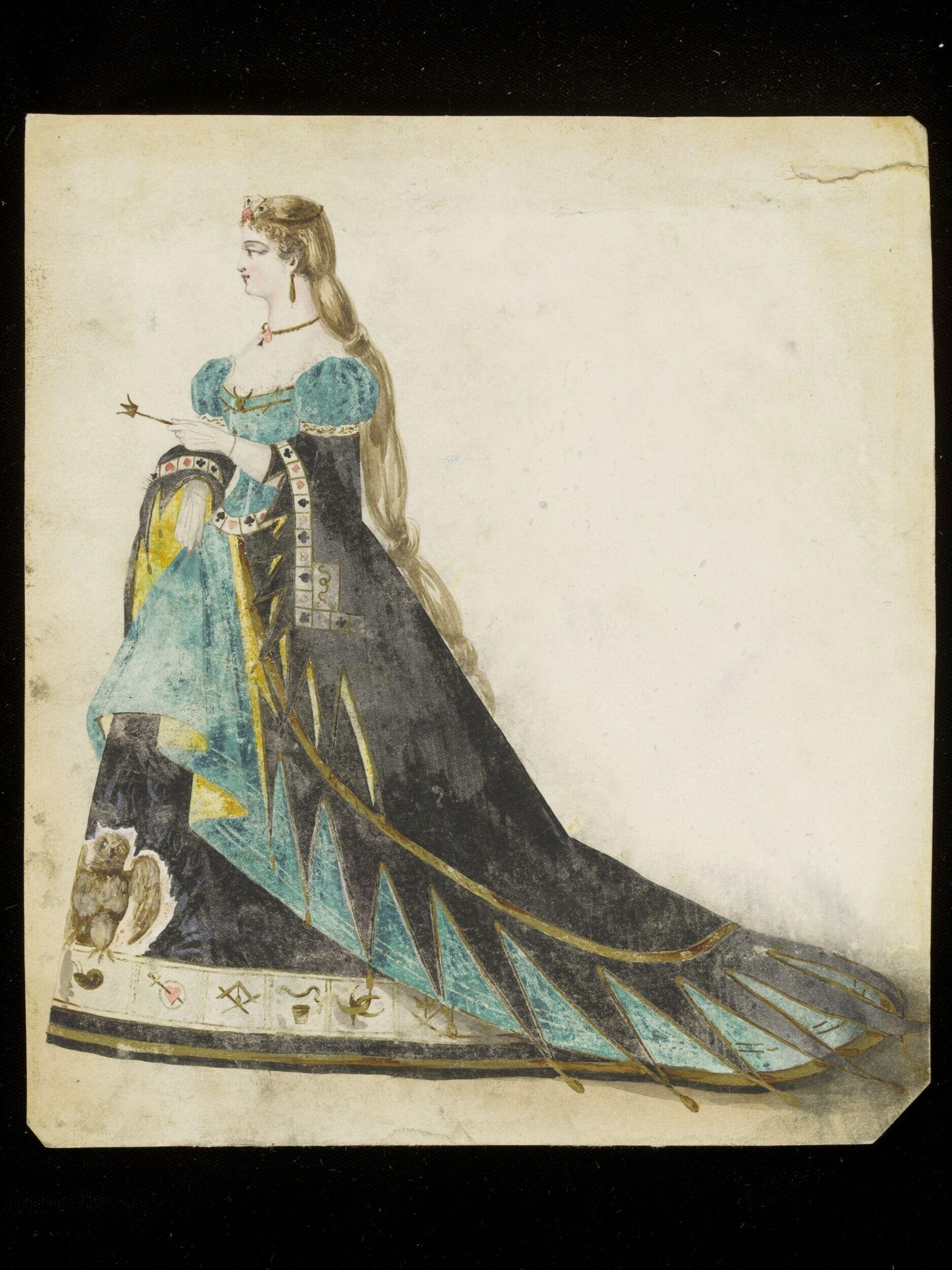
A single female figure in elaborate fancy dress stands in profile against a pale background, gazing to the left. She wears a striking costume combining historical and fantastical elements: a fitted dark bodice with jeweled ornament, wide turquoise puffed sleeves, and an extraordinarily long dark skirt with a dramatic turquoise and gold train sweeping behind her. A delicate tiara or hair ornament crowns her golden hair, which flows loosely down her back. Around her neck is a thin choker or ribbon. At the hem of the skirt, geometric and symbolic designs—stars, diamonds, and other ornamental marks—are visible. A small white owl or similar creature perches near her feet. The figure is rendered with precise attention to textile detail, the fabrics appearing substantial yet elegant.
The dancing
The body is held in a graceful, almost statuesque pose, with weight evenly distributed. The left arm hangs naturally while the right arm is raised and bent, as if holding something delicate or gesturing with restraint. The posture is upright and formal, with the torso facing forward while the head turns slightly in profile. This is a presentation pose rather than an action pose—the figure displays the costume rather than demonstrating movement. There is a single figure, presented in isolation.
The dance depicted
This is not a depiction of a specific dance in progress, but rather a costume design for theatrical or fancy dress performance, likely from the Romantic era. The elaborate fantasy costume—combining medieval-inspired elements, classical drapery, and exotic ornament—suggests this was created for a theatrical ballet or grand fancy-dress ball of the mid-19th century. The figure is frozen in a formal stance that allows full view of the costume's construction and visual impact. No specific dance vocabulary is evident; the image serves a design rather than documentary function.
How it was made
This appears to be a hand-colored drawing or watercolor on paper, rendered with careful draftsmanship and delicate washes of color. The turquoise and gold are applied with precision; the dark elements are executed in ink or graphite with fine detail. The technique allows for the exact rendering of textile pattern and ornamentation necessary for a working costume design that would guide construction. The paper shows age-related yellowing and wear, consistent with a working document from the 1860s held in a collection.
About this work
This is a costume design for fancy dress or theatrical performance, attributed to Léon Sault and dated to 1860. It exemplifies the elaborate fantasy costumes created during the height of the Romantic ballet era and the fashion for historical and exotic dress at mid-19th-century balls and theatrical events. The work sits at the intersection of fashion design, theatrical practice, and visual art—a practical working drawing transformed into a beautiful object in its own right. The figure presents a complete vision of how costume could embody fantasy, movement, and theatrical presence.
How to look at it
Attend to the proportions and architecture of the costume itself: the enormous puffed sleeves that would restrict the arms, the length and weight of the train, the structured bodice, the ornamental embroidery at the hem. These practical details reveal what movements this costume was designed to permit or prevent. The formal, presented pose was the convention for costume design—the figure is shown standing still to allow the full garment to be seen, rather than in a moment of dance. The artist has chosen to render every detail of fabric, trim, and jewel work with meticulous care.
The artist
Léon Sault was a French costume and fashion designer active in the mid-19th century. His designs bridged theatrical costume and haute couture during an era when these fields were closely linked. Sault worked in Paris during the height of the Romantic ballet, a period when costume design was an art form in itself, celebrated in its own right beyond the stage.
The period
The 1860s marked the twilight of Romantic ballet but the height of theatrical fancy dress as social entertainment. By this date, the Romantic era's preference for ethereal, weightless tutus had begun to shift, but the taste for historical fantasy and exotic dress remained powerful. The Victorian and Second Empire periods saw elaborate fancy-dress balls and theatrical spectacles as important social events. Costume design was a respected artistic profession, and designs were often published and collected.
Where it lives
Held in a collection designated 'Fancy dress costume design' (likely a fashion or theatrical costume archive). The work comes from a collection source marked 'va', suggesting either a visual arts institutional source or archive designation.
Questions about this work
Could this person actually dance in this costume?
With difficulty. The enormous puffed sleeves would severely limit arm movement, and the long heavy train would restrict leg extension and footwork. This is a display costume, designed to be beautiful and impressive while worn, rather than a functional performance costume for extensive movement. The formal pose suggests the wearer would stand, turn slowly, and allow the costume to do the visual work.
What do the symbols at the hem mean?
The stars, diamonds, and other marks are decorative ornament emphasizing the hem and giving the costume a finished, emblematic look. In the Romantic era, such symbols could carry theatrical meaning—stars suggesting the supernatural or celestial realm, common themes in Romantic ballet—but they may also simply be fashionable ornamentation.
Who would have worn this?
This could have been designed for a theatrical performance (a ballet, opera, or theatrical spectacle), or for an aristocratic fancy-dress ball. Both were fashionable and well-documented in 1860s Paris. The high level of craftsmanship suggests a wealthy patron—either a ballet company or an individual of substantial means.
How is this different from ordinary fashion of the time?
This is fantasy dress: it mixes historical periods, adds theatrical ornament and symbolism, and prioritizes visual impact over practical wearability. Ordinary dress of 1860 was far more constrained and practical. This costume is designed to transform and elevate the wearer into a character or fantasy figure.
More dance artwork





