49 works in this view — arrow keys or swipe to move between them.
Dance in Art
Fancy dress costume design
Léon Sault
- Collection:
- Fancy dress costume design
- Source:
- Victoria and Albert Museum
- Rights:
- Rights vary by item — check the source record before reusing this image. Source record ↗
- Recorded as:
- V&A — check rights per item
Costume designs from this period reveal the physical constraints and possibilities that shaped how people actually danced: the weight of layered skirts, the restriction of the tight bodice, the visual emphasis created by applied ornament. This design shows the mid-19th-century ideal of the ball gown as a sculptural object of decoration, raising the question of how bodies performed movement within such garments.
What you are looking at
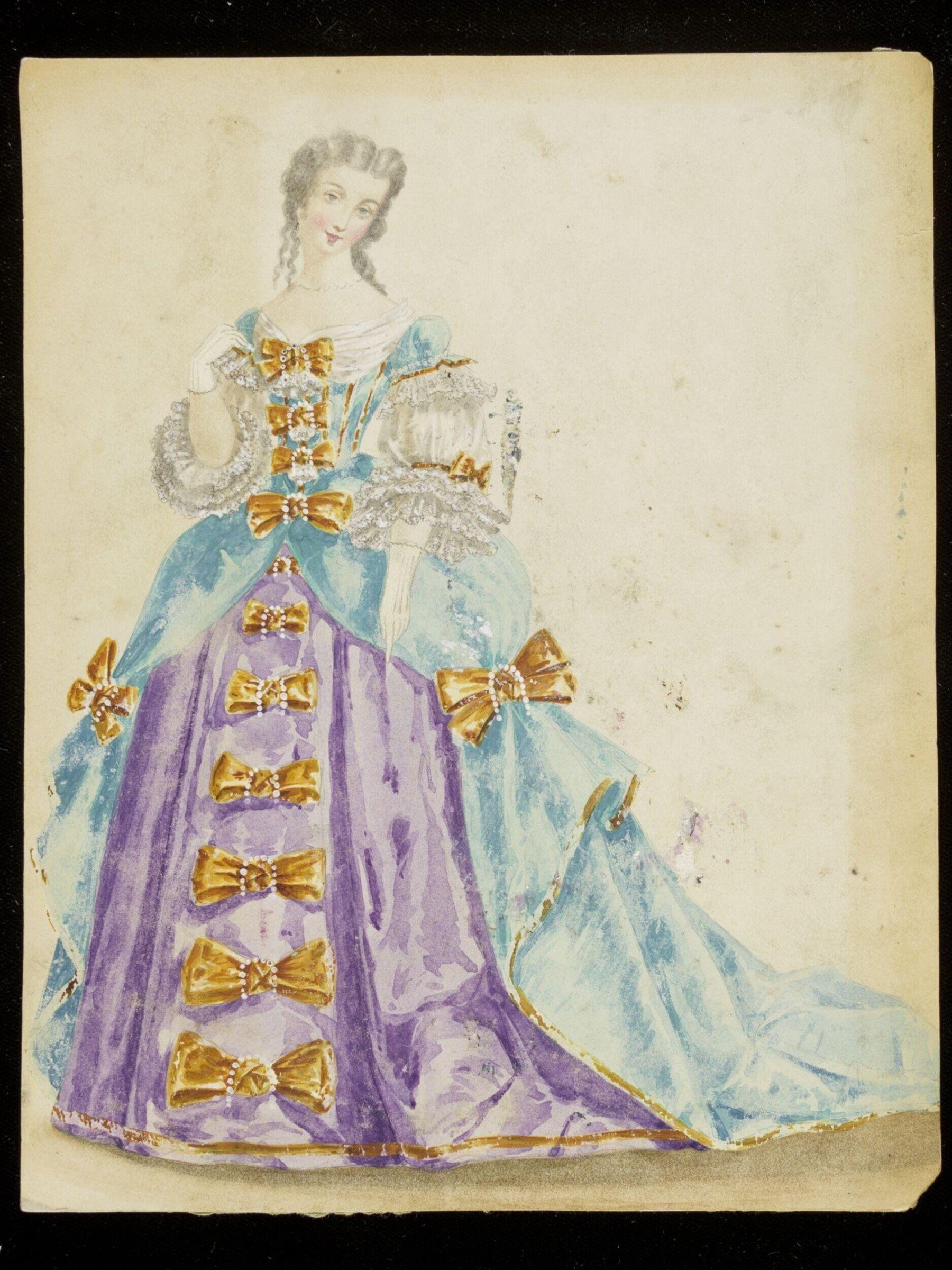
A single female figure stands in formal frontal pose against a plain cream background, dressed in an elaborate mid-19th-century ball gown. The gown consists of a fitted bodice in pale blue silk with short puffed sleeves trimmed in white lace, over which falls a deep white lace collar. A large gold bow adorns the center front of the bodice. The skirt is constructed in two layers: a purple or mauve underskirt visible at the hem, and a pale blue overskirt draped with voluminous folds that extend into a long train. The overskirt is embellished with a vertical arrangement of at least six large gold bows running down the center front, creating a dramatic linear accent. Additional gold bows trim the edges of the drapery. The figure's blonde hair is styled in long braided loops falling down the back. Her posture is upright and composed, with one arm at her side and the other raised slightly, in the manner of a fashion plate or dress design rather than an active dance pose. The overall effect is one of static display emphasizing the construction and ornament of the garment.
The dancing
The figure presents a single, isolated body in a standing presentation rather than in dance posture or dynamic movement. The positioning is vertical and formal, with weight evenly distributed and the frame frontal and symmetrical. The arm positions are modest and decorative rather than expressive; there is no indication of the sustained extension, lift, or spatial projection that would suggest active dance technique. The raised arm appears posed for display of the dress rather than for movement.
The dance depicted
This is a costume design document rather than a record of dance. While the elaborate dress conforms to the formal ball gowns worn at aristocratic social dances of the mid-19th century—particularly those accompanying Romantic ballet productions or elite private entertainment—the figure shown does not demonstrate dance movement or technique. The garment itself is consistent with fancy dress worn at balls and masquerades of the 1860s, and could have been worn during social dancing or theatrical performance, but nothing in the posture or composition indicates what dance, if any, was performed in it.
How it was made
This is a hand-colored watercolor or gouache design on paper, characteristic of 19th-century fashion and costume illustration. The artist has used delicate watercolor washes to render the fabrics, with careful attention to the play of light on silk and the texture of lace. Gouache highlights, particularly in the gold bows and white lace areas, create dimensional depth and shimmer. The technique is suited to costume design documentation for theatrical production or couture dressmaking, allowing for precise color reference while maintaining the fluidity of the draped fabrics. The paper shows age-related discoloration and foxing typical of 19th-century works on paper.
About this work
Léon Sault's design documents an elaborate ball gown from the mid-19th century through a formally composed standing figure wearing the completed garment. The work functions as both a costume design record and a fashion illustration, capturing the aesthetics and construction methods of mid-century formal dress. While the figure is not shown dancing, the garment itself is the type worn at balls, masquerades, and theatrical events where Romantic ballet and formal social dance took place. The work belongs in a gallery of dance in art as a document of the material culture surrounding ballroom and theatrical dance practice, showing the silhouette, ornament, and construction that shaped how dancers and ballgoers moved.
How to look at it
Attend to the construction details: how the skirt is layered, how the bows are positioned to create visual rhythm down the center front, how the lace collar and cuffs frame the body. Notice the artist's choices about what to emphasize—the draped fabrics are rendered with careful attention to volume and movement, while the figure herself is static. Consider what this garment would have allowed and prevented in terms of movement: the layered skirts would have substantial weight and would move with considerable momentum; the fitted bodice would restrict breathing and bending; the long train would require management and attention. These are the material facts that shaped how ballroom and theatrical dance was performed.
The artist
Léon Sault was a French costume and fashion designer active in the mid-19th century, working in the tradition of fashion plate illustration and theatrical costume design. His hand-colored designs were used for both theatrical production and couture dressmaking. Little biographical information is widely available, but his signed work appears in museum collections focused on 19th-century fashion and theater history, indicating he was a professional designer of some standing during the period.
The period
The 1860s were the height of the Romantic era in ballet, when the Romantic tutu had evolved into the long, full skirt seen here. Theatrical design and formal social dress cross-pollinated freely; ball gowns incorporated elements from ballet costume, while ballet costumes referenced the latest fashions. The silhouette of this gown—the wide, voluminous skirt, the fitted bodice, the profusion of applied ornament—is characteristic of the Second Empire period in France, when such gowns were worn at imperial balls, private masquerades, and elaborate social events. The dress code for such events was governed by strict convention, and the level of ornament visible here suggests a formal occasion of significant status.
Where it lives
The work is held in the V&A collection, likely as part of their extensive holdings in 19th-century fashion design and theatrical costume documentation. The V&A acquired such designs both as records of theatrical practice and as examples of fashion history and the decorative arts.
Questions about this work
Is this a picture of someone actually dancing?
No. This is a costume design document showing the completed garment on a standing figure posed for display. The figure is not captured in movement and shows no dance technique. However, this is the type of dress that would have been worn at balls and theatrical events where dancing occurred, so it documents the material reality of how people danced in this period.
Who would have worn a dress like this?
A woman of high social status attending a formal ball, masquerade, or theatrical event in the 1860s. The elaborate ornament and fine materials indicate wealth and fashion awareness. Such gowns were sometimes made for theatrical performances as well, particularly for social dance scenes in ballet or opera.
Why are there so many bows?
The profusion of applied ornament was a marker of expense and status in the 1860s, when hand-applied decoration was labor-intensive and costly. The vertical arrangement of bows also created visual emphasis on the center front of the body, drawing the eye downward along the length of the skirt—a key component of the Romantic-era silhouette.
More dance artwork





