49 works in this view — arrow keys or swipe to move between them.
Dance in Art
Rainbow
Léon Sault
- Collection:
- Fancy dress costume design
- Source:
- Victoria and Albert Museum
- Rights:
- Rights vary by item — check the source record before reusing this image. Source record ↗
- Recorded as:
- V&A — check rights per item
As a high-end costume design from the 1860s, this work reveals how dance and masquerade culture shaped luxury fashion and theatrical spectacle in the mid-Victorian era. The elaborate use of pleating, iridescent effects, and exotic ornament reflects the aesthetic ambitions of fashionable balls and the technical skill of costumiers and illustrators who served that world. For historians of dance costume, textile technology, and Victorian visual culture, it documents a moment when the boundary between haute couture and theatrical design was fluid and mutually enriching.
What you are looking at
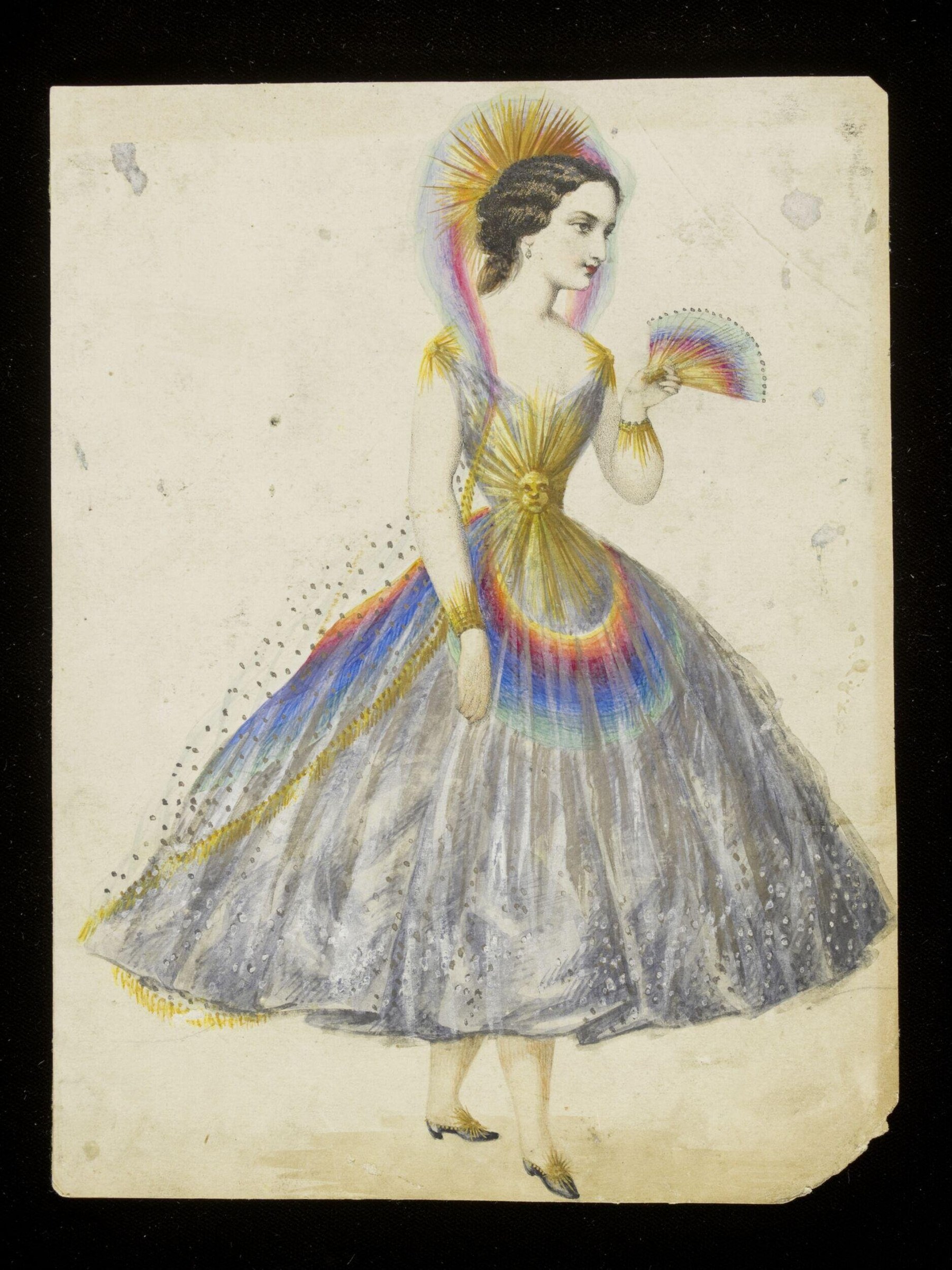
A single female figure stands in three-quarter profile, facing left, against a cream background. She wears an elaborate ball gown with a fitted bodice of golden yellow silk and a voluminous skirt of pale gray or white tulle, densely scattered with metallic speckles. The skirt's rear and sides are decorated with radiating fan-like pleats rendered in brilliant colors—gold, blue, pink, and green—that suggest peacock feathers or iridescent silk panels. A matching pleated fan of the same colors adorns her shoulders like a cape or shawl. She holds a small decorative hand fan in her right hand, executed in the same rainbow-feathered style as her costume. Her dark hair is arranged in an elaborate upswept style, crowned with a dramatic headdress of splayed golden rays tipped in blue and pink, resembling a sunburst or ceremonial crown. Her expression is serene and her posture elegant; the figure appears posed for display rather than in motion. The composition is a fashion plate or costume design drawing, with the entire focus on the elaboration and chromatic brilliance of the dress.
The dancing
The figure is stationary and frontal, posed to display the garment from the side. There is no suggestion of movement, weight shift, or active dance position. The arms hang naturally with the hand fan held at waist height; the body is upright and composed. The costume itself is the subject—the body is merely the armature for displaying textiles, pleating, and color. No footwork or dance-specific posture is evident.
The dance depicted
This is a fancy dress or masquerade costume design rather than a depiction of dance in action. The title *Rainbow* refers to the iridescent color effects and the peacock-feather-inspired pleating that dominates the design. While the costume might have been worn to a ball or social dance, the image captures it as stationary costume display, not as evidence of an actual dance style or technique. The exotic, ornamental character of the design—with its sunburst headdress and prismatic textile effects—suggests fashionable theatrical or masquerade wear of the mid-19th century, but no specific dance can be identified from the pose or garment structure.
How it was made
Hand-colored lithograph or colored engraving on paper, employing watercolor and metallic pigments (gold leaf or gold paint is visible in the radiating headdress and dress details). The technique allows for fine linear detail in the pleating and precise color separation, particularly in the rainbow effects. The speckled texture of the skirt appears to be stippled or dotted by hand. This is a work of commercial fashion design or costume illustration, likely produced for a fashion journal, theatrical costume reference, or luxury print market, suggesting circulation among affluent urban audiences interested in elaborate masquerade or ball culture.
About this work
This is a costume design illustration by Léon Sault dated 1860, depicting a fanciful ball or masquerade gown titled *Rainbow*. The work is a fashion plate rather than a dance scene: it presents a single figure in elaborate dress, posed to display a spectacular costume featuring iridescent pleating, a sunburst headdress, and jewel-toned hand fan. The image exemplifies mid-19th-century ornamental fashion design, when masked balls and fancy-dress occasions drove demand for spectacular, theatrical clothing. While the figure is a dancer or ball-goer in context, the artwork itself documents costume rather than choreography or technique.
How to look at it
Attend first to the color and its illusion of movement: the radiating fans of pleated silk create an optical shimmer and sense of wings or feathers, even though the figure is static. Notice how the artist uses metallic pigment and stippling to suggest sparkle and three-dimensional texture. The sunburst headdress and the hand fan are miniature versions of the larger costume effect—they establish a visual motif of radiant, prismatic ornament that dominates the composition. This is a design that works through spectacular visual excess rather than through bodily movement; the costume itself is the performer.
The artist
Léon Sault (dates unknown) was a French costume and fashion illustrator active in the 1860s. His practice centered on designs for masquerade, theatrical, and fancy-dress occasions, rendered in color with meticulous attention to textile effects, pleating, and ornamental detail. The precision of his work and the luxury of the hand-colored printing process suggest he served a clientele of wealthy urbanites, theater producers, and costumiers. Little biographical information survives, but his oeuvre places him within a tradition of commercial costume illustration that was central to 19th-century fashion and theatrical networks.
The period
The 1860s were a peak era for elaborate masquerade balls and fancy-dress entertainments in Paris, London, and other European capitals. The Victorian appetite for historical costume, orientalism, and theatrical spectacle found outlet in private balls and public carnival events. This was also a period of rapid innovation in textile manufacturing—silk pleating, metallic printing, and synthetic dyes were becoming more affordable and sophisticated. Fashion illustration was a high-status commercial art form, and hand-colored prints like this one were luxury objects in their own right, often kept as references or collected for their aesthetic and technical merit. The Romantic ballet tradition was in decline, but social dancing and costume spectacle remained central to fashionable life.
Where it lives
The work is catalogued as a fancy-dress costume design within the Costume Design collection (holding: va, presumed Victoria & Albert Museum or equivalent). It belongs to a category of commercial or professional costume illustration—designs intended either for actual execution by a costumier or for circulation as fashionable inspiration and reference among theatrical and society circles.
Questions about this work
Is this an actual dance costume or a fantasy design?
Both are likely true. The drawing is a professional costume design intended to be executed—such pieces were made for masquerade balls and fancy-dress galas. However, the image itself shows the costume as a stationary display, not in use during an actual dance. It documents the design and manufacture rather than the movement or social context.
What do the colors and feathers represent?
The radiating pleats in blue, gold, pink, and green mimic peacock feathers, a common motif in 19th-century ornamental design. The title *Rainbow* makes explicit reference to the iridescent color effects. This was fashionable aesthetic vocabulary for luxury and exoticism, drawn from orientalism and natural history imagery that captivated Victorian design.
Why is there so much emphasis on the costume and none on the body?
This is a costume design illustration, not a figure study. The body exists to model the garment; the goal is to communicate the construction, color, proportion, and ornament of the dress to other professionals—costumiers, patrons, or other designers. The stillness and formal pose are conventions of the fashion plate, designed for clarity and display rather than expressiveness.
Who would have worn such a costume?
A wealthy, fashionable woman attending a masked ball or fancy-dress entertainment—events that were extremely popular among the European elite and upper middle class during the 1860s. Such occasions were opportunities for theatrical self-presentation and social performance, distinct from but related to theatrical dance.
More dance artwork





