49 works in this view — arrow keys or swipe to move between them.
Dance in Art
Fancy dress costume design
Jules Marre
- Collection:
- Fancy dress costume design
- Source:
- Victoria and Albert Museum
- Rights:
- Rights vary by item — check the source record before reusing this image. Source record ↗
- Recorded as:
- V&A — check rights per item
Costume design drawings are primary sources for understanding how theatrical dance and spectacle were visualized and executed in the 19th century. This work documents the fantasy aesthetic that shaped Romantic-era theatricality and shows how artists recorded both the material and the character simultaneously—essential information for historians of theater, dance costuming, and the material culture of performance.
What you are looking at
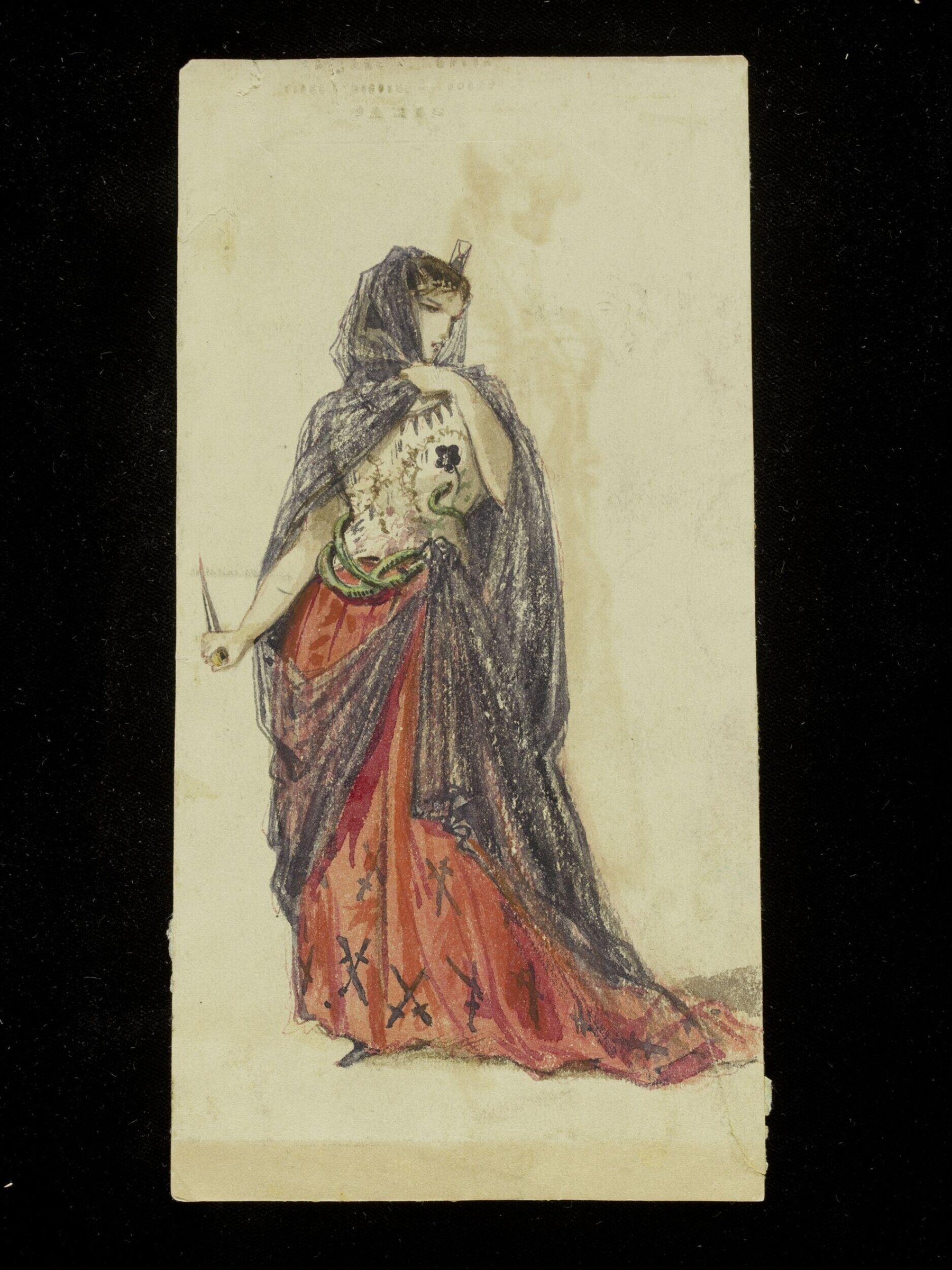
A standing figure in elaborate fancy dress is shown in three-quarter view against a plain background. She wears a long red skirt decorated with black X-marks or crosses, beneath a sheer black lace veil or shawl that drapes from her head across her shoulders and body. The veil is voluminous and nearly obscures her torso. Her face is pale and contemplative, turned slightly away. She holds a small dagger or sword in her left hand, pointed downward. A decorative circlet or tiara sits atop her head. The costume suggests a theatrical or masquerade fantasy—possibly a witch, sorceress, or exotic character from mid-19th-century theatrical imagination. The drawing is executed in ink with careful cross-hatching for shadow, and hand-colored with watercolor or gouache, giving the red fabric particular warmth against the cool blacks and pale flesh tones.
The dancing
A single standing figure, static and posed rather than captured in motion. Her weight rests evenly on both legs, suggesting a still life or costume study rather than an active dance moment. Her posture is upright but somewhat withdrawn, with one arm holding the blade and the other gesture obscured by drapery. There is no dynamic tension or momentum in the body—this is a presentation of costume and character rather than movement.
The dance depicted
This is a costume design drawing rather than a depiction of dance in progress. However, the theatrical context—the fancy dress, the theatrical props (dagger, tiara), and the period (1860)—suggests this may relate to theatrical dance or pantomime of the Romantic era. The figure could represent a character from a theatrical spectacle, possibly for a masquerade ball, a theatrical production, or a fancy-dress entertainment. Without inscription or further documentation, the specific dance form or theatrical origin cannot be determined. The static pose and formal presentation mark this as a costume record rather than a choreographic document.
How it was made
This is a mixed-media work on paper: ink line drawing with watercolor or gouache hand-coloring. The technique shows careful draftsmanship in the preliminary ink work—the face has delicate pen-work with cross-hatching for modeling, while the drapery is rendered with gestural pen strokes. The watercolor adds dimensional color, particularly visible in the red skirt and the cool grays of the veil. This combination of techniques was standard for theatrical costume designs of the 1850s–60s, allowing both precise detail and quick color notation for production use or documentation.
About this work
This is a theatrical costume design by the French artist Jules Marre, dated 1860, showing a fanciful character in Romantic-era theatrical dress. The figure wears an elaborate combination of a red skirt marked with mystical symbols, a dramatic black lace veil, and theatrical accessories (tiara, dagger), suggesting a character drawn from theatrical fantasy or masquerade culture. The work belongs to the tradition of 19th-century costume design drawings—ephemeral practical documents made to guide theatrical production, dressmakers, and performers. Marre's careful rendering preserves both the specificity of a working design and the romantic imagination of mid-Victorian theatrical culture.
How to look at it
This is a costume design, so the artist is not freezing a moment of dance movement but rather presenting a complete visual identity: the silhouette, the color story, the symbolic props, and the facial character. Look at how the drapery is constructed—the veil obscures rather than reveals the body, a deliberate theatrical choice that emphasizes mystery and costume over movement. The dagger and tiara establish character without narration. The stillness is intentional: this is a portrait of a role, not a choreographic document.
The artist
Jules Marre (1820–1895) was a French painter and theatrical designer active primarily in Paris. He was known for costume and character designs for theatrical productions, particularly for the Opéra and Théâtre du Châtelet, where spectacle and dance were central to production. His work spanned the Romantic and early Realist periods, and he contributed designs for ballets, operas, and theatrical pantomimes. Works like this drawing represent the practical craft of theater design in the mid-19th century, when visual artists collaborated directly with costume makers and performers to realize fantastical characters on stage.
The period
The 1860s were the height of the Romantic ballet tradition in Paris, though by this decade Romanticism in dance was giving way to a more eclectic theatrical culture that borrowed freely from exotic, historical, and fantastic sources. Fancy-dress balls and masquerade entertainments were popular among the Parisian bourgeoisie and aristocracy, and theatrical productions frequently drew inspiration from this fashionable culture. The costume style shown here—with its emphasis on theatrical fantasy, exotic accessories, and dramatic drapery—reflects the visual imagination of mid-Victorian spectacle, where dance, theater, and masquerade overlapped.
Where it lives
The work is held in a collection identified in the catalogue as 'Fancy dress costume design' (source: va, likely the Victoria and Albert Museum). It is part of a broader holding of theatrical and costume design drawings from the 19th century, representing the archival record of theatrical production practice.
Questions about this work
Is this a design for a ballet?
It may be, but the record does not specify. The theatrical context and date suggest it could relate to theatrical dance, but it could equally be a costume for a fancy-dress ball, a theatrical pantomime, or a stage production in another genre. Without an inscription or production record, the specific use cannot be confirmed.
What does the X-pattern on the skirt mean?
The X-marks are likely a symbolic or decorative motif intended to signal the character's fantastical or mystical nature—possibly suggesting witchcraft, exoticism, or supernatural association. Such shorthand symbols were common in 19th-century theatrical costuming to communicate character quickly to audiences.
Why is the veil so prominent?
The veil serves multiple functions: it creates dramatic silhouette and movement potential on stage, it signals mystery or exoticism, and it partially obscures the body in a way that heightens theatrical intrigue. In Romantic-era theater, such drapery was essential to the visual and kinetic language of performance.
What is the artist's medium here?
This is a drawing in pen and ink with hand-colored watercolor or gouache. This technique was standard for theatrical costume designs of the period, allowing designers to preserve both precise line and quick color information for production teams.
More dance artwork





