49 works in this view — arrow keys or swipe to move between them.
Dance in Art
Fancy dress costume design
Taubin
- Collection:
- Fancy dress costume design
- Source:
- Victoria and Albert Museum
- Rights:
- Rights vary by item — check the source record before reusing this image. Source record ↗
- Recorded as:
- V&A — check rights per item
Costume designs reveal what dancers actually wore and what audiences expected to see—information rarely captured in written records. This plate documents the extreme elaboration of fancy-dress spectacle in mid-19th-century theater and court society, showing how the boundary between fashion, costume, and dance wore dissolved in ballroom and theatrical settings.
What you are looking at
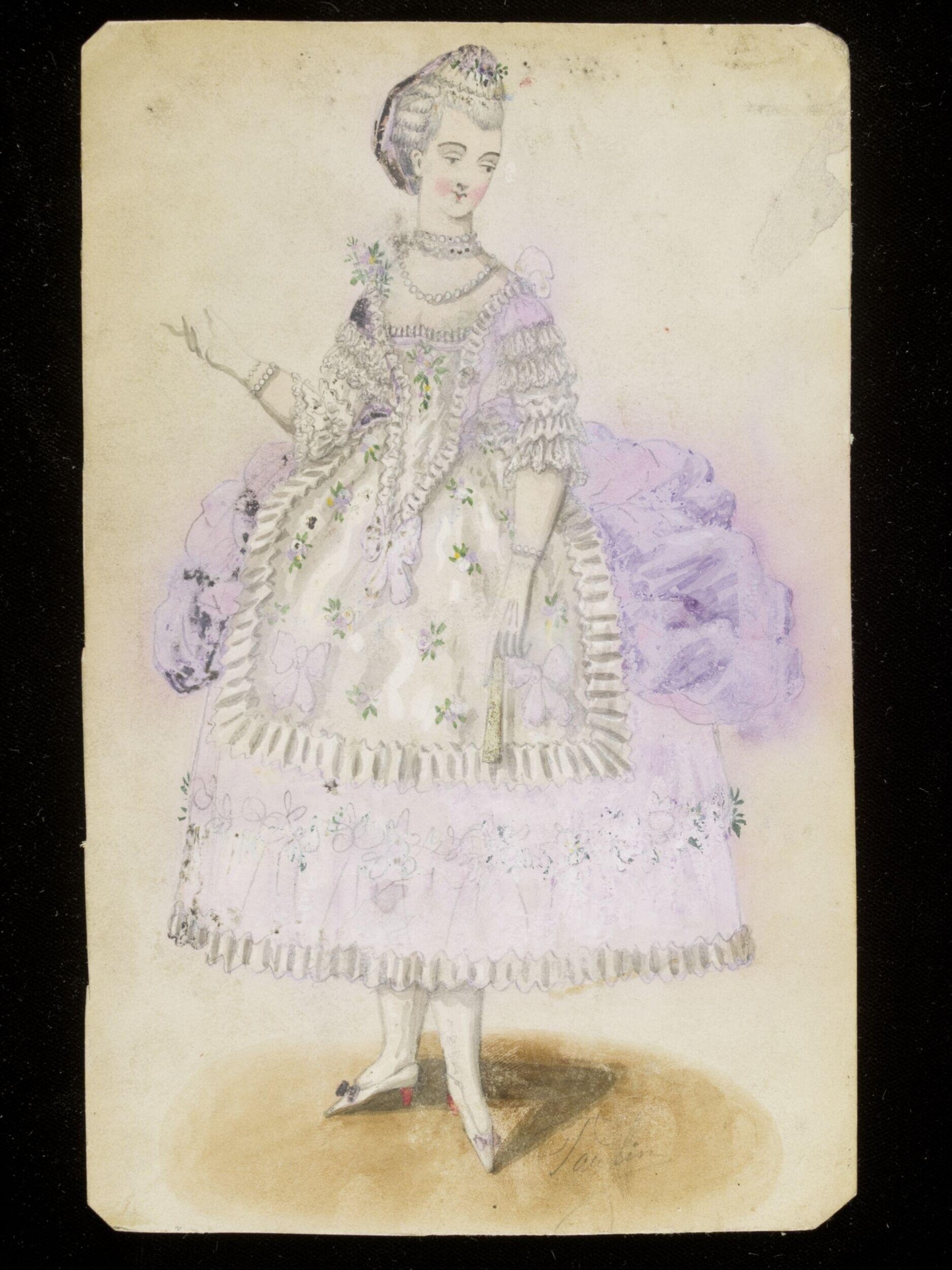
A single female figure stands in three-quarter view against a pale background, posed as if for a portrait or fashion illustration. She wears an elaborate costume of cream or pale lavender silk with extensive lace and ruching throughout the bodice and skirt. The dress is trimmed with deep purple or mauve ruffles and ornamentation, particularly at the shoulders and cascading down the back in a dramatic bustle or train. She wears a choker or pearl necklace at the throat and a tiara or ornamental comb in her upswept hair. Her right hand holds a small sprig of flowers or delicate branch; her left rests at her side. The figure is rendered in watercolor or gouache with fine pen detailing, on what appears to be aged cream-colored paper. The only setting is a wash of ochre or gold at the hem, suggesting a stage floor or simply framing the lower edge of the composition.
The dancing
A single standing figure in an upright, formal posture typical of fashion or theatrical costume plates. The weight appears evenly distributed on both legs. The arms are gently positioned without any active dynamic hold or frame. The right arm is bent at the elbow with the hand raised to hold the floral sprig; the left hangs straight. There is no partnering, no footwork visible, and no evidence of movement frozen mid-step. The pose is static and frontal, designed to display the costume.
The dance depicted
This appears to be a fancy dress or theatrical costume design rather than a depiction of dance in action. The figure is posed for display, not captured mid-movement. If worn on stage, such a costume would likely have been used for a ballroom scene, a masquerade, or a fancy-dress character in a theatrical production of the mid-19th century—possibly ballet, pantomime, or operatic spectacle. The extreme elaboration and artificiality of the dress suggest court or aristocratic fancy dress rather than a working dance costume. Without visible movement, partnering, or a named character, the specific dance form cannot be determined.
How it was made
This is a hand-drawn design rendered in watercolor or gouache with pen detailing, on paper that has aged to cream or pale yellow. The technique is that of a costume plate or design study: precise enough to show construction details (the placement of lace, ruffles, seams), colorful enough to convey the visual effect of the finished garment, but not photorealistic. This format was standard for theatrical and fashion costume documentation in the 19th century, allowing multiple copies to circulate among dressmakers, theaters, and collectors before printing was required. The delicate handling and careful finish suggest this may be an original artist's drawing rather than a reproduction.
About this work
This is a 19th-century costume design for an elaborate fancy dress or theatrical gown, rendered as a watercolor fashion plate. It represents the practice of documenting theatrical and ball costumes through hand-illustrated designs, a mode of circulation that predates photography and mass printing. The artist (identified in the record as Taubin) has captured the silhouette, construction, trim, and color palette of a dress designed to display wealth, artificiality, and fashion awareness—the visual language of fancy dress at mid-century courts and theaters. While not a depiction of dance in motion, it belongs in a dance archive as material evidence of how performers dressed for ballroom spectacle, pantomime, and operatic fantasy scenes where dance and pageantry intermingled.
How to look at it
Attend to the construction: the depth of the ruffles, the placement of the lace, the weight and apparent stiffness of the fabrics, and the sheer material excess of the costume. Notice how the figure is presented frontally and motionless—this is a display pose, not a dance pose. The artist has drawn the costume to show how it would appear to an observer at a ball or on a theater stage, emphasizing silhouette and ornament over movement. The small floral sprig in the hand is a conventional accessory of fancy dress and refinement, not a prop of narrative action.
The artist
The artist is identified only as Taubin in the catalogue record, with no further biographical information available. The style and technique are consistent with professional costume design and illustration practice in mid-19th-century Europe, but the artist cannot be confidently placed without additional research.
The period
In the 1860s, elaborate fancy-dress balls and masquerade spectacles were major cultural events in European aristocratic and urban society. These occasions combined music, dance, theater, and procession, often lasting entire evenings and requiring custom costumes of extreme artificiality. In the same period, Romantic ballet was in decline, but spectacular operatic pantomime and ballroom dance as social and theatrical spectacle remained central to entertainment. Costume design plates, whether hand-drawn or lithographed, circulated among the wealthy, the theater, and dressmakers as models for imitation and inspiration.
Where it lives
The work is held in a collection labeled 'Fancy dress costume design' with source identified as 'va' (likely referring to the Victoria and Albert Museum or a similar British collection). It appears as a single sheet within a larger corpus of 19th-century costume design documentation.
Questions about this work
Is this a drawing of someone dancing?
No. This is a costume design, not a depiction of dance in action. The figure is posed statically for display, to show how the finished garment would look when worn. It would have been used as a reference for dressmakers or as inspiration for costume selection at a fancy-dress ball.
What was a fancy-dress ball?
A formal social event, typically held at court or among the wealthy, where guests wore elaborate historical, theatrical, or fantastical costumes. These events often featured dancing, dining, and entertainment. They were occasions to display both wealth and wit through costume selection.
Who would have used this design?
A wearer planning a fancy-dress costume, a dressmaker executing the design, or a theater wardrobe department preparing costumes for a pantomime or operatic production. The hand-drawn format allowed the design to be shown to potential makers or the client before execution.
What is the date and artist?
The record gives 1860 and identifies the artist as Taubin, but no further biographical details are available. The style is consistent with mid-19th-century costume design practice, but without additional documentation, the artist cannot be further identified.
More dance artwork





