49 works in this view — arrow keys or swipe to move between them.
Dance in Art
Fancy dress costume design
Léon Sault
- Collection:
- Fancy dress costume design
- Source:
- Victoria and Albert Museum
- Rights:
- Rights vary by item — check the source record before reusing this image. Source record ↗
- Recorded as:
- V&A — check rights per item
Costume design drawings are primary sources for understanding how dancers and social performers were visualized in their era—what silhouettes were possible, what excess was permissible, what the eye was trained to expect. This work shows a specific moment in the 1860s when theatrical artifice and social spectacle were at a peak, and when the female form was being dramatically reshaped by corseting, layering, and applied ornament. For historians of dance and performance, costume designs are as important as photographs of dancers themselves, because they reveal the intended appearance and the technical means by which that appearance was achieved.
What you are looking at
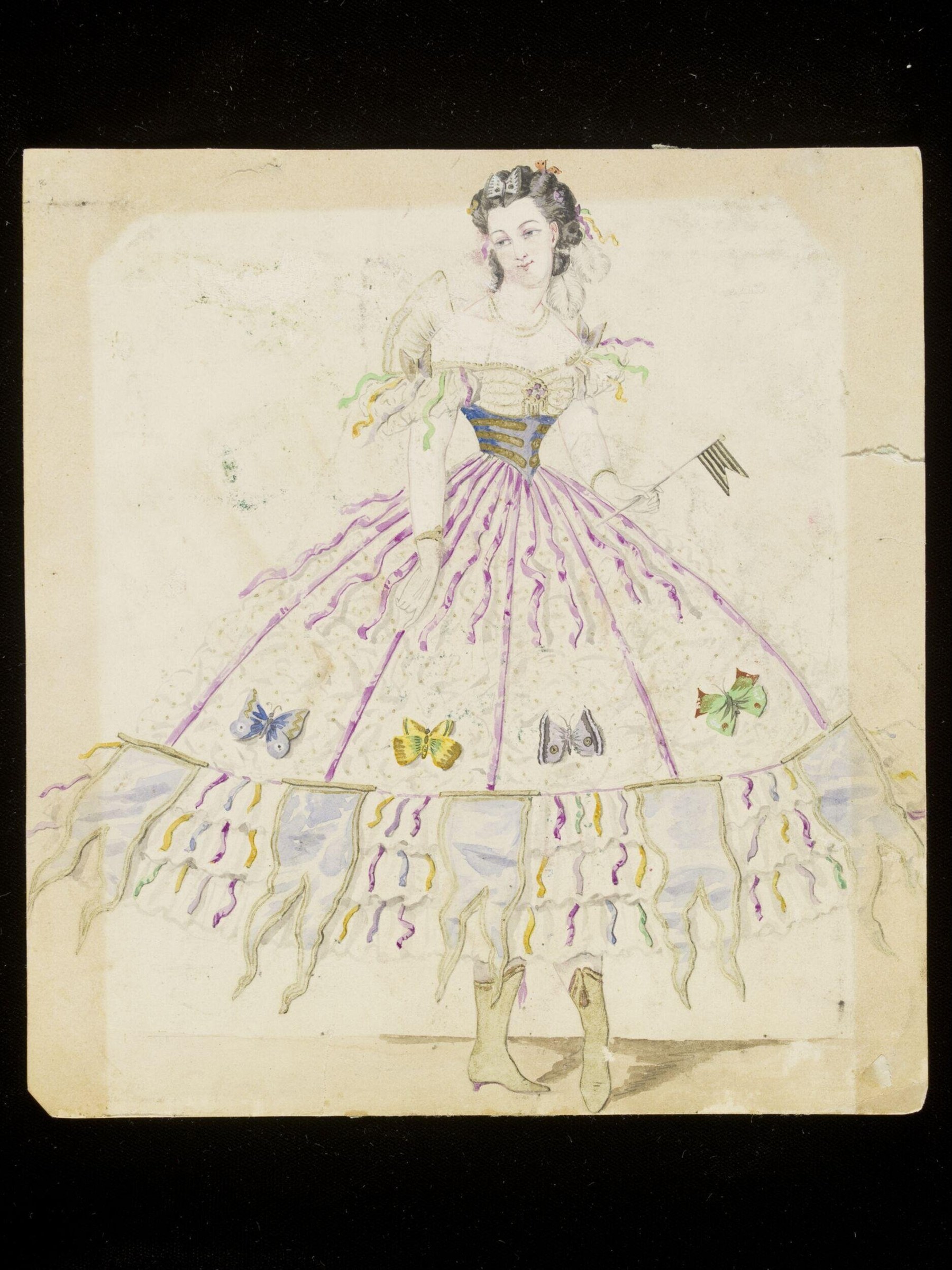
A young woman in fashionable mid-nineteenth-century dress stands alone against a plain cream background, posed as if for a costume design study. She wears a strapless bodice in cream with a deep blue corset, and a voluminous skirt in pale cream with purple linear striations or pleating that radiates from the waist. The skirt hem is edged with decorative scalloping or fringe in alternating purple and yellow threads that extends downward in loose strands, creating a spectacular fringed border. Scattered across the skirt are four hand-painted butterflies in blue, yellow, and green. A large decorative comb or ornament adorns her curled hair, and she holds a small fan in her right hand. The style suggests carnival, masquerade, or theatrical fancy dress rather than authentic period costume—the exaggerated fringe, the butterflies, and the theatrical silhouette all point to a stage or ball costume of high artifice.
The dancing
The woman stands in a relaxed, frontal pose with weight evenly distributed, her body upright and facing the viewer. Her right arm holds a fan at mid-level; her left arm rests naturally. There is no suggestion of active dance movement—the pose is static and presentational, as befits a costume design drawing. Her expression is pleasant and composed, with no indication of performance energy or the sustained tension of active dancing.
The dance depicted
This is a costume design rather than a depiction of dancing itself. The work documents fancy dress for a social occasion—carnival, masquerade ball, or theatrical performance—rather than showing dance in progress. The 1860s context places this in the era of the Romantic ballet's decline and the rise of spectacular theatrical productions and social dancing at balls and masked events. The costume's theatrical excess—the butterfly motifs, the exuberant fringe, the improbable silhouette—suggests this is fantasy dress, not naturalistic clothing, and would have been worn in contexts where display and artifice were valued. No specific dance style is depicted.
How it was made
This is a watercolor and ink costume design on paper, rendered in a delicate hand with fine detail work. The medium allowed the artist to combine precise line work (the bodice construction, the comb detail) with soft washes of color (the skirt fabric, the butterfly wings). The technique shows no indication of printing or mechanical reproduction—this is a singular drawn and painted design, likely created for a specific theatrical or social commission. The fragility of watercolor on aged paper and the evidence of wear across the surface suggest this is an original studio drawing intended to be consulted during costume construction rather than widely circulated.
About this work
This is a costume design drawing by Léon Sault dated 1860, showing a fancy dress costume for a woman—likely for a masquerade ball, carnival, or theatrical performance. The work combines precision technical drawing (the bodice and corset structure) with fantastical decoration (butterflies, theatrical fringe) to create a costume that values spectacle and artifice over authenticity. It belongs in a gallery of dance because fancy dress and masquerade costumes are inseparable from the social dances of the Romantic and Victorian eras, and because this drawing documents how the period's theatrical imagination shaped the body and the visual experience of social performance.
Sault's work is a direct historical record: not of dancers in motion, but of how costume designers of the 1860s conceived of the female body as a canvas for visual fantasy. The drawing shows the collaboration between artist, seamstress, and wearer that made theatrical spectacle possible in an age before mechanical reproduction.
How to look at it
Attend first to the construction of the bodice and corset: the artist has drawn precise anatomical shaping that shows how the body would have been controlled and presented by the garment. Then look at the contrast between the architectural precision of the top half and the decorative extravagance of the bottom—the fringe, the butterflies, the radiating pleats. This is a studied composition that balances structure with fantasy. Note the way the butterflies are scattered across the skirt as if in flight, adding a naturalistic, whimsical element to what is fundamentally a geometric garment. The comb in the hair and the fan in the hand are the final details that complete the costume as theater: they are accessories that gesture toward a social role and performance context.
The artist
Léon Sault was a French designer and illustrator active in the mid-nineteenth century, specializing in costume and theatrical design. His practice reflects the mid-century French tradition of theatrical commerce and the development of professional costume houses in Paris. Little is recorded of his individual life or career beyond the designs that survive, which suggests he was part of a broader workshop tradition rather than a celebrated individual artist. His work would have served costume makers, theater companies, and wealthy clients commissioning fancy dress for private social events.
The period
The 1860s were a period of extraordinary excess in women's fashion and theatrical costume. The crinoline was at its widest extent; corsetry was at its most extreme. This was also the height of the Romantic ballet's influence on social dance aesthetics—the emphasis on the female body as ethereal, decorative, and visually dominant. At the same time, public masquerade balls and carnival events were thriving in Paris and across Europe, creating demand for theatrical costume designers. The Second Empire (1852–1870) was a period of theatrical spectacle and conspicuous consumption, and fancy dress was a key form of social performance. Sault's work sits at the intersection of theatrical design and social choreography—the costume was not merely clothing but a kind of visual dance vocabulary in itself.
Where it lives
The drawing is held in the V&A (Victoria and Albert Museum) collection. It is catalogued as a fancy dress costume design and is part of the museum's holdings of theatrical and costume-related works on paper. The designation 'va' in the source field confirms the V&A as the holding institution.
Questions about this work
Is this a drawing of an actual dancer or a designed fantasy costume?
This is a design for a fancy dress costume—likely for a masquerade ball or theatrical event. The butterflies, the exaggerated fringe, and the theatrical silhouette are all indicators that this is fantasy dress rather than a record of an existing garment or a naturalistic portrait. It documents the imagination of the costume designer rather than the appearance of a specific performer.
What does the fringe at the hem suggest about how this costume would have moved?
The loose fringe would have created visual flutter and movement even when the wearer was standing still. In the context of social dance, where even modest movement would be visible, the fringe would have amplified any gesture or sway. This is characteristic of 1860s theatrical costume, where the objective was to make the body visually spectacular through applied decoration.
Who would have worn a costume like this?
This costume was designed for a woman of means attending a masquerade ball, carnival, or theatrical event in the 1860s. The cost and complexity of the construction—the fine friege work, the hand-painted butterflies, the corsetry—suggests a wealthy wearer or a professional performer. Such costumes were often commissioned from specialist designers like Sault.
What does the medium tell us about how this design was used?
The watercolor original is a singular artifact, not a mechanical reproduction. It would have been consulted by the seamstress during construction and possibly kept as a record of the design. The level of finish suggests this was a presentation drawing made for a client or patron, not a rough sketch for internal studio use.
More dance artwork





