49 works in this view — arrow keys or swipe to move between them.
Dance in Art
Diana
Leon Sault
- Collection:
- Fancy dress costume design
- Source:
- Victoria and Albert Museum
- Rights:
- Rights vary by item — check the source record before reusing this image. Source record ↗
- Recorded as:
- V&A — check rights per item
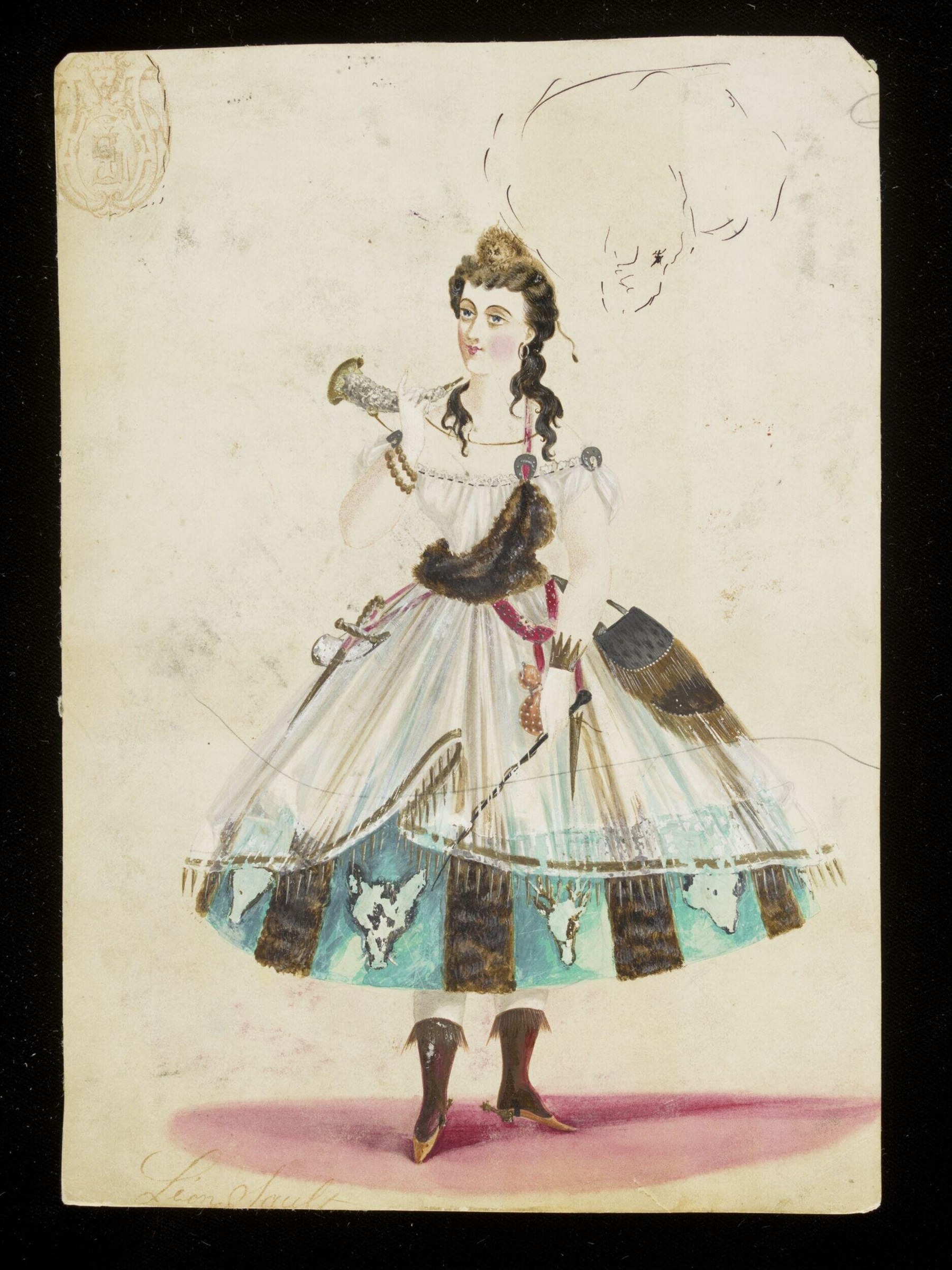
This design reveals how 19th-century theater and ballroom culture imagined classical mythology through costume: the elaborate skirt decoration with narrative figures transforms a simple garment into a stage set worn by the performer. For dancers and historians, it documents the visual framework within which performers moved at formal occasions, and shows the boundary between costume design and dance presentation in this period.
What you are looking at
A young woman in an elaborate mid-19th-century ball gown stands in three-quarter view against a plain background, her body angled slightly to the right. She wears a white off-shoulder dress with short puffed sleeves, the skirt voluminous and gathered, decorated with horizontal stripes in turquoise and dark brown with white appliqué figures—possibly putti or cherubs—creating a theatrical scenic quality. A dark fur stole drapes diagonally across her bodice. She holds a decorative golden object in her raised left hand, possibly a comb or fan handle, and her hair is elaborately styled in dark ringlets pulled back from her face. Her right arm hangs at her side. The lower border is a soft pink platform or stage floor. A sketch of a female head profile appears in the upper right margin, suggesting this is a costume design study. The signature at the bottom left appears to read "Léon Sault," and a faint institutional seal marks the upper left corner.
The dancing
The woman stands upright in a posed, presentational attitude typical of costume design drawings rather than active dance. Her weight appears centered on her legs, with minimal indication of active movement or weight shift. The raised arm suggests a gesture—perhaps acknowledging applause or holding an ornamental prop—rather than a dance position. Her posture is frontal and open, displaying the costume's construction for a viewer's assessment. There are no partners, no contact, and no bodily relationship to another figure.
The dance depicted
This does not depict dance in action but rather a fancy dress or theatrical costume design, possibly for a masked ball or operatic pantomime. The figure is styled as a theatrical character rather than a dancing body in motion. The mythological reference in the title 'Diana' and the decorative narrative elements in the skirt (putti, possibly hunting scenes) suggest a classical or allegorical character costume rather than a specific dance style. The pose is more aligned with static costume presentation than choreographic documentation.
How it was made
This is a hand-colored drawing or watercolor on paper, combining line work (visible in the sketched head at top right and some contour definition) with applied washes of color. The medium allows for both precise costume detail—the pattern work on the skirt, the fur texture, the jewelry—and the fluidity of the fabric drape. The style of hand-coloring, the paper's aged appearance, and the institutional mark suggest this is an original design drawing from a theater's archives or a designer's portfolio, intended for reference rather than mass circulation.
About this work
Léon Sault's colored drawing presents a theatrical costume design for a classical female character, likely Diana, suitable for a mid-19th-century fancy dress ball or opera-ballet production. The work is a primary document of theatrical costume practice and fantasy, showing how historical and mythological dress was reimagined for contemporary entertainment. The ornamental treatment of the skirt and the careful attention to fabric and silhouette reflect the standards of mid-Victorian spectacle costume.
How to look at it
Attend to the skirt's narrative decoration—those small white figures and the alternating color panels create a 'walking set,' turning the wearer's body into a moving stage picture. Note how the artist balances the static, presentational pose (suitable for a design drawing) with visual movement through the drapery and color rhythm. The pink floor base indicates this is a stage costume, not a street dress. The profile sketch above shows the designer considering the silhouette from another angle, a practical studio practice.
The artist
Léon Sault is documented as a costume and dress designer working in mid-19th-century Paris. Little is currently known of his broader practice or training, but the sophistication and detail of this drawing suggests he worked professionally for theaters or for wealthy patrons commissioning fancy dress costumes. His signature on this work indicates its status as a design document worthy of attribution.
The period
The 1860s saw a flourishing of fancy dress balls and themed entertainment among European aristocracy and wealthy bourgeoisie, often inspired by historical periods or classical mythology. Simultaneously, Romantic and early classical ballet was in its mature phase, with tutus and elaborate costume design fundamental to the spectacle. Costume designers of this period occupied a space between fine art and applied design, and their drawings were valued documents. The hand-coloring technique and the presentation style place this squarely in the tradition of European fashion and costume design illustration.
Where it lives
The work is held in the V&A (Victoria & Albert Museum) collection as a fancy dress costume design. The institutional seal and drawing format confirm its status as a museum acquisition within the decorative and theatrical design collection.
Questions about this work
Is this a design for an actual dance, or just a costume for a ball?
The pose and presentation suggest this is a costume design for theatrical or fancy dress wear rather than documentation of a specific dance. The figure is static and posed for costume display. However, a wearer of such an elaborate costume would have danced in it at a ball or in an opera-ballet production, so the design was created with movement in mind, even if this drawing does not show motion.
What are those little figures on the skirt?
The white appliqué shapes appear to be putti (cherubs) or possibly hunting-related figures, reinforcing the mythological Diana theme—goddess of the hunt. These narrative elements were typical of mid-Victorian costume decoration, allowing the wearer to display wealth, classical taste, and theatrical knowledge through a garment.
Why is there a head sketch at the top right?
The profile sketch shows the designer exploring the silhouette and hairstyle from another angle. This is a common studio practice visible in costume design drawings—working out multiple views to ensure the garment would photograph or present well from all directions.
More dance artwork





