49 works in this view — arrow keys or swipe to move between them.
Dance in Art
Fancy dress costume design
Leon Sault
- Collection:
- Fancy dress costume design
- Source:
- Victoria and Albert Museum
- Rights:
- Rights vary by item — check the source record before reusing this image. Source record ↗
- Recorded as:
- V&A — check rights per item
Though not a dance scene, this costume design records the material culture and aesthetic standards of 1860s theatrical and ball dress. For historians of dance and dress, it is evidence of the expense, detail, and heraldic symbolism invested in formal dance costumes and fancy dress, and of how artists and costumers collaborated to visualize character and status through garment.
What you are looking at
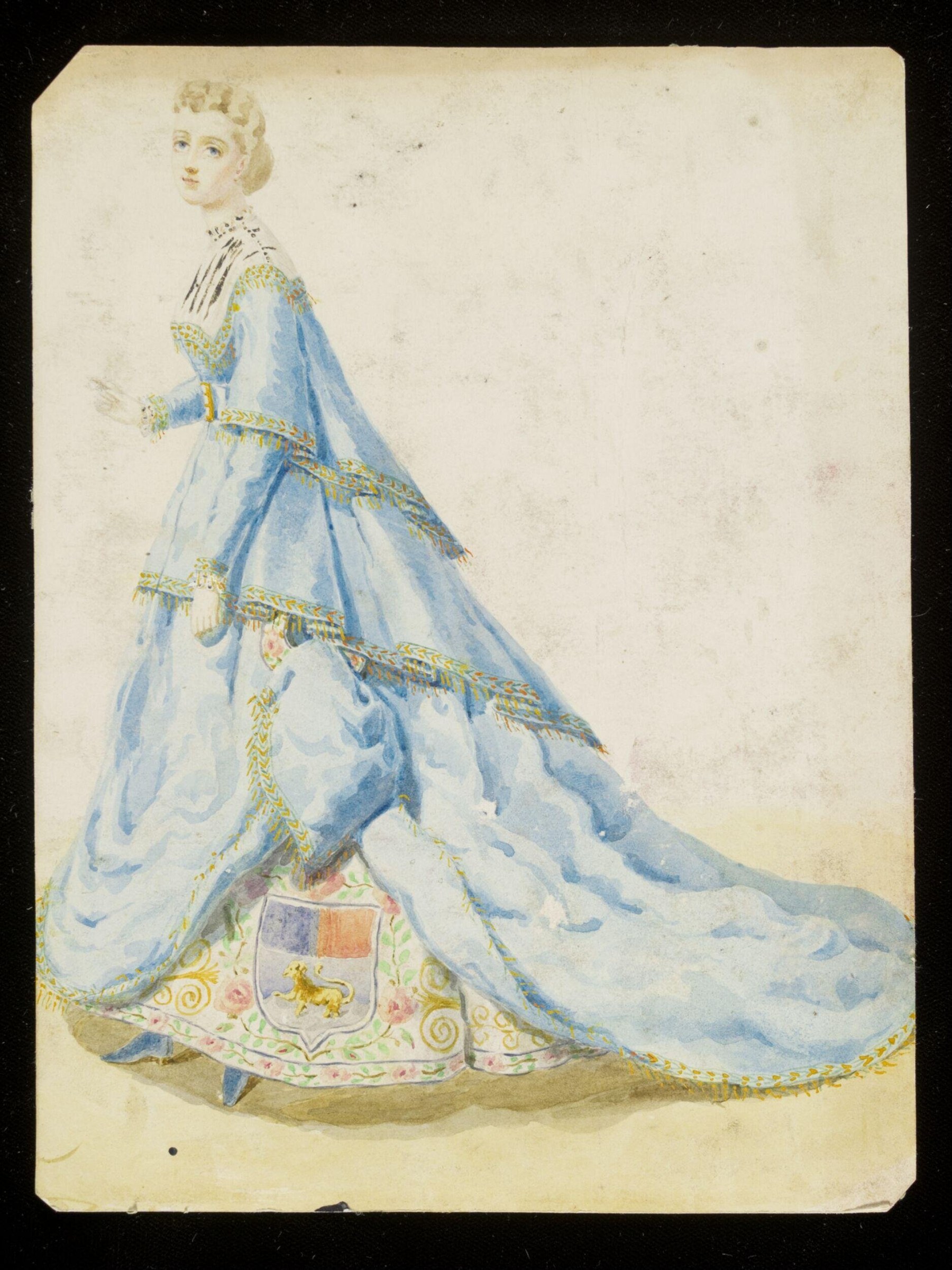
A single female figure is posed in a three-quarter view, turned to show the line of an elaborate gown. She wears a voluminous skirt of pale blue silk, gathered and draped with ornamental gold trim arranged in deep swags across the hem and lower skirt. A white or cream-colored cape or overskirt flows from her shoulders, also trimmed in gold, creating a long diagonal line from her left shoulder down the back. Her bodice is fitted and decorated with gold embroidery or beading at the sleeves and neckline. She holds what appears to be flowers or a small bouquet in her right hand. Her hair is styled up and away from her face in the fashion of the 1860s, with pale blonde curls. Beneath the hem of the skirt, a decorative shield or cartouche is visible, painted with heraldic designs—coats of arms in red, blue and gold, with scrollwork decoration in light colors. The figure stands against a plain cream background; the drawing appears to be a watercolor or gouache study on paper, with fine detail in the costume rendering but minimal setting or context.
The dancing
The figure is stationary and posed rather than captured mid-movement. Her posture is upright and formal, with her weight evenly distributed. Her right arm hangs naturally, holding flowers; her left arm is not clearly visible, likely held against her body or slightly forward. There is no indication of active dance movement—no weight shift, no turned-out leg position, no extension. The pose is one of display and presentation, typical of a fashion or costume study.
The dance depicted
This is not a depiction of dance in action. It is a fancy dress or theatrical costume design—a study for a ball gown or formal dress, possibly for a masquerade or historical costume event. The composition, pose, and heraldic emblems suggest either a royal or aristocratic character, or a personification of rank or nobility. No specific dance form is represented; the figure is modeled to show the garment rather than the dancer's movement.
How it was made
The work is executed in watercolor or gouache on paper, a standard medium for costume design and fashion studies of the 1860s. The delicate handling of fabric texture—the subtle shading that suggests the weight and drape of the silk, the precise linear detail of the gold trim—shows the technique at its most functional: the aim is to communicate the look of a finished garment to a seamstress, costumer, or client. This medium allowed rapid iteration and fine color rendering without the expense or permanence of oil paint, making it ideal for theatrical and fashion work.
About this work
This is a costume design study by Leon Sault, dated 1860, showing an elaborate fancy-dress gown in the theatrical or aristocratic mode. The figure is rendered as a fashion plate—a standing, posed display of a garment rather than a moment of dance or dramatic action. The blue silk skirt with gold swag trim, the cream cape, and the heraldic emblems at the hem suggest either a royal character or a personified rank or title. As a costume design, the work belongs in a dance gallery because fancy dress, masked balls, and historical costume entertainments were important contexts for social and theatrical dance in the 19th century, and because costume design is part of the material history of dance practice. The work documents what dancers wore and how costumers imagined and rendered those garments.
How to look at it
Read the costume from the ground up: notice how the heraldic cartouche grounds the gown in a specific symbolic register—this is not merely pretty, but titled. Trace the gold trim across the skirt and see how it articulates the volume and shape of the fabric beneath. The pose is didactic: the slight turn of the figure is calculated to show the length of the cape and the line of the skirt simultaneously. There is no movement to read, but rather a formal presentation of materials, color, and symbolic content. The artist has chosen a moment not of dance, but of stillness and display—the moment a dancer would stand to be admired before the dance began.
The artist
Leon Sault (also recorded as Léon Sault) was a French costume and fashion designer active in the mid-19th century, working in a period when the roles of theatrical costumer, fashion illustrator, and fine artist were not yet fully separate. Designers of his generation produced watercolor studies for clients in theater, opera, and aristocratic circles, translating those sketches into sewn garments. His hand is evident in the precision of line, the restraint of the palette, and the focus on the garment as the primary subject. Little is recorded of his wider practice or biography.
The period
The 1860s saw the height of the Victorian crinoline and the fashion for historical and Oriental fancy dress at balls and masquerades. Theatrical costume design had become a specialized and respected profession, with published pattern books and design studies circulating among makers and patrons. The heraldic imagery on this gown—the coats of arms, the formal shield—reflects a 19th-century taste for historicizing and genealogical costume, where fancy dress was meant to evoke or represent noble lineages, historical periods, or fictional rank. In dance, this was the era of the Romantic ballet in decline and the rise of the ballet à grand spectacle, in which costume design was lavish and narrative.
Where it lives
The work is held in the Victoria and Albert Museum's collection. It is catalogued as a fancy dress costume design, one of many such studies in the museum's archive of 19th-century theatrical and fashion materials.
Questions about this work
Is this a dancer?
The figure is shown in a pose of display rather than dance. She is stationary, upright, and presented to show the garment itself. This is a costume design study, meant to communicate to a seamstress or patron what the finished dress would look like, not to capture a moment of choreographed movement.
What do the coats of arms mean?
The heraldic shields at the hem suggest the wearer is a historical or fictional figure of noble rank. In 1860s fancy dress, such emblems were used to anchor costume in a narrative of genealogy or history, even if the wearer was an aristocrat or wealthy merchant adopting a role for a ball.
Why is this in a gallery of dance?
Costume is part of dance history. This design shows what dancers and masqueraders wore, how those garments were imagined and rendered, and what symbolic and aesthetic values were embedded in theatrical dress. It is a document of the material culture that surrounded dance practice.
What is the medium?
The work is watercolor or gouache on paper. This medium was standard for costume design in the 19th century because it allowed rapid, precise rendering of color and texture without the time and cost of oil paint, making it ideal for professional communication between designer, costumer, and client.
More dance artwork