49 works in this view — arrow keys or swipe to move between them.
Dance in Art
Fancy dress costume design
Jules Helleu
- Collection:
- Fancy dress costume design
- Source:
- Victoria and Albert Museum
- Rights:
- Rights vary by item — check the source record before reusing this image. Source record ↗
- Recorded as:
- V&A — check rights per item
Costume designs reveal how dance was embedded in spectacle and ritual. This drawing shows that the costume itself—its weight, its restriction, its visual drama—was part of what made fancy dress balls significant; the dance was not separate from the dress but inseparable from it. For historians studying 19th-century social dance, such designs are primary evidence of how bodies were visually constructed and contained.
What you are looking at
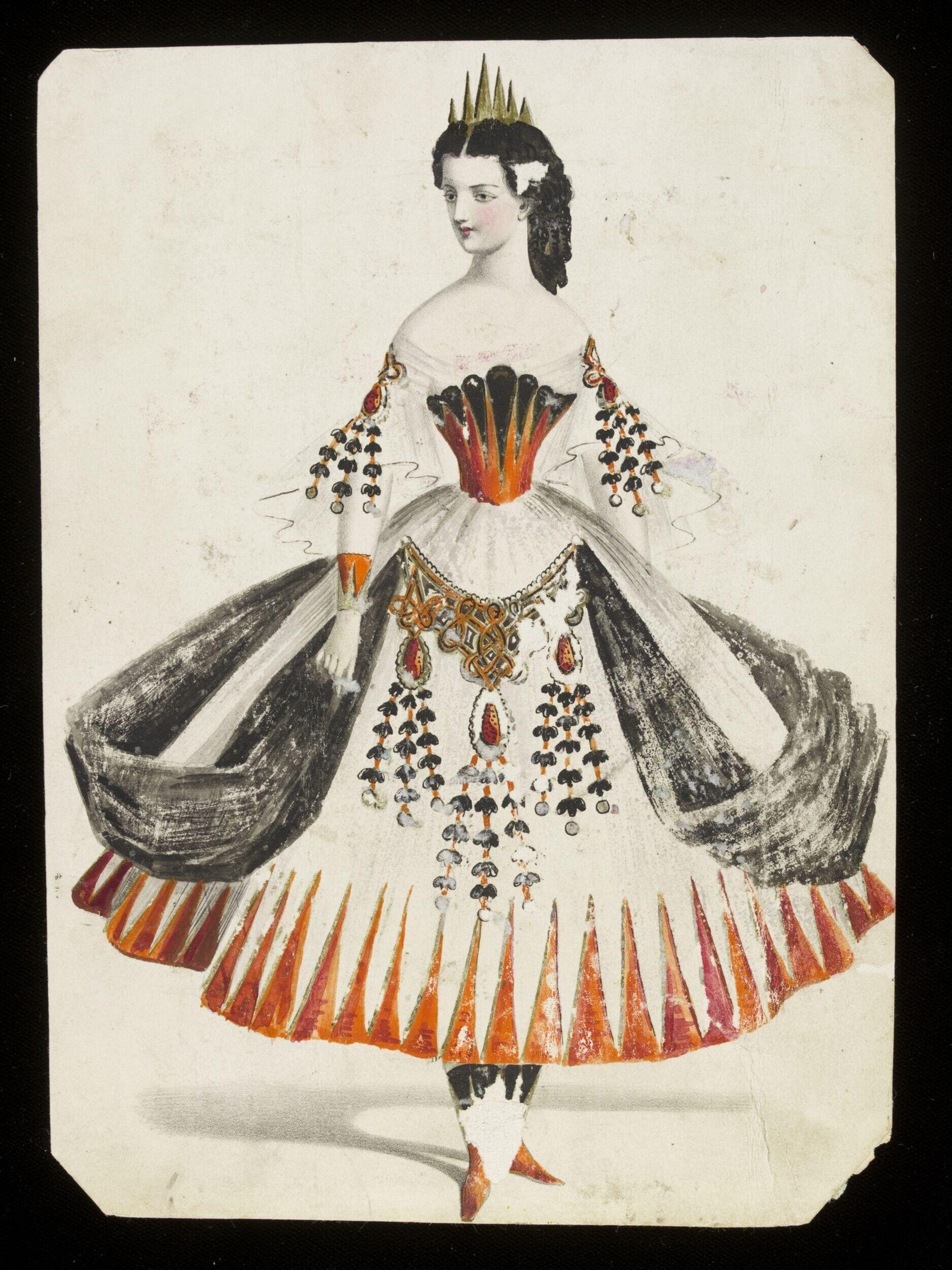
A single female figure in an elaborate fancy dress costume stands centered against a plain background, posed in a three-quarter view turning slightly to her right. She wears a white off-shoulder bodice with a dramatically boned corset in red and gold, from which hangs a full skirt composed of pleated panels in graduated shades of red, orange, and gold that suggest flames or a fan. The skirt extends to mid-calf and is edged with a scalloped ruffle in alternating warm tones. Cascading from the corset are long strands of beaded or jeweled ornaments in black and gold that drape down the center of the dress. She wears a tall, pointed gold crown and has her dark hair styled in a netted arrangement typical of mid-19th-century formal dress. White stockings and shoes with orange heels complete the ensemble. The costume suggests a theatrical or masquerade character—possibly representing fire, a celestial being, or an exotic courtly figure—rather than a contemporary street costume. The figure's posture is elegant and stiff, the pose chosen to display the garment rather than suggest movement.
The dancing
A single standing figure is presented in a formal, stationary pose rather than captured mid-movement. Her shoulders are pulled back, her torso erect and corseted, her arms at rest. There is no sense of dancers in relation to each other, no hold or frame. The body is used as a display armature for the costume itself, not as an instrument of dance. Her gaze is averted and her expression serene, in the manner of a fashion plate or costume design rather than a performer in action.
The dance depicted
This is a costume design rather than a depiction of dance in motion. The title and format suggest it was created to show how a fancy dress costume would appear when worn—the kind of drawing a seamstress, costumer, or ball organizer would commission. The garment itself evokes theatrical or masquerade contexts in which dance would have occurred, but the figure demonstrates the dress, not the dance. If worn at a ball or theatrical event, such a costume would have constrained the wearer's movement significantly due to the rigid boning and full skirt, suggesting a slow, formal dance—perhaps a promenade or processional movement rather than active steps.
How it was made
This is a hand-colored fashion or costume design, likely a lithograph or engraving hand-tinted with watercolor or gouache. The medium is not recorded in the catalogue, but the technique is consistent with 19th-century commercial costume designs: the figure is printed or drawn in black, and flat color is applied by hand, with particular care taken to render the jeweled ornaments and shading on the fabric. This method was standard for costume plates and fashion designs intended for circulation among dressmakers, theaters, or wealthy clients. The technique allowed rapid reproduction of the design while permitting individual artistic refinement of the color.
About this work
This is a costume design sheet for an elaborate fancy dress costume, created circa 1860 by Jules Helleu, a artist known for work in fashion and costume design. The object documents the history of masquerade and fancy dress balls as major social events in the mid-19th century—occasions on which elaborate theatrical costumes, often inspired by exotica or historical fantasy, were worn and displayed. The costume shown here combines theatrical silhouette (the stiff corset, the full skirt, the crown) with ornamental excess (the cascading beads, the elaborate color gradation) typical of the Romantic era. It sits at the intersection of fashion history and theatrical design, showing how costume was created and communicated before photography and ready-to-wear industries. For dancers and dance historians, it documents the material constraints and visual spectacle of 19th-century ballroom culture—the kinds of costumes worn at events where dance was the primary social activity, yet which fundamentally altered how bodies could move.
How to look at it
Attend to the costume's construction: the rigid, boned corset that would have severely limited the torso's flexibility and breathing; the full skirt and its weight, which would have required a woman to move in a contained, stately manner; the cascading jewels and their optical effect of drawing the eye downward and fragmenting the silhouette. The pose—feet together, torso erect, arms at rest—is the conventional stance for displaying a dress, not for dancing. Yet note that despite these constraints, the costume is designed to be visually impressive in motion; the graduated color of the skirt panels would have created a fan-like or flame-like effect when the wearer turned or walked. The artist understood both how the costume would look at rest and how it would move.
The artist
Jules Helleu (1821–1884) was a French artist known for fashion illustration and costume design. He worked in the mid-19th century when the illustrated fashion plate was at its height, before photographic reproduction became standard. His designs for fancy dress costumes were circulated among the wealthy and theatrical communities of Paris, and he appears to have been active in documenting the elaborate costumes worn at society balls and masquerades. His work sits between fine art, commercial design, and theater, typical of the period when those categories overlapped significantly.
The period
The 1860s were the height of the Victorian fancy dress ball, a social institution in which elaborate costumes—often inspired by history, exotica, fairy tales, or theatrical traditions—were commissioned at great expense and worn for evening entertainment that centered on dancing, promenading, and display. The silhouette shown here (the narrow waist, the full skirt, the rigid corset) is characteristic of 1860s fashion, and the crown and ornamental style suggest reference to historical or theatrical precedent rather than contemporary dress. Jules Helleu's work is contemporaneous with the rise of lithography and color printing as tools for fashion dissemination; such designs were widely collected and used as inspiration for actual garments.
Where it lives
The work is held by the V&A (Victoria and Albert Museum) in the United Kingdom, one of the world's most comprehensive collections of costume design and fashion history. It is catalogued as a fancy dress costume design and likely held in the museum's Prints, Drawings & Paintings collection or as part of its fashion studies materials.
Questions about this work
Is this a painting or a print?
The medium is not recorded in the catalogue, but the technique—black printed line with hand-applied color—suggests a lithograph or engraving that was printed and then hand-colored with watercolor or gouache. This was standard practice for costume designs in the 1860s, allowing the design to be reproduced while still allowing individual artistic embellishment.
Who would have worn a costume like this?
A wealthy woman attending a fancy dress ball—an exclusive social event in which guests wore elaborate theatrical or historical costumes. These were major entertainments in mid-19th-century European high society, and the costumes could cost as much as a year's servants' wages. The costume shown here, with its jeweled ornaments and elaborate construction, suggests the wearer was of considerable means.
What does this tell us about dance in the 1860s?
It shows that costume was integral to the experience and meaning of dance. The rigid corset and full skirt would have enforced a slow, contained style of movement—no energetic waltzing or jumping, but rather stately promenading and formal partnering. The costume itself was as much the point of the event as the dancing; display and spectacle were central to how 19th-century social dance functioned.
Could this costume actually be danced in?
Movement would have been extremely restricted. The corset would prevent deep breathing and torso flexibility; the full skirt and its weight would limit step size and speed. A woman in this costume could participate in slow, formal dances like the quadrille or a slow waltz, but the costume was designed for visual impact while standing and walking, not for vigorous movement. The design prioritizes spectacle over function.
More dance artwork





