49 works in this view — arrow keys or swipe to move between them.
Dance in Art
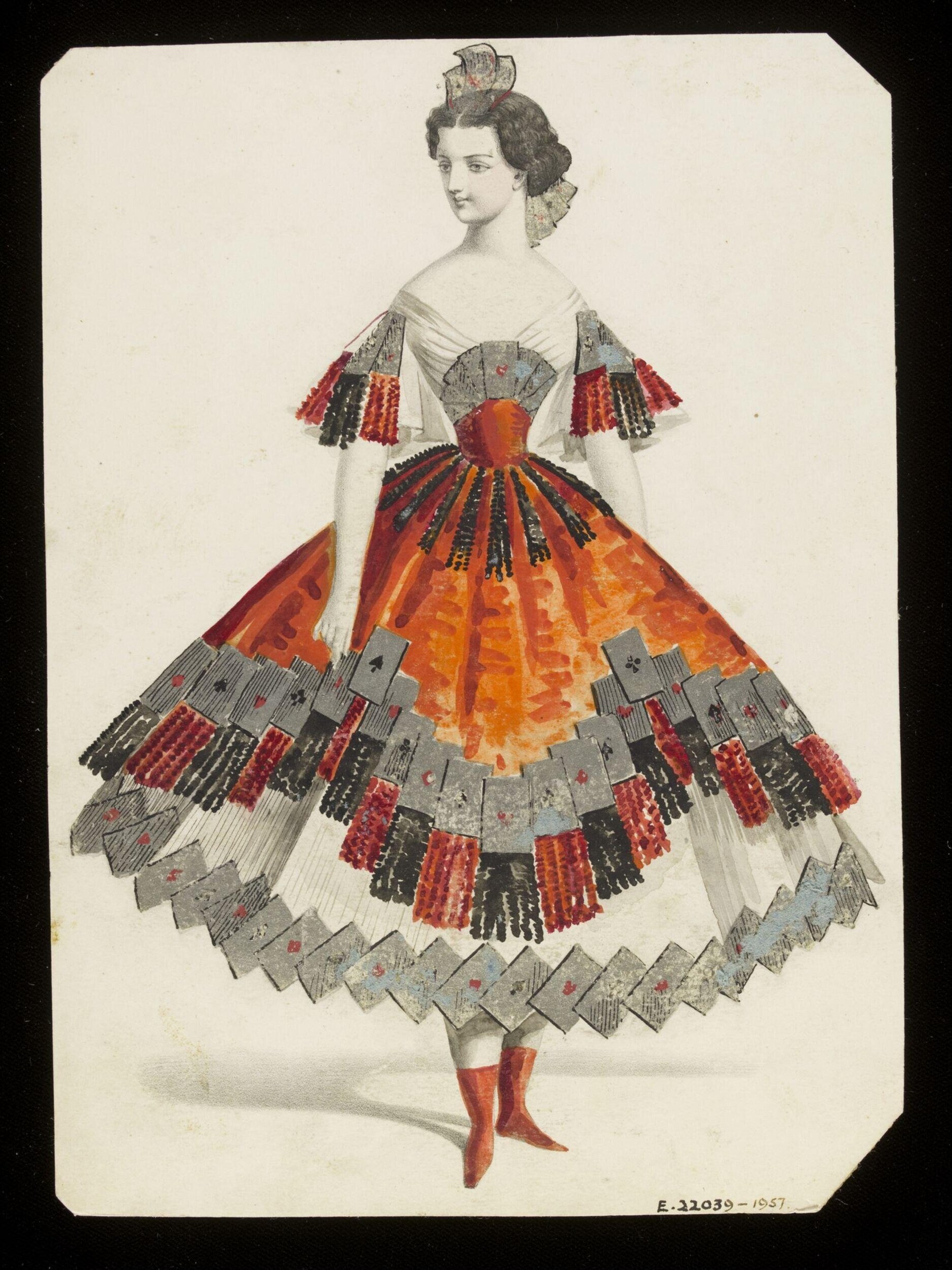
Fancy dress costume design
Jules Helleu
- Collection:
- Fancy dress costume design
- Source:
- Victoria and Albert Museum
- Rights:
- Rights vary by item — check the source record before reusing this image. Source record ↗
- Recorded as:
- V&A — check rights per item
For dance historians, this work documents the kinds of fancy-dress costumes available to social dancers and performers in the 1860s, and shows how costume design could create spectacular silhouettes through construction rather than through fabric weight or volume. The boldly geometric panel design also suggests how costume innovation could be marketed and circulated through printed fashion plates—a crucial channel for disseminating ideas about how to dress for dance.
What you are looking at
A single fashionable woman is presented in three-quarter view against a plain background, wearing an elaborate mid-19th-century ball gown. The bodice is fitted white silk with a gray patterned corset front, and the shoulders are bare. The sleeves are short and dramatically flared, constructed from rectangular panels of alternating red, black, and gray printed fabric—a distinctive design that appears to be the primary novelty of the costume. The skirt dominates the composition: it sweeps to the ankles in a full circle, constructed from dozens of vertical rectangular panels of patterned fabric in the same red, black, and gray palette, arranged in radiating pleats that fan out from the waist like a peacock's tail or an opened fan. The panels create a bold graphic effect, quite unlike the smooth curves typical of 1860s ball gowns. A gray patterned belt cinches the waist. Red stockings and red shoes complete the ensemble. The woman wears her dark hair pulled back and decorated with a small ornamental headdress or comb. Her posture is upright and refined, her expression serene; she presents the costume as an object for admiration rather than as a figure in motion.
The dancing
The single figure stands in a formal pose typical of fashion illustration: slightly turned, weight evenly distributed, arms at rest at the sides. There is no suggestion of active dance movement—no weight shift, no arm gesture, no captured moment of motion. The body serves as an armature for displaying the costume.
The dance depicted
This is not a depiction of dance in action. It is a costume design for fancy dress—a masked ball or theatrical costume intended for social wear or stage performance. The elaborate construction of the skirt from discrete printed panels suggests either a novelty costume (perhaps meant to reference a fan, playing cards, or abstract geometry) or an allegorical or character costume for carnival or theatrical use. The style and construction would allow movement, but the figure here is posed as a model to display the garment's design rather than to suggest how it would be danced in.
How it was made
The work is a hand-colored engraving or lithograph, likely a fashion plate or costume design sheet. The line work is fine and precise, establishing the form and drape of the fabric, while selective hand-coloring in red, gray, and black emphasizes the patterned panels of the skirt and sleeves. This technique—engraving or lithography with hand-coloring—was the standard method for circulating fashion and costume designs in the 1860s, allowing multiple copies to be produced and distributed to tailors, performers, and fashion-conscious clients. The precision of the line and the neatness of the coloring suggest a professional design house or publication rather than a private sketch.
About this work
This is a fashion design or costume illustration for an elaborate fancy dress, created in the mid-19th century by Jules Helleu, a French costume and fashion designer. The work documents a striking innovation in ball-gown construction: the skirt is built from dozens of discrete rectangular panels of printed fabric, arranged in radiating pleats to create a dramatic fan or shell-like silhouette. While not a depiction of dance itself, it belongs in a dance collection because such costumes were worn at masked balls, theatrical performances, and social events where dancing was the primary activity, and because the design reflects how costume and movement were understood to work together in mid-century performance and entertainment. The work is presented as a design proposal or advertisement for bespoke costume creation.
How to look at it
Attend to the construction of the skirt: the eye follows the radiating pleats and discrete fabric panels from waist to hem, creating a sense of expansion and fan-like opening. This is a design meant to be striking in a ballroom, where the movement of the dancer would cause the panels to flutter and shift, creating a rippling, shell-like effect. The designer has made the garment's structure visible and graphic—each panel is a discrete unit, almost like playing cards or a deck fanned open. The hand-coloring emphasizes this panel structure by varying the pattern and color across the radiating sections. The figure's static pose and serene expression frame the costume as a spectacle to be admired, not as a garment in motion.
The artist
Jules Helleu (flourished 1860s–1880s) was a French costume and fashion designer known for theatrical and fancy-dress designs. His work was distributed through printed fashion plates and design sheets, establishing him as part of the professional infrastructure of mid-century theatrical and social costume. Little is widely documented about his biography, but his surviving works show a consistent interest in elaborate construction and eye-catching novelty designs intended to impress in performance or ball-room settings.
The period
In the 1860s, fancy dress and masquerade balls were at their height of popularity in European high society. The enormous hoop-skirted silhouettes of the 1860s provided a canvas for experimental costume design, and the period saw intense competition among tailors and designers to create novel effects through construction and patterning rather than through new fabrics. Simultaneously, theatrical costume design was becoming increasingly sophisticated and professional, with costume designers marketing their work through printed plates distributed to performers and patrons. The geometric novelty of Helleu's panel construction reflects mid-century taste for visual impact and technical ingenuity.
Where it lives
The work is recorded in the collection of the Victoria and Albert Museum (accession E.2120:39-1957), a primary repository of theatrical and costume design drawings and prints from the 19th and 20th centuries. It is likely part of a larger collection of fashion plates or costume design sheets, possibly assembled for teaching, reference, or exhibition purposes.
Questions about this work
Is this a real costume or a fantasy design?
It was almost certainly a real costume that could have been made and worn, though whether any specific example was actually constructed is unknown. The design is practical and based on standard mid-19th-century tailoring techniques. Fancy-dress balls in the 1860s routinely featured elaborate one-off costumes made by professional tailors from designs by costume artists like Helleu.
What would this skirt look like in motion?
The radiating panels would flutter and ripple with every movement, creating a constantly shifting geometric pattern. The weight and stiffness of the printed cotton or linen panels would cause them to hold their shape and fan outward as the wearer danced, making the skirt expand and contract with each step. The effect would be both visually stunning and kinetically engaging.
Why are the panels in different colors and patterns?
The variation in printed pattern and color across the panels is the primary novelty of the design. It draws the eye and emphasizes the geometric structure of the skirt, making the construction method visible and graphic. This kind of eye-catching patterning was typical of mid-19th-century fancy-dress design, which valued impact and novelty over elegance.
Who would have worn this?
A fashionable woman attending a masked ball, theatrical costume party, or elaborate social event where fancy dress was expected. Such costumes were worn by aristocratic and middle-class women, and sometimes by professional performers or dancers. The quality of the design and the expense of the construction suggest it was made for someone with access to elite costume makers.
More dance artwork





