49 works in this view — arrow keys or swipe to move between them.
Dance in Art
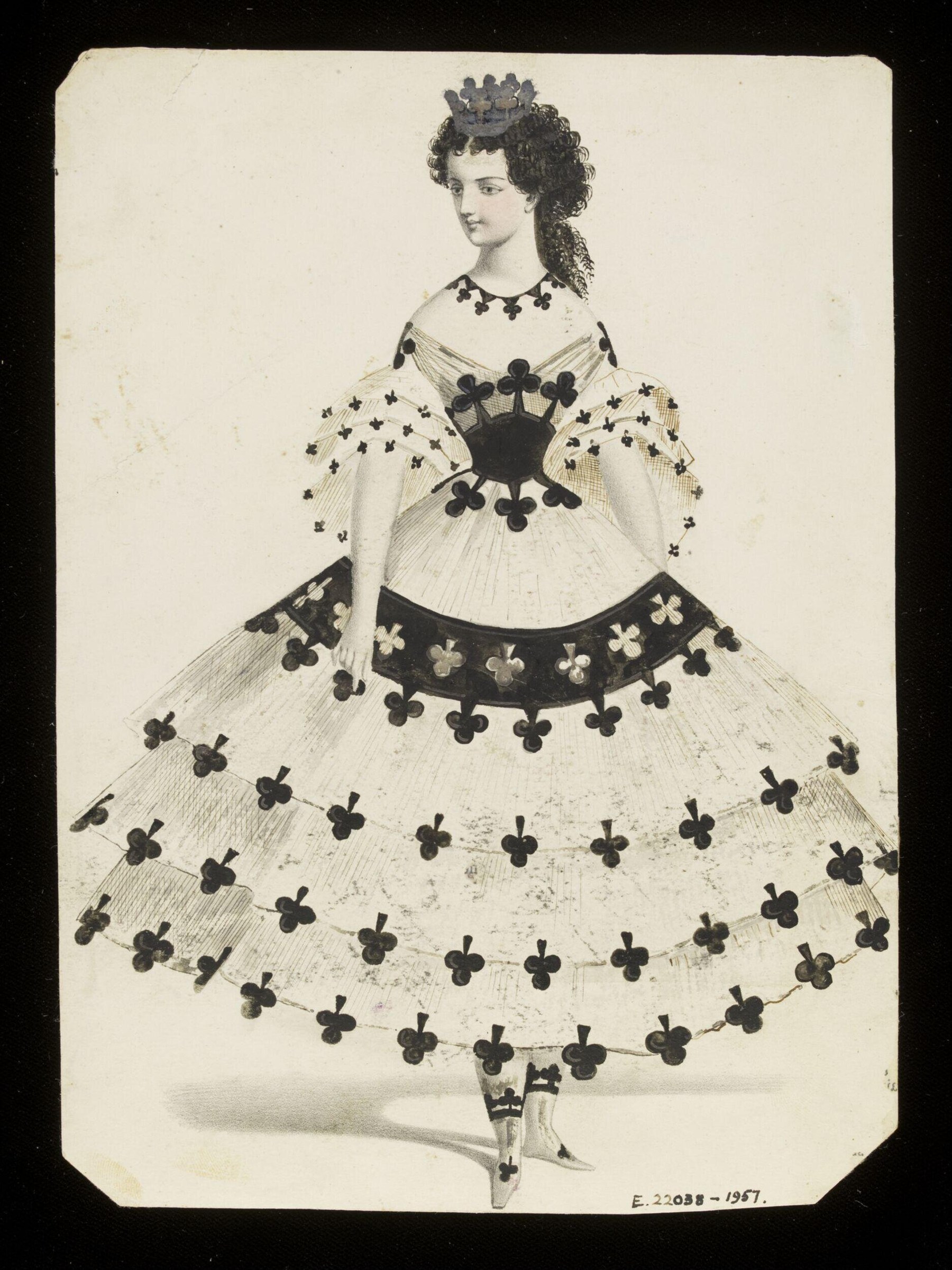
Queen of Clubs
Jules Helleu
- Collection:
- Fancy dress costume design
- Source:
- Victoria and Albert Museum
- Rights:
- Rights vary by item — check the source record before reusing this image. Source record ↗
- Recorded as:
- V&A — check rights per item
The image documents the spectacular dress codes of Victorian ballroom culture and the elaborate costumes that framed social and theatrical dance events. For historians, it reveals both the technical skill of mid-nineteenth-century fashion illustration and the specific motifs and silhouettes that defined an era of costume entertainment. For dancers and choreographers, it shows the visual vocabulary and material abundance that surrounded their practice.
What you are looking at
A single female figure in formal dress stands centered against a plain light background, posed as if for a costume design illustration. She wears an elaborate ball gown with a fitted bodice and dramatically voluminous skirt, both decorated extensively with black fleur-de-lis motifs arranged in orderly rows across white or cream fabric. The neckline is square and modest, edged with a small black ornamental border. She wears a jeweled tiara or crown on her head, and her dark hair is arranged in the fashion of the 1860s, with ringlets gathered at the back. Her posture is upright and formal, arms held naturally at her sides with hands visible at the front of the skirt. The figure is shown full-length, standing in a slight contrapposto position. At the bottom of the composition appear partial details of heeled shoes with what appears to be a small decorative element.
The dancing
The figure is static and posed rather than captured mid-movement. The body is held in an upright, formal stance typical of fashion and costume illustration of the period—weight distributed evenly, no dynamic twist or turn. The arms hang naturally, neither raised nor extended. There is no indication of active dance movement; this is a display pose designed to present the garment itself. The single figure dominates the composition entirely.
The dance depicted
This is not a dance depiction but a fancy-dress costume design, as the catalogue record states. The 'Queen of Clubs' title refers to a playing-card character suitable for masked ball or theatrical costume, not to a dancer or choreography. No dance style or movement vocabulary is evident. The garment might be worn by a performer or dancer, but the image shows only the costume itself, posed statically for viewing and potential reproduction.
How it was made
This appears to be a wood engraving or steel engraving, executed in black line on a pale ground with fine hatching and cross-hatching to indicate shading and fabric texture. The technique is characteristic of mid-nineteenth-century fashion plate and costume design illustration—a medium suited to reproduction and circulation among designers and producers. The precision of line and the systematic patterning of the fleur-de-lis motifs suggest a skilled hand practiced in technical illustration. The archival mark 'E 2202B – 1957' at lower right appears to be a cataloguing reference.
About this work
This is a design drawing for a fancy-dress costume, not a dance image proper, but it documents the garments worn in the ballroom entertainments and masquerade events of the 1860s where social and theatrical dance took place. The 'Queen of Clubs' is one of several playing-card character costumes popular in mid-Victorian fancy dress. The high level of finish and technical precision suggests this was either a designer's working drawing or a commercial pattern or inspiration sheet, intended for tailors, dressmakers, or affluent amateurs preparing costumes for balls or private theatrical events. It belongs in a dance gallery because costume, setting, and occasion are inseparable from the history of social dance and theatrical spectacle.
How to look at it
Observe the geometric precision with which the fleur-de-lis motif is repeated across the skirt—this is not naturalistic ornament but a formal pattern, the kind that signals heraldic or symbolic dress rather than everyday fashion. Note how the skirt volume is indicated through the converging vertical lines (hatching), a technique that makes the vast circumference of the garment apparent without bulk. The static pose and frontal presentation are conventions of the fashion plate, designed to display the complete silhouette and all surface decoration. The costume is meant to be read as a visual symbol (the Queen of Clubs, a playing-card character) as much as a wearable garment.
The artist
Jules Helleu (1821–1884) was a French engraver and illustrator active in the mid-nineteenth century, known for fashion plates, theatrical costume designs, and book illustrations. His work exemplifies the tradition of the fashion and costume engraving that flourished in Paris during the July Monarchy and Second Empire. He was associated with commercial publication of designs for both amateur dressmakers and professional theatrical and ballroom costume makers.
The period
The 1860s were the height of the crinoline era, when vast skirts supported by multiple petticoats or steel hoops defined fashionable dress. Fancy-dress balls and masked entertainments were major social events among the European elite and merchant classes, and costume design became both an art form and a commercial enterprise. The same decade saw the rise of professional fashion journalism and the fashion plate as a medium; publications like Le Moniteur de la Mode and similar journals circulated designs for home dressmaking and professional tailoring. In the ballroom, this was also the period of the waltz, polka, and quadrille, all of which required the dancer to navigate and display elaborate costume while moving.
Where it lives
Held in the V&A (Victoria and Albert Museum) collection as a fancy-dress costume design. The accession reference E 2202B with date 1957 suggests it was acquired or catalogued during that year; the design itself dates to 1860 or the immediate vicinity.
Questions about this work
Is this a photograph or a drawing?
This is an engraving—a print made from a metal plate incised with fine lines. You can see this from the uniform density of the black ink, the systematic hatching to create shading, and the crisp precision of every line. Engravings were the dominant medium for fashion and costume illustration in the 1860s because they could be reproduced many times from a single plate, making designs available to dressmakers and customers across Europe.
What is a 'Queen of Clubs' costume?
A playing-card character costume, part of a set of suits for fancy dress balls and masquerade events. 'Queen of Clubs' refers to one of the four court cards (spades, hearts, diamonds, clubs), and such costumes were popular in the 1860s for evening entertainments among affluent Europeans. The black fleur-de-lis and crown are heraldic symbols identifying the card suit and rank.
What would a person do in this dress?
Attend a ball or masquerade event, where she would participate in social and formal dances such as the waltz, quadrille, or polka—all of which required dancers to move through space, turn, and display their garments. The vast skirt, supported by a crinoline or multiple petticoats, would move dramatically with each step and pivot, creating a spectacular visual effect, which was part of the entertainment.
More dance artwork





