49 works in this view — arrow keys or swipe to move between them.
Dance in Art
Flower Basket
Jules Helleu
- Collection:
- Fancy dress costume design
- Source:
- Victoria and Albert Museum
- Rights:
- Rights vary by item — check the source record before reusing this image. Source record ↗
- Recorded as:
- V&A — check rights per item
For dance historians, this work documents the costume vocabulary available for fancy dress dances and theatrical balls in the 1860s, and shows how character and fantasy were conveyed through dress rather than through trained movement. The elaborate, immobile pose and the emphasis on the costume's decorative program reveal that fancy dress dancing was fundamentally a social display in which the gown itself was often more important than the steps danced.
What you are looking at
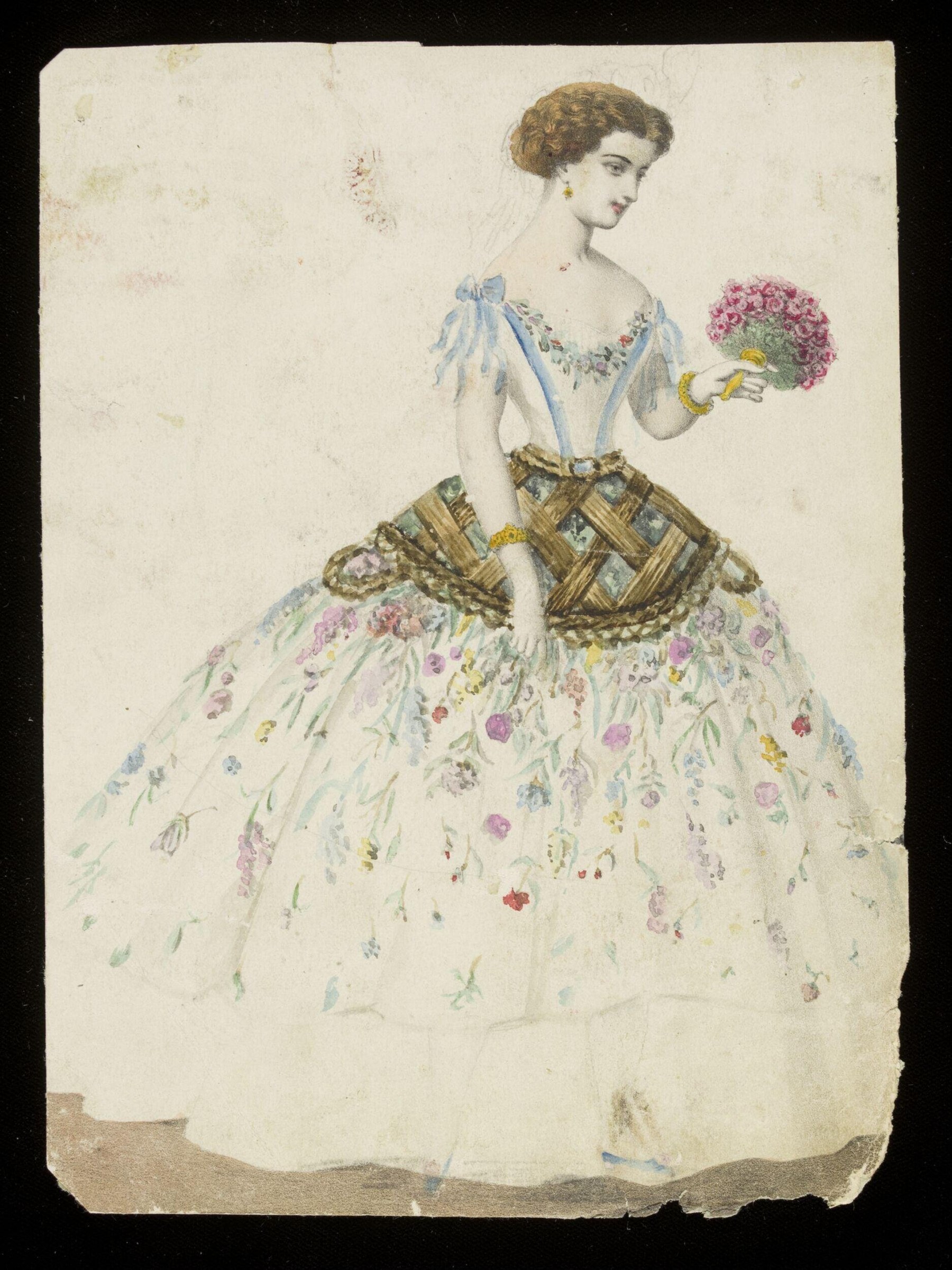
A young woman in an elegant ball gown stands in three-quarter profile, turned slightly toward the viewer's right. Her dress is the focal point: a fitted bodice in pale blue silk with delicate floral embroidery across the shoulders and neckline, cinched at the waist with a wide gold brocade belt, gives way to a voluminous skirt of ivory tulle. The skirt's most striking feature is its hem, where hundreds of small flowers—rendered in soft pinks, purples, yellows, and greens—appear to cascade downward as though the botanical abundance is spilling from the garment itself. She holds a large bouquet of pink flowers in her right hand, cradled at her hip. Her hair is styled in the fashion of the 1860s, gathered up in soft waves, and she wears a small gold earring. The background is plain cream, devoid of setting or context, which focuses all attention on the costume design itself.
The dancing
The woman stands in a relaxed, frontal pose with her weight evenly distributed—she is not dancing but displaying. Her shoulders are gently sloped, her arms soft and natural: one hangs at her side while the other holds the flowers. There is no tensile engagement in her frame, no arabesque or turnout, no evidence of balletic training in her posture. She is a model for dress, not a dancer in motion.
The dance depicted
This is not a depiction of dance but a costume design for fancy dress or theatrical masquerade. The horticultural theme—the flower-laden skirt, the bouquet, the botanical embroidery—suggests a character role, possibly 'Flora' or a flower-seller, spring maiden, or similar allegorical or comic figure from 19th-century fancy dress balls and theatrical productions. The costume is designed for display and movement through a ballroom or stage, but the pose itself is static and presentational rather than choreographic. No specific dance style is indicated.
How it was made
This is a hand-colored engraving or lithograph, likely a design drawing rather than a finished artwork for independent display. The precision of the line-work, the deliberate tinting in watercolor or gouache, and the scale suggest it is a commercial costume design—possibly for a couturier, theatrical company, or fancy dress manual. The technique allows for fine detail in the embroidery and facial features while the hand-coloring permits the vibrant botanical palette. Such designs circulated among the wealthy and theater professionals who could commission or purchase elaborate costumes.
About this work
This is a costume design by Jules Helleu catalogued as *Flower Basket*, dated 1860, representing a fancy dress or theatrical costume rather than a documented dance. The work exemplifies the Victorian passion for elaborate fancy dress balls and the theatrical imagination applied to women's costume in the mid-19th century. The image shows a woman in an extraordinarily decorated gown where the costume itself is the subject—the flowers that form the hem and ornament the bodice are not merely applied but are the conceptual center of the design. Helleu, active in theatrical and fashion circles in the 1860s–1870s, designed costumes that merged high fashion with theatrical artifice, and this work belongs to that tradition of costume as wearable art and storytelling.
How to look at it
Examine the relationship between structure and decoration: the rigid, corseted bodice contrasts sharply with the flowing, naturalistic quality of the flower hem. The flowers appear almost detached from the garment—they seem to grow from it or fall away from it rather than being sewn onto it. This visual surprise, the sense that the costume is almost alive or about to shed its botanical burden, is the conceptual wit of the design. The woman's serene, upright posture and her bouquet create a unified theme: this is a woman made of, or emerging from, flowers—a fantasy of nature and femininity.
The artist
Jules Helleu (1821–1884) was a French artist and lithographer known for fashion illustrations, costume designs, and theatrical work. He contributed to the theatrical and fashion press and created costume designs for stage and fancy dress occasions. His work bridges fine art and commercial design; his lithographs and drawings circulated widely among the upper-middle and aristocratic classes who frequented Paris theatres and participated in fancy dress culture.
The period
The 1860s saw the apex of the Victorian fancy dress ball—an aristocratic and upper-middle-class amusement in which guests commissioned elaborate, often fantastical costumes and attended masked or allegorical balls. Simultaneously, theatrical production was expanding and professional costume design was becoming a recognized specialty. The Romantic ballet had established the white tutu and ethereal aesthetic as the model for female dance dress; fancy dress design adapted and exaggerated these conventions for non-dance contexts, often with comic or allegorical intent. Helleu's costume designs reflect both the ballroom and the theatre.
Where it lives
The work is catalogued as a fancy dress costume design held in the Victoria and Albert Museum's collection. It is one of many theatrical and costume design drawings in the museum's holdings, indicating it was considered a significant design document worthy of institutional preservation.
Questions about this work
Is this a real person or a character?
The figure is a character or type—a flower-maiden, possibly named 'Flora'—rather than a portrait of an individual woman. The work is a design document showing how the costume would appear when worn.
Could someone actually dance in this dress?
The voluminous tulle skirt with a weighted, flower-laden hem would be unwieldy and restrictive. The costume is designed for walking, posing, and minimal movement in a ballroom or on stage. It prioritizes visual impact over mobility.
What is the difference between this and a ballet costume?
Ballet costumes of the same era were designed to allow the dancer's body and its lines to be visible and to support technical movement. This fancy dress costume obscures the body beneath the skirt and uses decoration as its primary language, not movement.
Why does the title say 'Flower Basket' when she is holding a bouquet?
The title may refer to the overall effect—the woman as a living flower basket, or the skirt as a basket from which flowers spill. Alternatively, it may be a translation or archival variant of the original title.
More dance artwork





