49 works in this view — arrow keys or swipe to move between them.
Dance in Art
Fancy dress costume design
Leon Sault
- Collection:
- Fancy dress costume design
- Source:
- Victoria and Albert Museum
- Rights:
- Rights vary by item — check the source record before reusing this image. Source record ↗
- Recorded as:
- V&A — check rights per item
Costume design drawings like this reveal the material and visual world in which social and theatrical dance took place. The extreme decoration and historical pastiche suggest the themes, silhouettes, and labor involved in creating costumes for masquerades and fancy-dress balls, events that were central to 19th-century social dancing. The presence of clock motifs and the theatrical excess point to the period's love of visual spectacle and historical fantasy in dance contexts.
What you are looking at
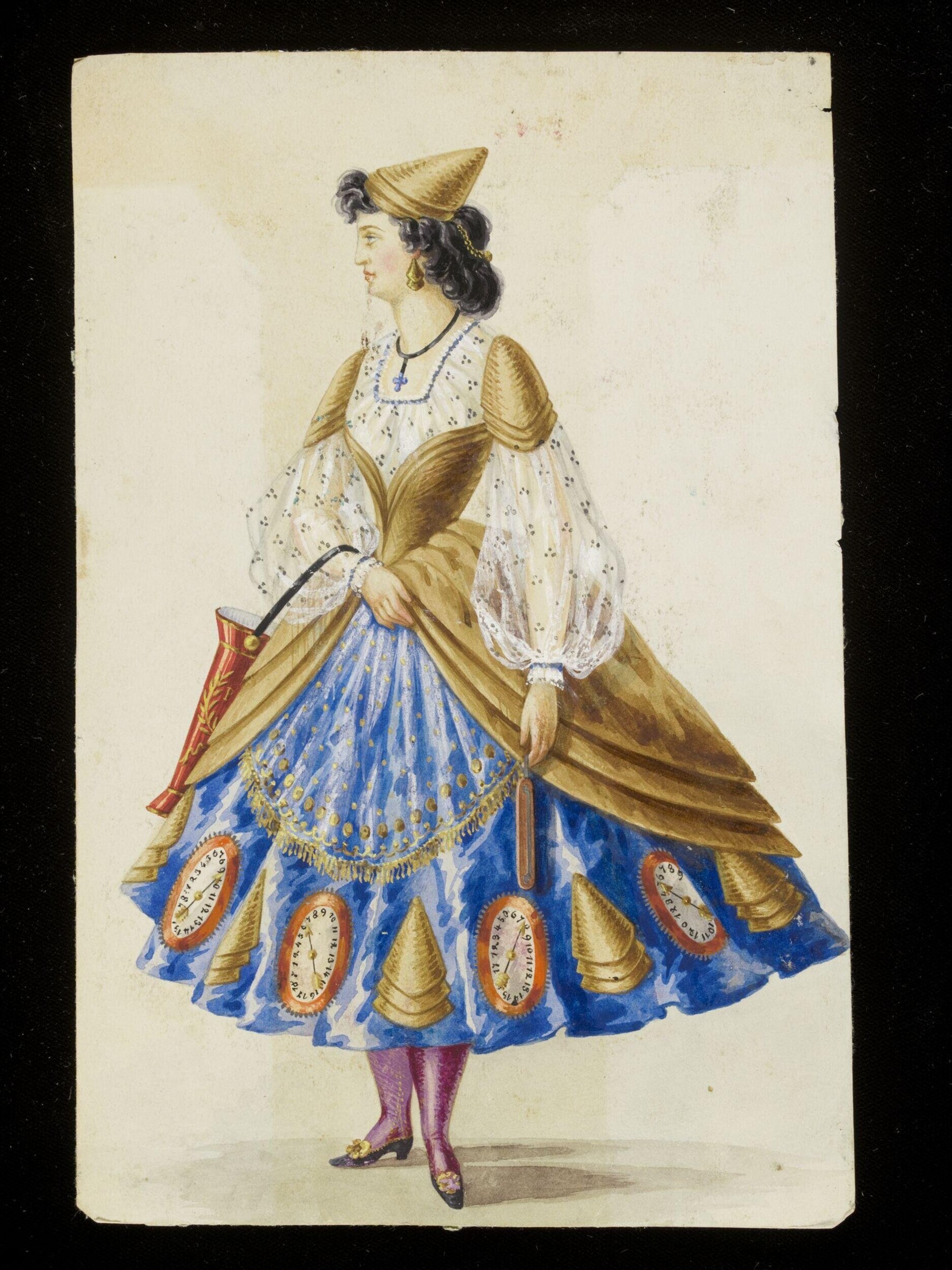
A single elegantly dressed woman stands in three-quarter profile against a pale ground, wearing an elaborate costume of the 1860s. Her ensemble combines a white chemisette or underdress with dense embroidered or printed detail, worn beneath a sleeveless overjacket of golden-tan silk. The overjacket is draped to reveal the skirt, which dominates the composition: a voluminous bell-shaped garment in bright cobalt blue, decorated with a pattern of golden cone or shell motifs and adorned with red-bordered ovals containing what appear to be clock faces or dials arranged in a symmetrical scatter across the fabric. The woman wears a tall golden pointed hat—a poulaine or similar fancy-dress headdress—and pulls the draped golden cloak or shawl at her side with her right hand. Her left hand rests against the gathered skirt. She wears burgundy stockings and small golden shoes. A folded parasol or fan of red and gold hangs at her side.
The dancing
A single standing figure, shown full-length. The pose is static, frontal yet turned slightly to one side, with weight evenly distributed. The right arm drapes the cloak in a casual hold; the left hand gathers the skirt fabric. There is no active stepping or weight transfer visible. The figure is isolated against the background, presented as a costume study rather than a figure in motion or interaction with others.
The dance depicted
This is not a depiction of dance, but rather a costume design study, almost certainly for masquerade or fancy dress of the Victorian period. The elaborate, theatrical dress—particularly the anachronistic pointed hat, the fantastical clock-face motif on the skirt, and the dramatic color and silhouette—suggests a historical fancy-dress costume or a character costume for theatrical presentation, possibly drawing on Renaissance or medieval silhouette. The figure is presented as a static model displaying the garment, not as a dancer or in a moment of dance.
How it was made
This is a hand-colored drawing or watercolor on paper, executed with fine linear precision and delicate color work. The technique shows controlled hatching in brown or sepia ink for the golden fabrics, careful washes of blue and red, and precise line work defining the embroidered details on the white chemisette. The style and medium suggest a professional costume design or fashion illustration, likely intended for reference or publication, and typical of 19th-century costume design practices. The hand-coloring indicates this was a finished document rather than a preliminary sketch.
About this work
This is a costume design drawing by Leon Sault from around 1860, presenting a single fancy-dress costume in meticulous detail. It is not a dance image per se, but rather a costume study—a professional design document of the kind prepared for masquerade, theatrical, or carnival wear. The work demonstrates the Victorian fascination with historical fancy dress and theatrical costume, executed in the watercolor-and-ink technique standard to 19th-century fashion and costume illustration. It belongs in a gallery of dance in art because fancy dress and masquerade were integral to the social dance culture of the period, and such designs document the visual culture surrounding those events.
How to look at it
This is a costume display drawing, not an action scene, so the viewer should attend to what is shown: the precision of the embroidered or printed decoration on the chemisette, the bold geometric rhythm of the clock-face motifs on the skirt, the color contrasts, and the overall silhouette and scale. The artist has chosen a static, frontal pose to display the costume fully and symmetrically. Notice how the drooping golden cloak and the gathered skirt are arranged to show off the elaborate blue ground and the decorative patterns—the focus is on visual effect and material richness, not on the body or its movement.
The artist
Leon Sault is recorded as a costume designer active in mid-19th-century Paris or France. Little is documented about his broader practice or training in standard sources. The precision and professional finish of this drawing suggest he was an experienced designer producing work for commercial or courtly use. His focus on elaborate fancy-dress and historical costume is typical of the period's costume industry.
The period
The 1860s saw a peak in the popularity of masquerade balls and fancy-dress events among European aristocracy and upper-middle classes. These gatherings were central social occasions combining music, dancing, and theatrical spectacle. Costume designers like Sault were in demand to create historically-themed or fantastical dress for participants. The silhouette here—the full skirt and waisted bodice—reflects the crinoline fashion of the 1860s itself, while the historical headdress and narrative motifs (the clock faces) layer theatrical and fantastical meaning onto contemporary dress. Watercolor costume designs were standard tools of the trade, produced for clients and often kept as records of designs executed.
Where it lives
The drawing is recorded as held in a collection labeled 'Fancy dress costume design,' with attribution to the VA (Victoria & Albert Museum, London). It is a professional costume design document of the type that would have been produced for reference or client approval.
Questions about this work
Is this a depiction of dance?
Not directly. It is a costume design study for fancy dress or masquerade wear, which contextualizes it within the social and theatrical dance culture of the 1860s. The drawing shows the garment, not the dancer or the dancing; it is a document of the material world in which dance took place.
What are the clock faces on the skirt?
They appear to be part of the decorative motif—possibly a whimsical or symbolic element chosen by the designer, or they may reference a narrative or theme associated with the specific masquerade event or costume concept. Such fantastical decorations were typical of fancy-dress costume design.
Who was Leon Sault?
A mid-19th-century costume designer, recorded as active around 1860. Details of his training, clientele, and career are not widely documented, though the quality of his surviving work indicates he was a professional operating at a sophisticated level.
What collection is this in?
The record indicates it is held in the Victoria & Albert Museum (VA), London, in their collection of costume design drawings and fancy-dress designs.
More dance artwork





