49 works in this view — arrow keys or swipe to move between them.
Dance in Art
Fortune Teller
Léon Sault
- Collection:
- Fancy dress costume design
- Source:
- Victoria and Albert Museum
- Rights:
- Rights vary by item — check the source record before reusing this image. Source record ↗
- Recorded as:
- V&A — check rights per item
For dance historians and costume specialists, this work is valuable evidence of how mid-19th-century entertainment defined and visualized the 'fortune-teller' character type through costume synthesis—showing how European ballroom dress was combined with invented 'exotic' signifiers to create a recognizable theatrical persona. The work also illustrates the commercial infrastructure of costume design and fancy-dress culture, demonstrating that such designs were produced as commercial prints for public consumption, not merely bespoke creations. Understanding such visual documentation is essential to reconstructing what participants in 19th-century balls and entertainments actually wore and how they imagined and performed character.
What you are looking at
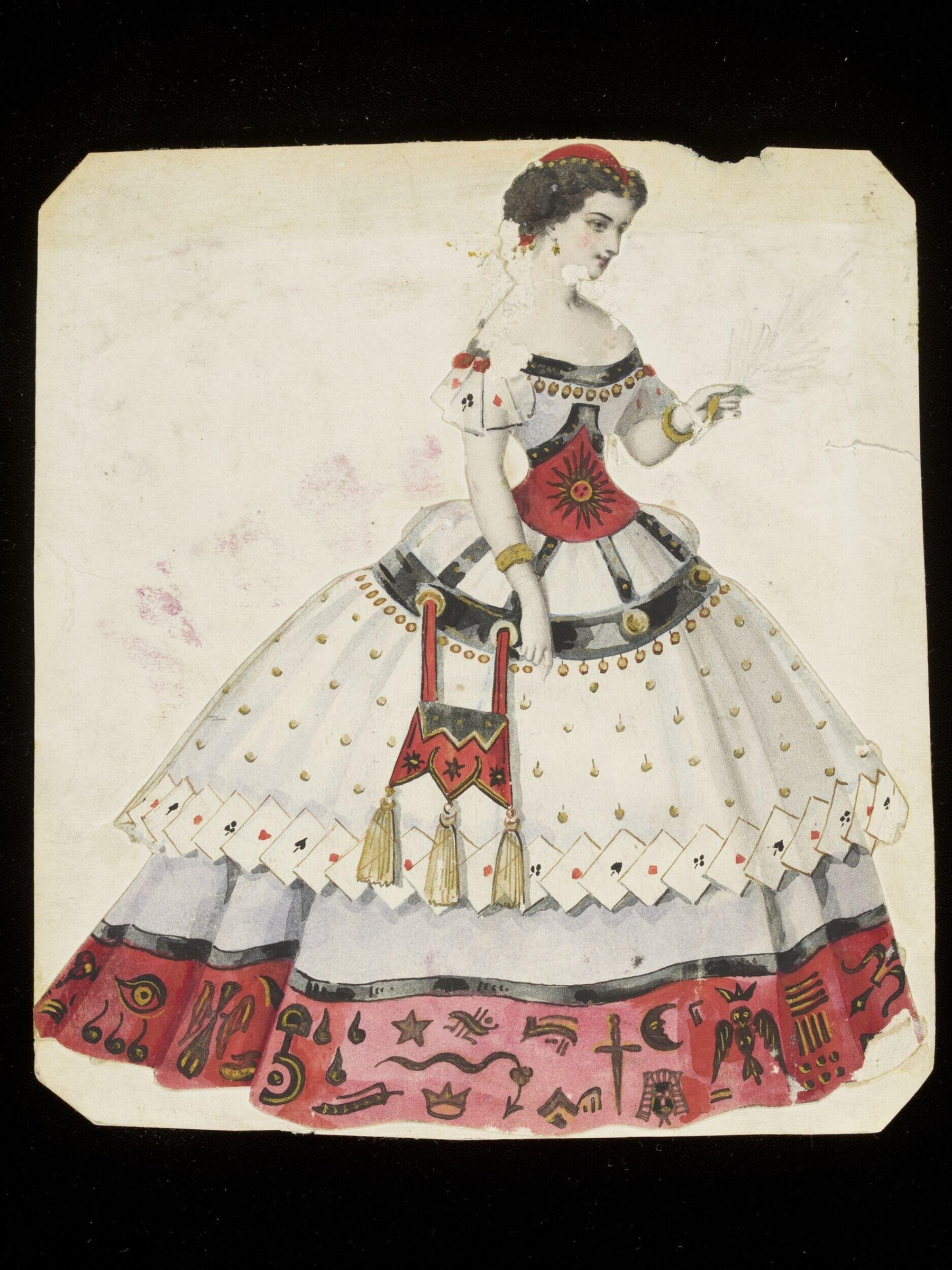
A young woman in elaborate fancy dress stands alone against a plain background, posed in profile facing right. She wears an ornate costume that mixes theatrical and orientalist references: a red headband or tiara, a white short-sleeved jacket with red diamond patterns and gold trim, and a corset or belt in black and red with gold studs and ornamental tassels. The dominant feature is an enormous skirt of white fabric printed with small playing-card suits (hearts, diamonds, clubs, spades), layered and scalloped at the hem. Over this sits a deep red underskirt or petticoat printed with occult and heraldic symbols—stars, moons, crosses, crowns, castles, and unidentified emblems rendered in darker red and gold. A drawstring purse in red leather with gold tassels hangs from her waist. Her right hand is extended as if gesturing or offering; her left hand rests near her body. The composition is vertical and centered, emphasizing the costume's construction and decorative density rather than any moment of movement. The work appears to be a hand-colored print or lithograph on cream paper, with evidence of age and handling.
The dancing
A single standing figure, not in active dance position. Her posture is upright and still, the extended right hand suggesting a theatrical or presentational gesture rather than a dance hold or frame. The stance is frontal in intention but turned slightly to show the profile, a convention of costume design documentation. There is no partnering, no weight shift into movement, and no indication of footwork. The gesture reads as aristocratic presentation or tableau rather than kinetic action—the hand extended as if to tell fortunes or address an audience.
The dance depicted
This is not a depiction of dance but rather a costume design or fashion plate for a fancy-dress ball or theatrical entertainment. The 'Fortune Teller' title indicates a character from 19th-century masquerade or theatrical tradition, where fortune-telling was a popular entertainment persona combining orientalist mystique with playing-card imagery (the tarot or fortune-telling association). The costume synthesizes European ballroom fashion (the voluminous skirt, fitted bodice) with invented 'exotic' elements (headband, occult symbols) typical of how Western entertainment imagined the fortune-teller. No actual dance style is shown; the work documents costume and character type rather than movement or technique.
How it was made
The work appears to be a hand-colored lithograph or engraving, likely a commercial print for a costume pattern or fancy-dress catalogue. The precision of the line work, the flat color application, and the cream paper support this reading. Hand-coloring is evident in the way the reds, golds, and greens sit on the surface without gradation. Such prints were circulated widely in the mid-19th century to inspire costume choices for public balls and private entertainments, making this an artifact of how costume was distributed and consumed by the middle and upper classes. The technique allowed rapid reproduction and accessibility, suggesting this design was intended for wide circulation among people planning fancy-dress events.
About this work
This is a costume design document from 1860 by Léon Sault, recording the outfit for a 'Fortune Teller' character type for fancy-dress masquerade or theatrical entertainment. It is not a dance image but a fashion plate or costume blueprint, now held in the V&A collection as part of its record of theatrical and fancy-dress history. The work sits at the intersection of fashion history, entertainment culture, and the 19th-century Western fantasy of the 'exotic' fortune-teller—a figure that synthesizes playing-card symbolism, orientalist costume, and ballroom silhouette.
While the figure does not dance, the costume itself was designed to be worn in ballroom or theatrical contexts where movement would occur. The work thus documents both the visual language of a popular entertainment persona and the material culture of how costumes for such characters were designed, produced, and circulated among the urban public.
How to look at it
Attend first to the sheer density and surface detail of the costume: the artist has invested as much visual information as possible in the printed fabrics, ornaments, and accessories, showing that this is a design that promises visual impact and complexity. The standing pose, though static, is carefully composed to display the full costume from multiple angles—the profile shows the silhouette and the scalloped hem; the frontal orientation shows the breast and arms. Note how the artist has used the white playing-card-printed skirt as a visual field on which to organize information, and how the red underskirt with its darker symbols provides contrast and visual weight. The extended hand is not accidental: it signals the theatrical or mystical persona the costume is meant to evoke. This is documentation designed to be legible and instructive to someone who will execute or wear the costume, not a moment of performance frozen in time.
The artist
Léon Sault (documented 1860) appears as a costume designer working in the mid-19th-century commercial print tradition. No substantial biographical record is immediately available, but the formal attribution and commercial quality of the work suggests he was an established designer whose work was reproduced and distributed through print markets. The work exemplifies the 19th-century genre of the costume-design print, where artists specialized in creating saleable designs for fancy-dress entertainments, theatrical productions, and private balls. Such designers were often anonymous or semi-anonymous commercial figures rather than fine artists, though their work shaped the visual culture of entertainment.
The period
The 1860s saw the height of fancy-dress ball culture among European and American urban elites, particularly in London and Paris. These balls were highly orchestrated entertainments where elaborate costumes conveyed character, historical reference, or fantasy. The 'fortune-teller' or 'gypsy' costume was a stock type—instantly recognizable, easily assembled, and allowing the wearer to adopt a persona associated with mystique and transgression. Simultaneously, orientalism in Western art and fashion was at its height; costumes that mixed 'exotic' elements with European silhouettes were fashionable among those wanting to signal cosmopolitan taste. The playing-card imagery (suggesting tarot) reflected both popular interest in spiritualism and the game of chance as a form of entertainment. Lithographic costume-design prints like this one were the mass-market equivalent of bespoke costume commissions, democratizing access to fashionable costume ideas.
Where it lives
The work is held by the V&A (Victoria and Albert Museum, London) as part of its collection of costume designs and fancy-dress ephemera. The V&A's holdings in this area document 19th-century commercial costume design and the material culture of theatrical and social entertainment. Such designs were typically stored or discarded after use, making surviving examples valuable records of how costumes were visualized and communicated in this period.
Questions about this work
Is this a painting or a print?
The work appears to be a hand-colored lithograph or engraving, a mass-produced commercial print designed for circulation. The crisp line work, flat color application, and cream paper support this reading. Such prints were the standard way costume designs were distributed to the public in the 19th century.
What is the fortune-teller costume actually supposed to represent?
It synthesizes European ballroom silhouette (the fitted bodice and voluminous skirt characteristic of 1860s fashion) with invented 'exotic' and mystical signifiers: the headband, the occult symbols on the underskirt, and the playing-card imagery suggesting tarot or divination. The costume allows the wearer to adopt a persona associated with mystery and transgression, a popular role for fancy-dress entertainment.
Who would have worn this costume?
Typically a woman at a fancy-dress ball or theatrical performance, most likely from the middle or upper classes who had access to such events and could afford or commission elaborate costumes. The commercial distribution of designs like this suggests that such balls were significant social occasions with widely shared aesthetic conventions.
Why are the playing cards and symbols so prominent?
They function as shorthand for the 'fortune-teller' character type: playing cards invoke both gambling and divination (tarot), while the occult symbols (stars, moons, crosses) reinforce the persona of someone associated with mystical knowledge. Together they make the character instantly legible to viewers at a ball or performance.
More dance artwork





