49 works in this view — arrow keys or swipe to move between them.
Dance in Art
Fancy dress costume design
Léon Sault
- Collection:
- Fancy dress costume design
- Source:
- Victoria and Albert Museum
- Rights:
- Rights vary by item — check the source record before reusing this image. Source record ↗
- Recorded as:
- V&A — check rights per item
Costume designs reveal the material reality of 19th-century performance—the weight, structure, and visual language that dancing bodies inhabited. This work documents the scale and complexity of theatrical dress during an era when costume design was a specialized and respected craft, and shows how fancy dress traditions created visual spectacle through construction rather than through movement alone.
What you are looking at
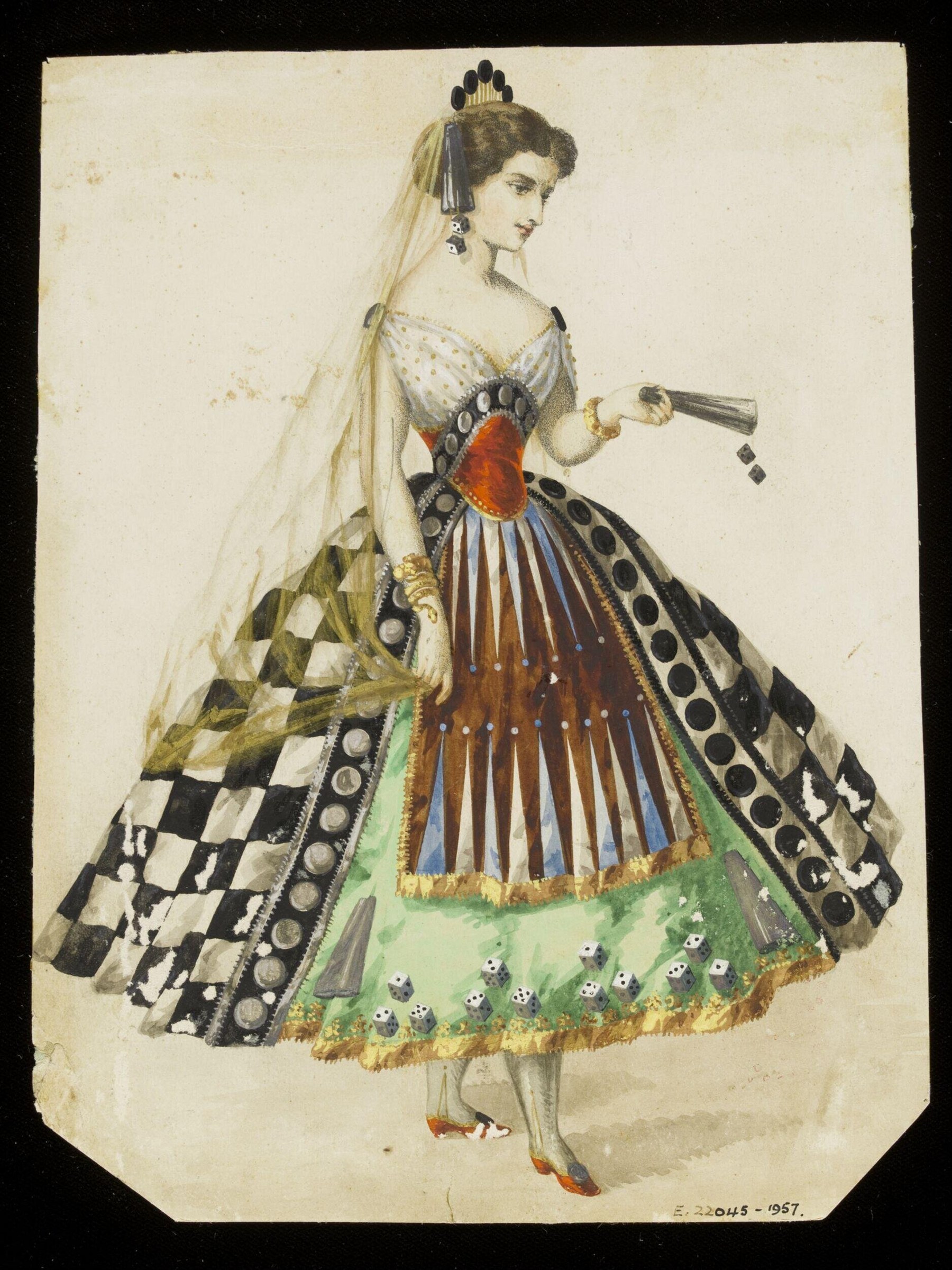
A single elegantly dressed woman stands in three-quarter view against a plain background, her body angled to present the full grandeur of her costume. She wears an ornate ball gown with a fitted bodice in coral-red silk adorned with dark jeweled buttons, paired with a voluminous skirt of extraordinary visual drama: the skirt's upper panels are rendered in warm brown with radiating pleated sections like a fan, while the lower portion features a bright spring green base densely scattered with small white dice motifs and gold trim. A sheer yellow veil cascades from an ornamental headdress down her back. She holds a closed fan in her right hand and wears a long emerald earring. Her expression is composed and her pose static—this is a presentation of costume rather than a moment of movement. The meticulous hand-coloring and fine linework suggest this is a design document created to communicate the precise construction and color relationships of the garment.
The dancing
The single figure stands in a relaxed contrapposto stance with minimal weight shift, her body presented frontally for optimal viewing of the costume's complex construction. There is no dynamic gesture or movement quality in her posture. Her arms hang naturally at her sides, with the right hand holding a closed fan as an accessory rather than as evidence of an active moment. The figure's stillness and formal presentation suggest this is a costume study rather than a depiction of an actual dance or performance moment.
The dance depicted
This appears to be a costume design for theatrical or carnival fancy dress rather than documentation of any specific dance tradition. The dice-patterned skirt and elaborate layering suggest a character costume, possibly for masquerade or theatrical performance in the 1860s tradition of French fancy dress spectacles. The absence of any dynamic movement, partnering, or spatial context makes it impossible to identify a specific dance form. This is costume design as object—a blueprint for making, not a record of dancing.
How it was made
This is a hand-colored drawing or lithograph on aged paper, executed in ink with careful hand-coloring in watercolor or gouache. The technique is characteristic of 19th-century fashion and costume design documentation, where precise line work captures construction detail while selective hand-coloring communicates color relationships and material richness to a maker or customer. The aging and archival marks on the paper suggest this was a working document intended for circulation among dressmakers, designers, or theatrical costume shops rather than a fine art print for display.
About this work
This is a costume design drawing by Léon Sault dated 1860, presenting an elaborate ball gown or fancy dress costume in meticulous detail. The work documents theatrical dress of the mid-19th century French tradition, in which elaborate costumes combined historical references, allegorical symbolism (the dice), and spectacular construction techniques. It belongs in a dance archive not because it depicts dancing but because costume design is inseparable from dance history: how performers dressed shaped what bodies could do, and these designs are evidence of the theatrical and social contexts in which 19th-century dancers moved.
How to look at it
Attend to the costume's construction logic: how the different fabric panels and decorative elements (the dice, the pleated sections, the jeweled buttons) work together to create visual impact. Note that this is a static presentation—the figure is posed to show the costume, not to suggest movement. The hand-coloring technique uses selective bright tones (the red bodice, the green skirt, the yellow veil) to guide the eye to the most visually complex and important elements, showing the designer's priorities in communicating the costume's effect.
The artist
Léon Sault was a 19th-century French costume and design artist active in Paris during the period of romantic ballet and grand opera. He worked in the tradition of specialized theatrical costume designers whose drawings and designs were distributed to professional makers and performers. His practice was documentary and prescriptive: to capture and communicate the maker's intent with precision.
The period
The 1860s were a moment of transition in theatrical dance and costume. Romantic ballet had given way to the grand spectacular pantomime-ballets and operas of the Second Empire, in which costume and set design were central attractions. The fashion for fancy dress balls—elaborate masked entertainments among the wealthy—created demand for theatrical costume design. This drawing belongs to that tradition of spectacular dress rather than to the history of technique-based dance forms.
Where it lives
The work is held in the Victoria and Albert Museum (VA) collection, catalogued as a fancy dress costume design. The archival mark "E.22045 -1957" visible at the bottom of the image indicates its accession. It is one of many such design drawings in the collection, which holds significant examples of 19th-century French and English theatrical and fancy dress design.
Questions about this work
Is this a drawing of an actual dancer performing?
No. This is a costume design—a blueprint for making a garment. The figure is posed statically to display the costume's construction and color scheme. The artist's purpose was to communicate design intent to a dressmaker or costumer, not to depict dancing.
What are the dice on the skirt for?
The dice motif suggests this costume was for a character or allegorical fancy dress ensemble, possibly representing chance, fortune, or gaming—common themes in 19th-century masquerade culture. Fancy dress costumes often incorporated symbolic or playful visual references.
Why is this in a dance archive if there's no dancing?
Costume design is foundational to dance history. What dancers wore, how garments were constructed, and what visual effects costumes created directly shaped the history of movement and performance. This design is evidence of the theatrical and material culture that surrounded 19th-century dance.
More dance artwork





