49 works in this view — arrow keys or swipe to move between them.
Dance in Art
Fan
Sault, Léon
- Collection:
- Fancy dress costume design
- Source:
- Victoria and Albert Museum
- Rights:
- Rights vary by item — check the source record before reusing this image. Source record ↗
- Recorded as:
- V&A — check rights per item
This work documents the visual culture of theatrical fancy dress and masquerade costume at a moment when dance spectacle and costume design were becoming increasingly integrated into urban entertainment. It shows how designers thought about and presented fantastical, character-based costumes, and reveals the imaginative and technical standards expected of costume work in the mid-19th century.
What you are looking at
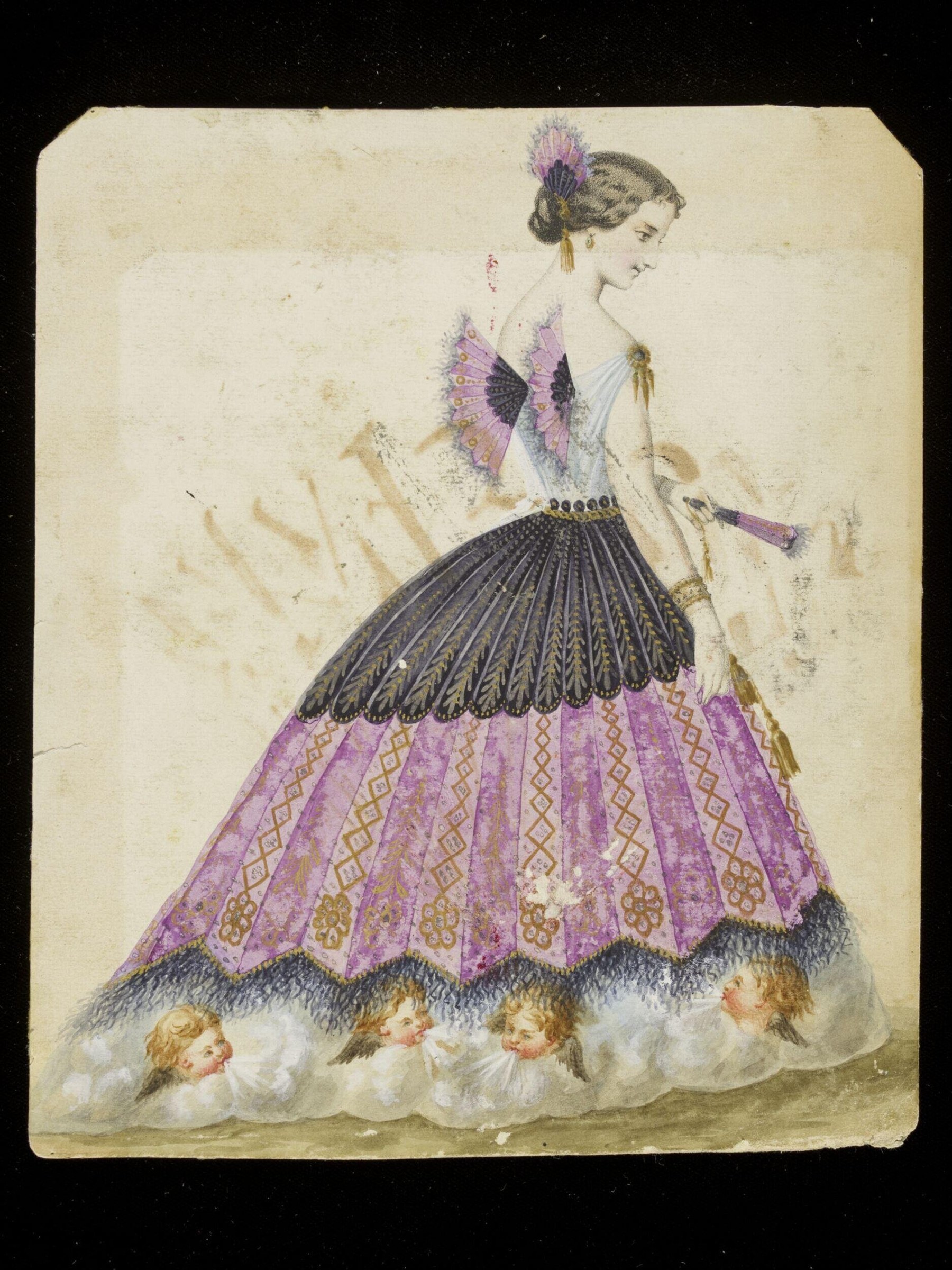
A tall woman in an elaborate costume stands in profile against a cream background, her body poised in an elegant contrapposto stance. She wears a white bodice with purple butterfly-wing sleeves edged in black, and an extraordinary skirt composed of black feathered segments forming a fan-like arrangement, overlaid with purple silk panels decorated with gold geometric patterns and topped with a black fringe. Her hair is styled in an upswept arrangement secured by a purple feathered ornament, and she holds a purple fan. At the base of her skirt, emerging from beneath the hem, are the faces of four golden-haired putti or cherub heads, their features rendered in delicate detail. The composition is that of a fashion or costume design rather than a narrative scene—the figure is presented as a spectacle, a vision of theatrical fancy dress rather than a moment of action.
The dancing
The woman's weight rests on one leg in a relaxed classical pose, her torso slightly angled and her gaze directed downward in a profile that emphasises her refined features and elongated neck. Her arms are positioned naturally, one holding the fan, the body utterly still and composed. There is no dance movement visible—this is a standing presentation of costume design, the figure treated as a model or mannequin displaying the garment rather than embodying physical gesture.
The dance depicted
This is not a representation of dance in motion, but rather a costume design, likely for fancy dress or theatrical masquerade. The butterfly and feathered wings, the ornamental fan, the cherub-adorned hem, and the overall exuberant fantastical dress suggest a allegorical or imaginative figure—perhaps a personification or mythological character—intended for a costume ball or theatrical spectacle. The work documents fashion and fancy costume rather than a specific dance practice or style. The static, presentation-focused composition is typical of costume design sheets from the period.
How it was made
This is a hand-coloured drawing or watercolour, likely gouache or watercolour on paper, executed with considerable delicacy and precision. The gold patterning on the skirt panels and the metallic details on the butterfly wings show the use of metallic pigments or gold leaf. The technique allows for fine detail in the face and hair, while the shading suggests three-dimensionality in the fabric draping. The work was executed with the careful finish expected of a design sheet intended for presentation to a patron or theatrical producer, a common practice in 19th-century theatrical and fashion design.
About this work
This is a fancy-dress costume design attributed to Léon Sault and dated 1860, presenting an imaginative allegorical or theatrical figure rendered in the refined manner of mid-Victorian costume design. The work sits between fashion illustration and theatrical design, documenting the period's enthusiasm for elaborate masquerade costumes and the visual language used to present them. It belongs in a dance gallery not as a record of choreographed movement, but as evidence of the theatrical, fantastical contexts in which dance and costume spectacle intersected in 19th-century urban entertainment.
The work exemplifies how costume design was visualised and communicated to producers, dancers, and patrons in the 1860s. The static, frontal presentation of the figure, combined with the meticulous rendering of fabric, pattern, and ornament, was the standard convention for such designs. This is not a sketch made during rehearsal or a snapshot of performance; it is a finished design document intended to communicate a complete vision.
How to look at it
Attend first to the moment frozen here: this is not movement, but stillness and display. The figure is presented as a vision or apparition, not as a dancer caught mid-gesture. Look at the meticulous rendering of the feathered skirt—the parallel lines that suggest the barbs of feathers, the shading that gives them weight and dimension. The cherub heads at the base are the most surreal element; their presence transforms the skirt from mere costume into a vehicle for fantasy and allegory. The profile view and downward gaze are classical conventions used to present the figure as noble, refined, and worthy of contemplation.
The artist
Léon Sault was a 19th-century French costume designer and illustrator. His practice was centred on the design and presentation of theatrical and fancy-dress costumes, a role that placed him at the intersection of fashion, theatre, and visual culture. Costume designers of this period occupied a crucial position in theatrical production, responsible not only for creating garments but for visually conceptualising character and narrative. Sault's work exemplifies the refined draughtsmanship and attention to textile detail expected of designers working for the Parisian theatrical and society markets.
The period
The mid-19th century saw a sustained enthusiasm for theatrical fancy dress, masquerade balls, and costume spectacle among urban elites. The 1860s marked a period of particular exuberance in theatrical costume design, driven by the expansion of commercial theatre and the rise of large-scale public entertainments. Costume designers became celebrated artists in their own right, and the presentation of costume designs—as finished, hand-coloured drawings—became an important art form. The aesthetic visible here—the eclecticism, the decorative abundance, the fantasy elements drawn from nature (wings, feathers, cherubs)—was characteristic of the period's romantic and theatrical sensibility.
Where it lives
The work is held as part of a collection of fancy dress costume designs. The source designation 'va' likely refers to a visual arts collection or archive. This appears to be a design sheet produced for presentation and reference, part of a tradition of costume documentation intended for theatrical producers, dancers, or wealthy clients commissioning costumes for private fancy-dress events.
Questions about this work
Is this a design for an actual dance costume, or pure fantasy?
It is almost certainly a design for a fancy-dress costume to be worn at a masquerade ball or theatrical spectacle, rather than for a choreographed dance. The static pose, the presentation format, and the imaginative allegorical character all suggest this is costume design for display and spectacle. Dancers at such events would have worn these costumes while performing social dances or moving through formal entertainments, but the costume itself was not designed for a specific choreography.
What do the cherub heads at the base of the skirt mean?
They are a decorative allegory, transforming the costume into a fanciful, heavenly vision. This kind of playful inclusion of mythological or cherubic elements was common in 19th-century fancy dress, especially designs for masked balls or theatrical spectacles. The cherubs may suggest the wearer is a celestial or magical being, or simply add whimsy and visual spectacle.
Why is the figure so still and posed?
This is a presentation drawing, not a representation of dance in motion. The still, profile pose is a convention of fashion and costume design—it allows the viewer to see the complete costume clearly and assess its silhouette, decoration, and overall effect. The refined, classical pose suggests elegance and status.
How would someone actually move in this costume?
With considerable difficulty. The feathered skirt, while visually spectacular, would restrict leg movement. The costume was designed primarily for visual impact and display at a stationary or slowly-moving event—a receiving line at a ball, a procession, or tableau vivant—rather than for energetic dancing. The elaborate fan and wing construction would require the wearer to be conscious of managing the costume's dimensions as they moved.
More dance artwork





