49 works in this view — arrow keys or swipe to move between them.
Dance in Art
Hell
Leon Sault
- Collection:
- Fancy dress costume design
- Source:
- Victoria and Albert Museum
- Rights:
- Rights vary by item — check the source record before reusing this image. Source record ↗
- Recorded as:
- V&A — check rights per item
For theater historians and designers, this drawing is evidence of how mid-Victorian spectacle encoded moral and infernal figures through color, ornament, and silhouette. For dance scholars, it documents the visual context in which dancers moved—the costume framework that shaped how a body could be seen and what stories it could tell. The precision of the design work and the theatrical provenance of the collection suggest this was a working drawing, making it a record of actual production practice rather than a flight of fancy.
What you are looking at
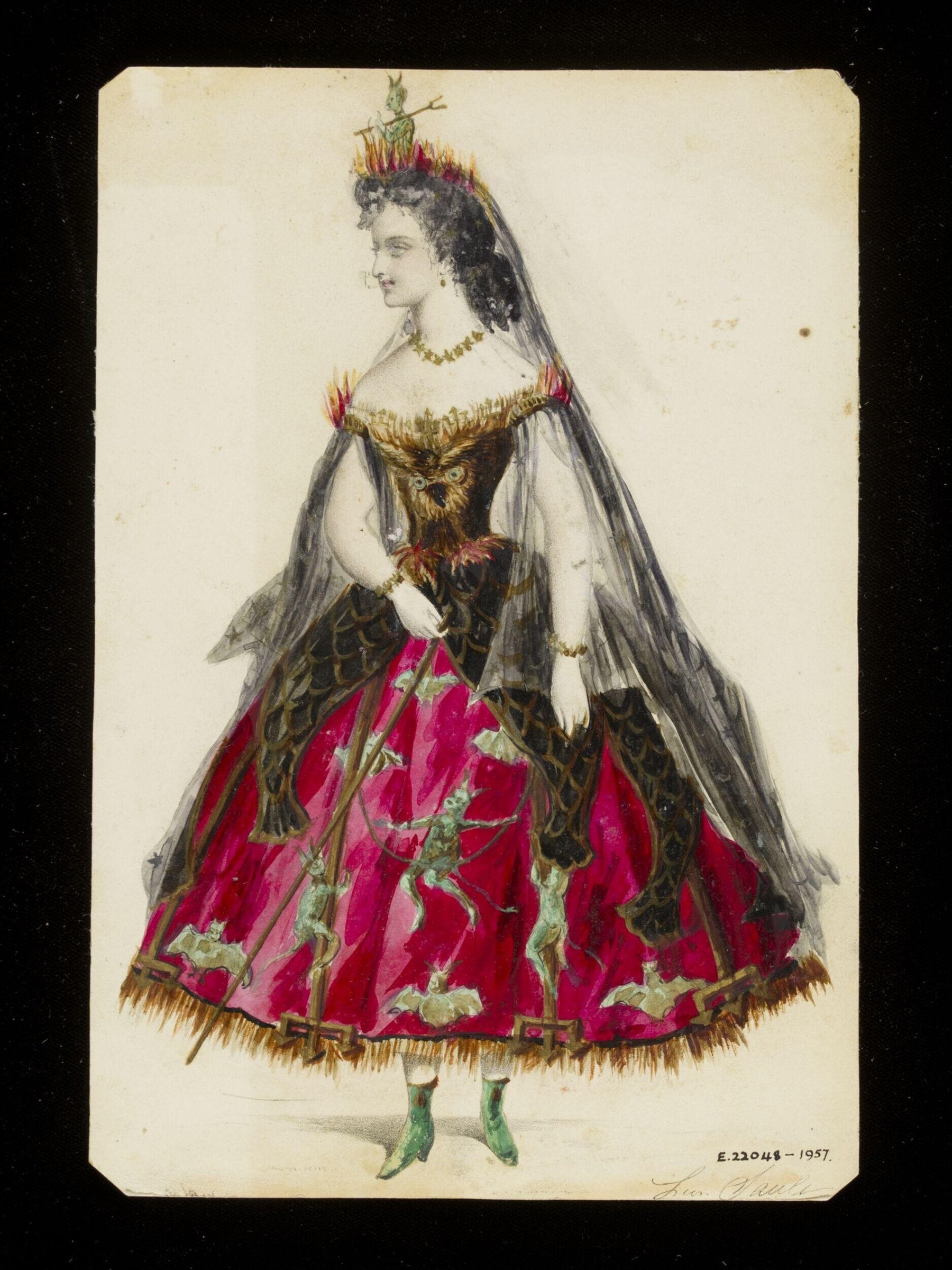
A single female figure dominates the composition, posed in three-quarter profile facing left. She wears an elaborate costume of the mid-nineteenth century: a corseted bodice in gold or bronze with red and gold trim, topped by a low-cut white chemise with puffed sleeves. The skirt is the focal point—a voluminous structure in vibrant magenta or crimson silk, decorated with bold gold leafwork or floral motifs, and finished with a deep gold fringe at the hem. A gossamer black veil trails from an ornate headdress of stiffened greens and reds that rises above the crown like flames or exotic plumage. The figure wears a gold beaded necklace and green boots. The pose is static and frontal despite the profile angle, more display than action: the body faces forward, one arm at the side, the other raised slightly at the elbow. The figure stands against a plain cream background. The entire work is rendered in mixed media—pen and ink for the linear underdrawing and facial detail, with watercolor or gouache applied to the costume elements, producing the rich color and dimensional effect.
The dancing
The dancer is depicted standing upright with minimal articulation or weight shift. Both arms fall naturally at the sides or rest lightly at the waist; there is no dynamic hold or frame as would appear in partnered dance. The posture is symmetrical and display-oriented, suggesting presentation or parade rather than movement. The body is vertical and formal, without the forward momentum, turn-out, or sculptural tension one would see in trained dance technique. This is a figure posed for costume visibility rather than captured in the act of dancing.
The dance depicted
The image is a fancy-dress costume design, not a depiction of actual dance. The title 'Hell' suggests this is a theatrical or masquerade costume, possibly for a pantomime, operatic tableau, or fancy ball popular in the 1860s. The exotic headdress—suggesting flame, demons, or infernal imagery—combined with the rich jewel tones and golden ornament signal a stock character type from theatrical tradition: an allegorical figure of vice, damnation, or the underworld. The static pose and frontal display mode are characteristic of costume plates and design sheets of the period, created to show tailors and performers how the garment should be constructed and worn, not to document actual choreography. Without movement vocabulary, footwork, or partnering to examine, no specific dance genre can be identified.
How it was made
This is a hand-colored costume design drawing, likely executed in pen or pencil for the linear work, with watercolor, gouache, or mixed media applied to the fabrics and ornaments to suggest texture, sheen, and color. The technique is that of the professional costume illustrator—precise in outline, economical in setting, and designed for practical use by dressmakers and stage hands. The medium itself announces this as a working document in a theatrical workshop rather than a finished fine-art print intended for framing or collection. Such drawings circulated in theater offices, pattern books, and sometimes as published fashion plates in magazines of the period.
About this work
This is a mid-nineteenth-century costume design for a theatrical fancy-dress character called 'Hell,' rendered as a hand-colored drawing by designer Léon Sault. The work captures the visual language of mid-Victorian theatrical costume—ornate, symbolically coded through color and emblem, and designed for maximum visual impact in masquerade or pantomime. Although costume design documents exist at the intersection of fashion, theater history, and visual spectacle, this particular image reveals more about how allegorical roles were costumed than about dance practice or movement. It belongs in a gallery of dance in art because costume design was integral to how dance was understood, performed, and imagined in nineteenth-century theater; the absence of actual dancing in the image is itself informative, reflecting the period's distinction between costume-display and choreography.
How to look at it
Look first at the headdress and its symbolic language: the stiffened, flame-like ornaments in red and green announce this figure's infernal status without requiring movement or narrative context. Then follow the eye down to the extreme silhouette—the corseted torso and vast skirt represent not just high fashion but theatrical exaggeration and artifice. The static pose is crucial: this is a figure to be *seen and recognized*, not a body in motion. The color choices—the harsh magenta, the lurid gold, the funereal black veil—are the costume's primary communication system, not the gesture. Finally, note what is absent: there is no indication of footwork, no direction of weight, no spatial relationship to a stage or other dancers. The costume is presented as pure visual design, a surface to be made and worn.
The artist
Léon Sault (dates unknown) was a theatrical costume designer active in Paris in the mid-nineteenth century. Little detailed biographical information survives, but his work in costume design places him among the working craftspeople and artists who supported the rapid expansion of theatrical and masquerade entertainment in the 1850s-1870s. Costume designers of this era occupied a specialized role: part tailor, part illustrator, part dramaturge, translating directorial and dramaturgical vision into garments that could be executed, worn, and seen across a theater or ballroom. Sault's surviving designs suggest competence in ornamental drawing and a thorough knowledge of contemporary silhouette and trimming.
The period
The 1860s saw a flourishing of fancy-dress balls, theatrical spectacles, and masquerade entertainments in European cities, particularly Paris. The crinoline silhouette at its most exaggerated dominated women's fashion, and theatrical costume often exaggerated it further for visibility and dramatic effect. Allegories of virtue and vice, heaven and hell, were stock subjects in pantomime, ballet d'action, and operatic tableaux. At the same time, the mid-Victorian era saw a codification of costume design as a specialized, documented practice—the rise of the costume plate as a publishable, circulating object. Sault's work sits at this nexus: theatrical tradition, industrial fashion, and the emerging documentation of design itself.
Where it lives
The work is held at the Victoria and Albert Museum, London, catalogued as a fancy-dress costume design. The accession number E.22048–1957 indicates it entered the collection in 1957, likely as part of a broader acquisition of theatrical costume drawings and design documentation. It is one of a type of working document common in nineteenth-century theater archives.
Questions about this work
Is this a real dance costume from the 1860s?
This is a *design* for a costume, not a surviving garment. It shows how the costume should be made and worn. Costume design drawings like this were created for tailors, seamstresses, and performers to follow during production. Whether this particular design was executed and worn is not recorded.
What is 'Hell' and why is it a costume?
In nineteenth-century theater, 'Hell' is an allegorical character—a personification of the infernal realm, sin, or damnation. Such figures appeared in pantomimes, operatic spectacles, and masquerade balls. The costume's symbolic language—the flame-like headdress, the blood-red skirt, the black veil—conveyed the character's identity and moral status without the performer having to do much of anything except stand and be seen.
Why is this in a gallery of dance in art if there is no dancing?
Dance and costume are inseparable in theatrical contexts. How a body is clothed shapes what it can do and how it is perceived. This design document reveals the visual world dancers inhabited and the aesthetic codes through which their bodies were read. It is part of the material culture of nineteenth-century theatrical movement.
What can you tell from the costume about fashion in the 1860s?
The exaggerated crinoline silhouette, the low neckline, the ornate trimming, and the jewel tones all reflect mid-Victorian high fashion. The theatrical version exaggerates all of these elements—the skirt is larger, the colors more vivid, the ornament more lavish—because theater requires visibility and impact at a distance. The gold fringe and embroidered motifs would have caught light and movement onstage.
More dance artwork





