49 works in this view — arrow keys or swipe to move between them.
Dance in Art
Fancy dress costume design
Jules Helleu
- Collection:
- Fancy dress costume design
- Source:
- Victoria and Albert Museum
- Rights:
- Rights vary by item — check the source record before reusing this image. Source record ↗
- Recorded as:
- V&A — check rights per item
This work documents the material culture and visual imagination of mid-Victorian theatrical spectacle at the moment when elaborate fancy dress and theatrical costume became major forms of elite entertainment and social performance. For dance historians, it shows what dancers and performers wore during balls and masquerades, and how costume design anticipated and constructed the body's presentation on stage.
What you are looking at
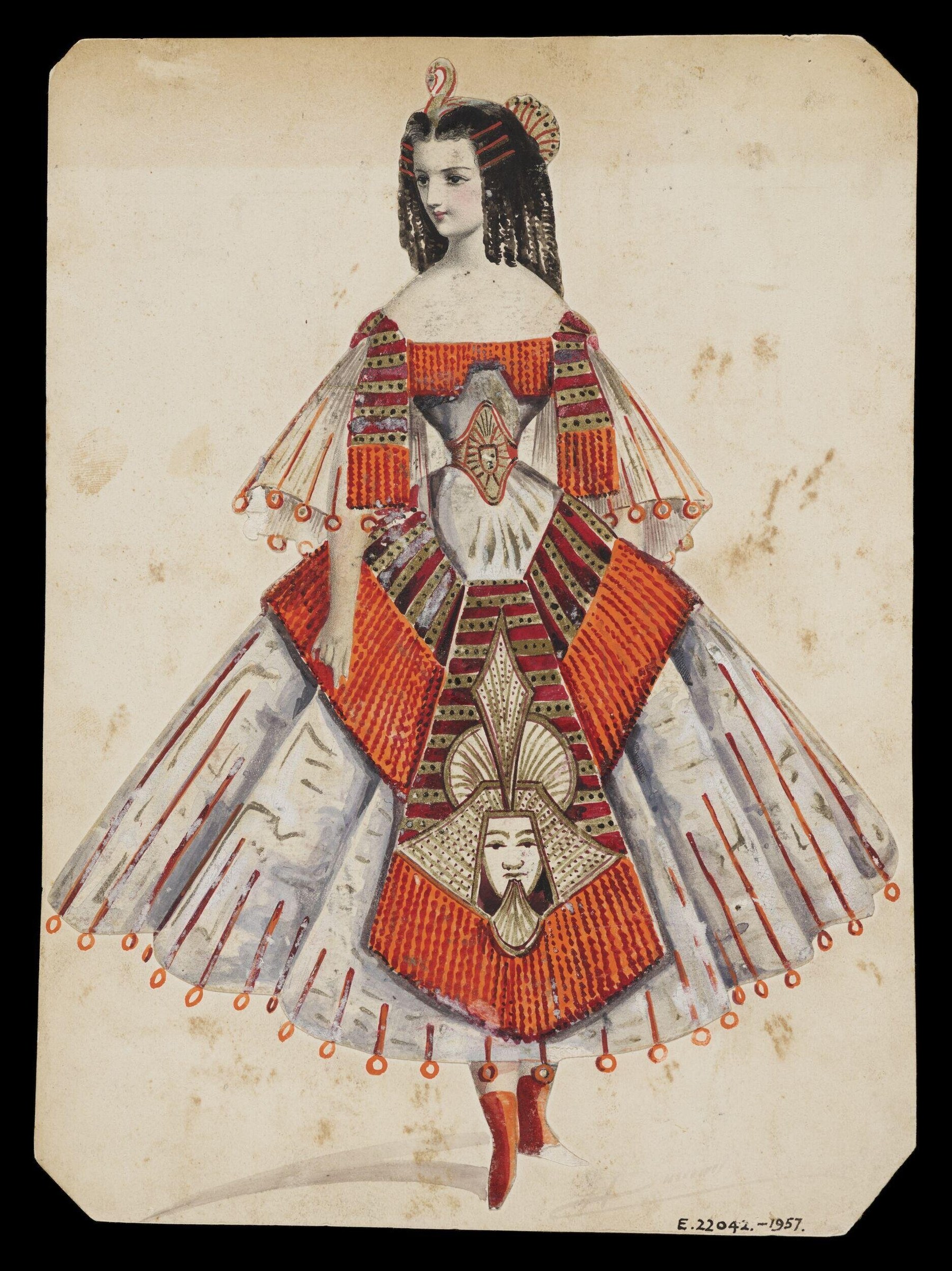
A full-length figure study of a woman in elaborate fancy dress costume drawn in colored ink and watercolor. She stands in a frontal pose wearing an ornate ensemble composed of stacked horizontal panels in bright orange-red alternating with decorative borders in green, gold, and dark red. The costume features a pronounced architectural silhouette with wing-like structures extending from the shoulders, each terminating in hanging golden beads or ornaments. The wings appear to reference Egyptian or theatrical costume traditions, with stylized feathering rendered in pale blue and cream. The bodice displays an elaborate breastplate-like ornament with shell or fan motifs. At the center front hangs a triangular panel bearing an Egyptian pharaonic face mask rendered in profile. The figure's dark hair is arranged in braided sections with red striping and adorned with a spiral ornament at the crown. She wears scarlet heeled shoes. The pose is still and presentational, meant to display the costume's full construction rather than to capture movement.
The dancing
A single standing figure photographed or rendered from the front in a stationary, presentational pose. The body is upright with no weight shift, arms held naturally at the sides. There is no suggestion of dance movement or dynamic stance. The figure functions as a costume display form rather than a performer in motion. The pose is typical of theatrical costume design drawings meant to show garment construction and silhouette.
The dance depicted
This is a costume design drawing rather than a depiction of dance itself. The fancy dress ensemble suggests theatrical or masquerade wear of the mid-to-late nineteenth century. The Egyptian, Art Deco, and orientalist elements point to the aesthetics of late Victorian theatrical fashion, when elaborate costume balls and theatrical fantasias were popular entertainment. The specific dance form cannot be determined from a still costume study; the work documents what was worn rather than how it was performed.
How it was made
Hand-colored engraving or lithograph, evidenced by the fine linear detail of the costume elements, the applied watercolor or gouache washes in reds, greens, golds, and grays, and the pale cream ground. The technique combines reproductive printmaking with selective hand-coloring, a common method for theatrical costume plates and fashion illustration of the 1850s–1870s. The precision of the engraved line suggests professional theatrical publication, likely for a costume repository or theatrical journal.
About this work
This is a theatrical costume design by Jules Helleu dated 1860, showing a woman's elaborate fancy dress outfit combining Egyptian revival and orientalist theatrical aesthetics popular in mid-Victorian masquerade and theatrical contexts. The drawing serves as a record of spectacular costume construction rather than a documentation of choreography or technique. The work sits within the tradition of nineteenth-century theatrical design drawing, where elaborate ensembles were created for balls, tableaux vivants, and theatrical entertainments. Helleu's drawing is precise and professional, clearly intended for publication or reference within theatrical circles, capturing the ornamental excess and cross-cultural fantasy that characterized mid-Victorian fancy dress culture.
How to look at it
Attend to the costume's architectural complexity: the way horizontal bands of contrasting color build the silhouette, the wings extending from the shoulders that suggest both bird and theatrical abstraction, and the placement of ornamental zones—the breastplate, the pharaonic mask, the hanging beads. Notice how the drawing uses fine linear detail for decoration while creating broad areas of flat color for the main panels. The Egyptian mask at the center front is the design's narrative anchor, indicating that this is a historical or orientalist fantasy rather than street wear. The precision and frontality of the presentation is characteristic of nineteenth-century costume design, where clarity of construction mattered as much as visual impact.
The artist
Jules Helleu (c. 1821–1884) was a French theatrical designer, costumier, and illustrator active in Paris during the Second Empire and early Third Republic. He was known for designs and watercolor costume studies for Parisian theaters, opera houses, and the fashion-conscious elite. His practice bridged theatrical costuming, fashion illustration, and decorative art, producing detailed hand-colored prints for theatrical publications and private collectors. He worked during a period when theatrical costume design was a prestigious and specialized profession, and his meticulous technique was characteristic of the highest professional standard.
The period
In 1860, when this drawing was made, fancy dress balls and theatrical masquerades were major events in European high society, particularly in Paris. The Second Empire court under Napoleon III and the Empress Eugénie championed elaborate historical and orientalist fantasias. Simultaneously, the theater world was expanding; spectacular pantomimes, ballets, and tableaux vivants required increasingly elaborate and imaginative costumes. Orientalism—artistic fascination with Near Eastern, Egyptian, and Asian forms—was at its height in European visual culture, filtering into costume design through Orientalist painting, world's fairs, and theatrical exoticism. The mixing of Egyptian, Art Deco-like geometric forms, and theatrical baroque elements in this design reflects the syncretism typical of mid-Victorian ornamentalism.
Where it lives
Held in the collection noted as 'va' (the Victoria & Albert Museum, London, based on the accession code E.22042–1957). This is a professional theatrical design drawing, likely part of the museum's extensive collection of nineteenth-century theatrical and costume design materials.
Questions about this work
Was this worn as an actual costume?
Almost certainly yes, but this is a design drawing, not a performance image. The work served as a professional blueprint for construction. Helleu's designs were made for elite Parisian clients—wealthy patrons of the opera, aristocratic hosts of fancy dress balls, and theater companies. Whether this specific design was realized cannot be determined from the drawing alone.
Why does it have an Egyptian pharaoh's face on the front?
Orientalism and historical fantasy were central to mid-Victorian theatrical costume and fancy dress culture. Designers and wearers drew freely from ancient Egypt, the Near East, Asia, and other traditions to create exotic, imaginative ensembles. The pharaonic face signals that this is a masquerade costume meant to evoke historical or fantasy authority, not to represent actual Egyptian dress.
What technique was used to make this?
The drawing is a hand-colored engraving or lithograph, combining fine reproductive printmaking with selective watercolor or gouache washes applied by hand. This technique allowed the design to be both precisely detailed and vividly colored, making it suitable for publication or as a reference model for tailors and theater staff.
Who was Jules Helleu?
A French theatrical designer and illustrator working in Paris in the mid-nineteenth century, known for costume design, watercolor studies, and fashion illustration for theaters and wealthy clients. His work exemplifies the high standard of professional theatrical design during the Second Empire.
More dance artwork





