49 works in this view — arrow keys or swipe to move between them.
Dance in Art
Raggiana Bird of Paradise
Jules Helleu
- Collection:
- Fancy dress costume design
- Source:
- Victoria and Albert Museum
- Rights:
- Rights vary by item — check the source record before reusing this image. Source record ↗
- Recorded as:
- V&A — check rights per item
Costume designs are primary sources for understanding how 19th-century fancy dress events looked and how natural history was translated into wearable spectacle. This drawing shows the level of craft and naturalistic detail expected in high-end costume work, and it preserves evidence of how exotic animals were imagined and embodied by people in an era before widespread color photography.
What you are looking at
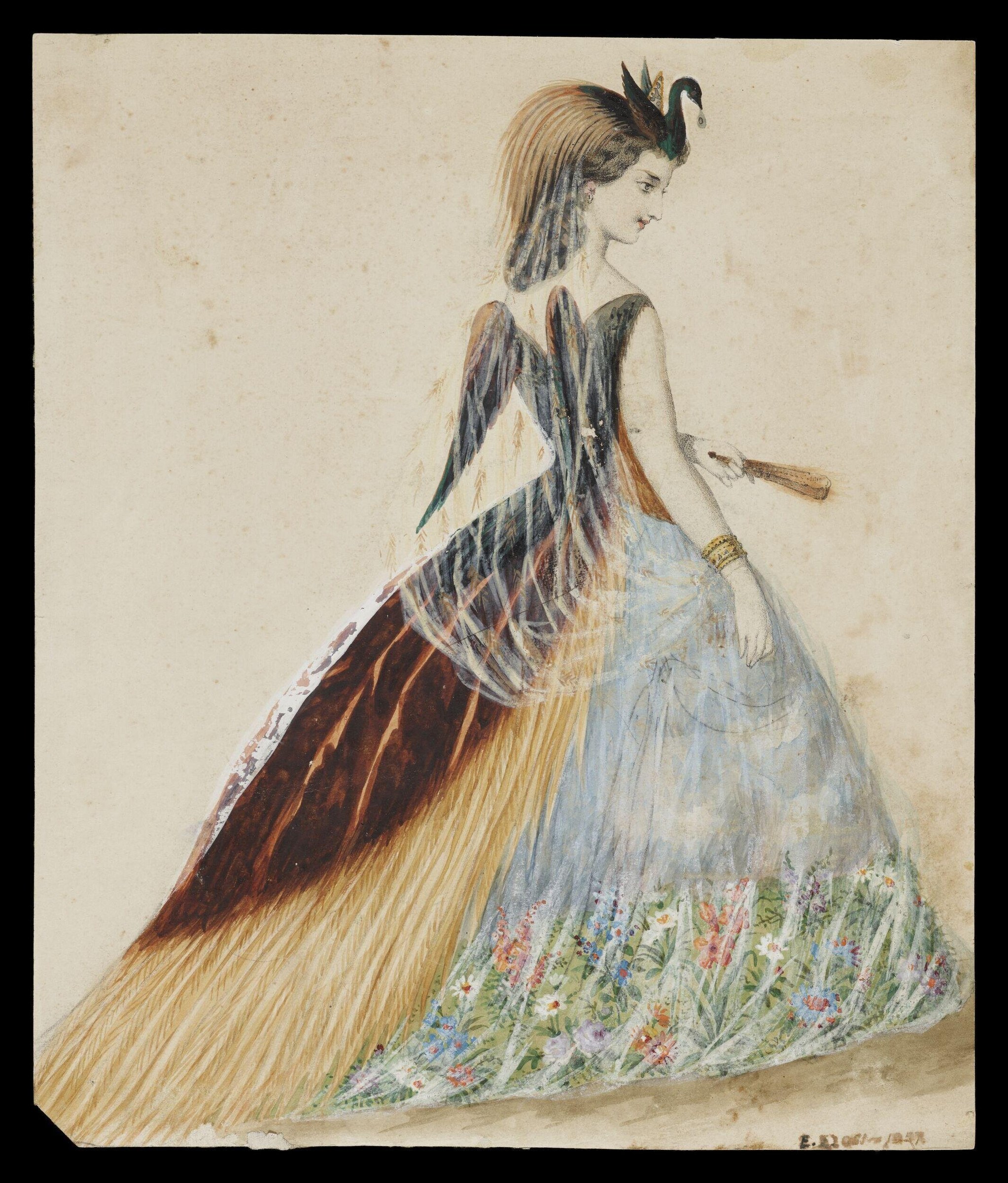
A woman in elaborate fancy dress stands in profile facing left, her body posed as if mid-movement or display. She wears a floor-length skirt decorated with densely painted wildflowers—pinks, blues, whites, and greens—rendered in careful botanical detail across the hem and lower garment. Above this sits a fitted bodice, and most strikingly, large feathered wings in deep blues and warm browns extend from her back, detailed with the characteristic plumage pattern of the Bird of Paradise. A tall feathered headdress in matching tones crowns her head. She holds what appears to be a fan or small implement in her right hand. The figure is rendered in watercolor or gouache on pale paper, with careful attention to the fall and drape of fabric, the individual feathers of the wings, and the delicate rendering of each flower. The composition is a three-quarter-length portrait of the figure against an empty ground, emphasizing the costume itself as the subject.
The dancing
The woman's posture is upright and graceful, with her weight settled on both feet, her body turned to present the costume rather than to suggest active movement. Her left arm hangs naturally at her side; her right arm is slightly raised and bent, holding a small object. The pose is that of display or presentation—the attitude of a figure modeling costume for theatrical use—rather than a dancer captured mid-step. There is no suggestion of partnering or interaction with another figure.
The dance depicted
This is a costume design for fancy dress, not a depiction of dance in progress. The costume references the Raggiana bird of paradise through its feathered wings and headdress, suggesting that the wearer would have been intended to evoke the bird's exotic plumage and bearing. Such costumes were typical of 19th-century masquerades, balls, and theatrical fancy dress events, where participants adopted fantastical or naturalistic characters for entertainment. Whether the wearer would have danced in this costume, what dance form they might have executed, and what choreographic tradition (if any) governed such costumed entertainment cannot be determined from the image alone.
How it was made
This is a watercolor or gouache drawing on paper, recognizable from the translucent wash technique, the handling of the pigment, and the visible paper ground. The artist has used fine brushwork for detail—individual feathers are delineated with precision, and the wildflowers are rendered with botanical care—while broader washes establish the color and volume of the skirt and bodice. This technique was standard for costume design documentation in the 19th century, allowing designers to present color, fabric drape, and decorative detail to patrons, producers, or the wearer before execution. The surviving signature and date at lower right (partially legible as "E.D" and "1860") confirm this as a finished design drawing, not a preliminary sketch.
About this work
This is a costume design drawing for a woman's fancy dress ball or theatrical costume in the form of the Raggiana bird of paradise, dated 1860 and attributable to Jules Helleu. The work documents a moment when European society absorbed and reimagined natural history through costume: the exotic bird becomes a masquerade character, its brilliant plumage reproduced in feathered wings and its form suggested through the upright bearing of the wearer. The careful rendering of both the bird's structural features and the wildflowers scattered across the skirt indicates a designer concerned with plausibility and visual richness, not mere fantasy. As a costume design, this belongs to the history of fancy dress culture and theatrical design as much as to the history of dance, though it documents the visual culture in which dancers and entertainers moved.
How to look at it
Notice the specificity of the bird's anatomy: the feathers are differentiated by color and direction, and they follow the actual structure of the bird's wings and tail, not a generic fantasy arrangement. The wildflowers on the skirt are identifiable species rendered in careful color, suggesting the designer worked from a natural-history reference—perhaps a museum specimen or a botanical plate. The costume is presented as a complete visual statement, with the wearer's bearing contributing to the character. The choice to show the figure in profile emphasizes the silhouette and the fall of the feathered train.
The artist
Jules Helleu (1821–after 1860) was a French costume and theatrical designer working in Paris during the Second Empire, a period of intense theatrical and social activity. His practice centered on costume design for the stage, masquerade balls, and fancy dress events serving the wealthy Parisian society. While records of his work are sparse, surviving designs demonstrate a consistent attention to naturalistic detail, rich color, and the integration of natural-history subjects into fashionable dress.
The period
The 1860s were a moment of intense European interest in natural history and exotic taxidermy, driven by colonial expansion and the growth of natural history museums. At the same time, fancy dress balls and masquerades were at their height as a form of elite entertainment, and costume design was a recognized professional specialization. The fancy dress costume allowed wearers to temporarily adopt other identities—animals, historical figures, allegorical characters—in a sanctioned, playful context. Such costumes were often danced in at balls, though the nature and form of that dancing remains poorly documented.
Where it lives
This work is catalogued as a fancy dress costume design in the collection identified as VA (Victoria and Albert Museum), where such designs are held as primary sources for the history of dress and theatrical design. The surviving signature and date make it a documented example of a professional designer's work.
Questions about this work
Is this a design for a real costume that was made and worn?
The drawing is certainly a working design, executed with the precision and detail a costumier or patron would need to execute it. Whether this specific costume was realized cannot be determined from the image alone. Costume designs survive more frequently than the costumes themselves, which were often altered, repurposed, or lost.
Why a bird of paradise? What made it fashionable for costumes?
The Raggiana bird of paradise was among the most exotic and visually spectacular birds known to Europeans, indigenous to New Guinea and prized for its brilliant plumage. In an era of colonial expansion and growing natural-history museums, such birds became symbols of the exotic and the remote. Their visual drama made them ideal subjects for fancy dress, where wearers could embody the exotic and marvelous.
Would someone actually dance in a costume with large feathered wings?
Fancy dress balls involved both display and movement, though the nature of the dancing is not well documented. Heavy or large costumes would have constrained movement, suggesting that such costumed figures may have paraded, posed, or danced slowly and formally rather than executing rapid steps. The costume's elegance and the wearer's graceful bearing suggest an aesthetics of presentation more than athletic movement.
How do we know this is by Jules Helleu?
The signature at the lower right of the drawing, though partially faded, reads as 'E. D' or similar and is dated 1860. The catalogue record attributes it to Jules Helleu. Without being able to see the signature clearly in this reproduction, attribution cannot be verified from the image alone.
More dance artwork





