49 works in this view — arrow keys or swipe to move between them.
Dance in Art
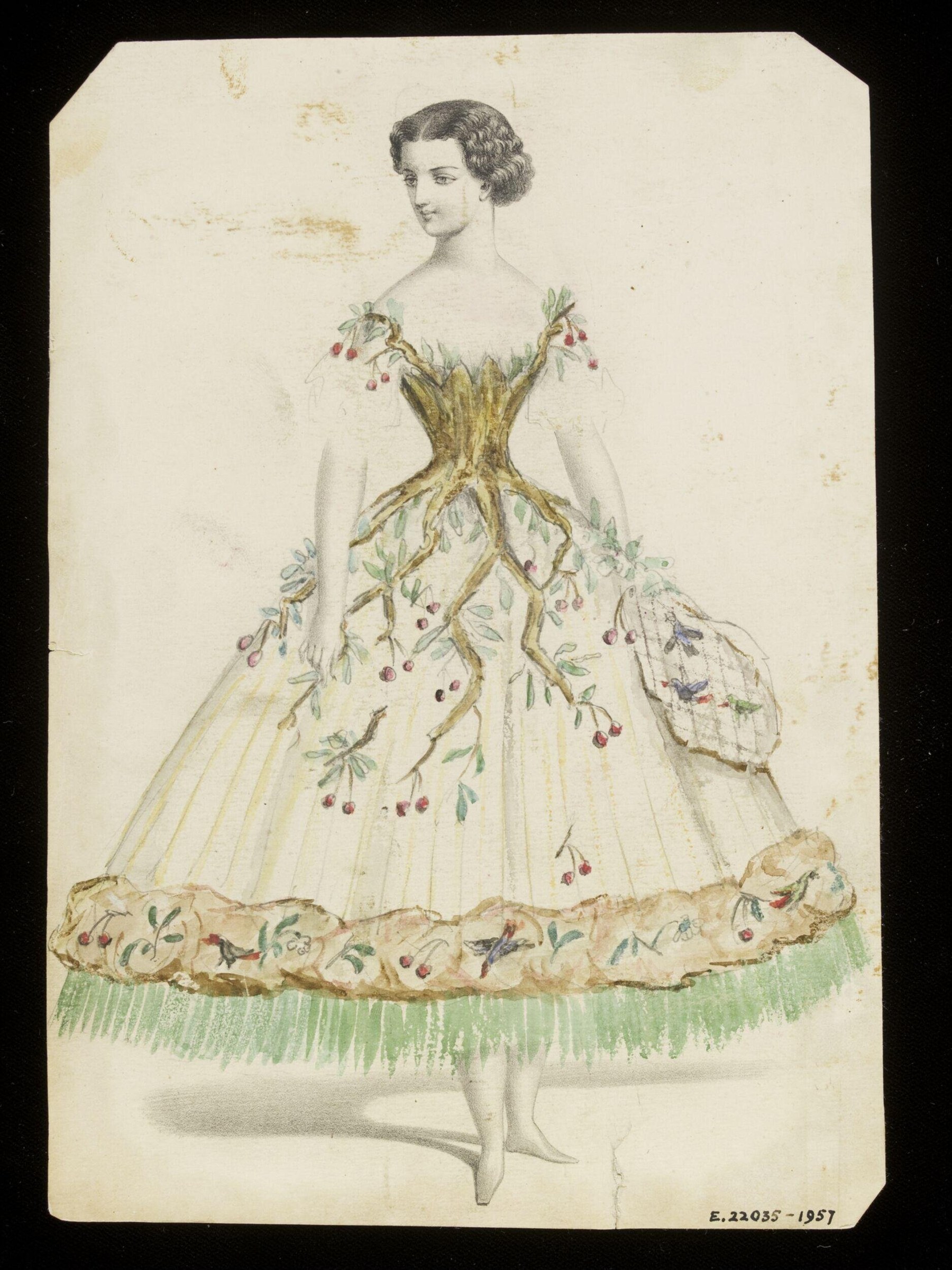
Cherry Tree
Jules Helleu
- Collection:
- Fancy dress costume design
- Source:
- Victoria and Albert Museum
- Rights:
- Rights vary by item — check the source record before reusing this image. Source record ↗
- Recorded as:
- V&A — check rights per item
This drawing reveals the aesthetic concerns of mid-nineteenth-century ballroom culture: the marriage of nature-study (a Victorian obsession) with women's formal dress, and the role of costume design in creating theatrical presence at social events. It shows how fancy-dress balls functioned as a legitimate arena for women's performance and transformation, a site where ballroom dancing was staged alongside elaborate costuming.
What you are looking at
A young woman in an elaborate mid-nineteenth-century ball gown stands in a three-quarter pose against a neutral background. Her dress is the visual centre: a fitted golden corset with a sharply defined waist supports a full skirt of white pleated silk that descends to mid-calf. The skirt is decorated with an extraordinary botanical design—living cherry branches laden with red fruit trail across the bodice and cascade down the front and sides of the dress, their leaves and berries rendered in careful watercolour detail. The branches appear to grow organically from the corset, creating the illusion that the dress itself has sprouted vegetation. Her shoulders are bare, the neckline low and modest for the period. She wears her dark hair pinned up in the fashion of the 1860s. A small fan or handkerchief dangles from her wrist. The hem of the skirt is trimmed with a band of patterned fabric that echoes the botanical theme. Her posture is upright and composed, the pose of formal presentation rather than movement.
The dancing
A single standing figure, not a dancer in motion. Her weight is evenly distributed; her stance is frontal and static, the body held in the formal presentation posture required for costume design drawings. Her arms hang naturally at her sides. There is no indication of steps, elevation, partnering, or the weight-shift and articulation that would mark an active dancer. This is a costume display rather than a capture of dance in progress.
The dance depicted
This is not a depiction of a dance in action. Rather, it is a costume design drawing for fancy dress—a masquerade or themed ball costume based on the fantasy of becoming a living cherry tree. The work belongs to the tradition of theatrical costume design for ballroom entertainment, likely intended for a woman dancer or society participant attending a fancy-dress ball during the 1860s. The cherry-tree costume concept suggests an allegorical or naturalistic theme common to such entertainments. No specific dance style is depicted; the figure is posed for costume presentation rather than choreographic analysis.
How it was made
This is a hand-coloured costume design drawing, likely watercolour or gouache on paper. The medium allowed the artist to render botanical detail with precision—each leaf and cherry is individually articulated—while the white-ground paper serves as both the base and the white of the gown itself. The technique of hand-colouring permits both linear accuracy (in the dress structure and branch tracery) and painterly finish (in the foliage and the graduated tone of the skirt pleats). The small scale and delicate execution suggest circulation within theatrical or aristocratic circles as a design proposal or record.
About this work
This is a mid-nineteenth-century costume design for a fancy-dress ball, depicting a woman's gown constructed around the fantastical conceit of a living cherry tree. The artist has integrated botanical ornament with tailored dress structure, using the corset as the visual anchor for branches that trail across the full skirt. The work records a moment in the history of theatrical and ballroom costume when elaborate thematic fancy dress was fashionable among the wealthy. It belongs in a dance gallery not because it depicts choreography, but because it documents the visual culture surrounding ballroom entertainment and the costume language through which society women performed allegory and fantasy at formal events.
How to look at it
Attend to the relationship between the dress structure (corset and pleated skirt) and the applied ornament (the branches). The artist has positioned the branches so that they appear to grow from the woman's body rather than merely decorate it, creating a hybrid figure that is both human and botanical. Note the precision of the leaf-work and the delicate articulation of individual cherries—this level of detail indicates a proposal for an expensive, labour-intensive garment. The formal presentation pose tells you this is a design document, a proposal or record, rather than a sketch of movement.
The artist
Jules Helleu (1821–1884) was a French theatrical and costume designer known for his work in the decorative arts. He designed costumes and theatrical sets during the July Monarchy and Second Empire, a period of intense activity in Parisian ballroom culture and opera. His practice bridged costume design, fashion illustration, and fine art, situating him within the circle of designers who supplied both theatrical companies and wealthy private clients. This drawing exemplifies his skill in combining structural tailoring with ornamental naturalism.
The period
The 1860s saw a peak in the fashion for elaborate fancy-dress balls among European aristocracy and the wealthy bourgeoisie. These events, often themed around historical periods or allegorical conceits, required costumes that were at once structurally sound garments and fantastical visual statements. Simultaneously, the Victorian obsession with botanical accuracy and naturalism infused decorative arts; combining a woman's gown with a naturalistic cherry tree in full fruit was both whimsical and intellectually fashionable. The full skirt and fitted corset were the dominant silhouette of the period, and this design makes maximum use of that form to create an ambitious visual effect.
Where it lives
The work is catalogued as a fancy-dress costume design and is held in a collection focused on costume design as a historical practice. The accession record identifies it as part of a broader archive of dress design from the theatrical and social worlds of the nineteenth century.
Questions about this work
Is this a real dress that was made and worn?
This is a design drawing—a proposal or record of a costume. Whether it was executed as a full garment is not documented in the catalogue record. Costume designs were often made whether or not they were realized, and some were proposals for clients who then decided whether to commission them.
Why would someone wear a cherry tree to a ball?
Fancy-dress balls were theatrical entertainments for the wealthy in the nineteenth century, where guests wore allegorical, historical, or fantastical costumes. A cherry-tree costume was witty and visually stunning—it allowed the wearer to embody nature and display wealth through the labour-intensive embellishment. Such costumes were a form of performance and display that was part of ballroom culture.
Who was Jules Helleu?
Jules Helleu was a French costume and set designer active in the mid-nineteenth century, working for theatres and private clients during the period when Paris was the capital of ballroom culture and opera. He specialized in the intersection of fashion, theatre, and fine art.
More dance artwork





