49 works in this view — arrow keys or swipe to move between them.
Dance in Art
Eve and the Serpent
Leon Sault
- Collection:
- Fancy dress costume design
- Source:
- Victoria and Albert Museum
- Rights:
- Rights vary by item — check the source record before reusing this image. Source record ↗
- Recorded as:
- V&A — check rights per item
Fancy dress ball culture was central to nineteenth-century ballroom life, and costume designs like this document both the visual imagination and the practical technology of that world. The work shows how the S-bend silhouette of the 1880s–90s was adapted for theatrical fantasy, and how expensive hand-coloured prints circulated designs among makers and wearers. For dance historians, it reveals what a performer or guest might actually have worn to a fancy dress ball, and how the body was meant to be framed and displayed in that context.
What you are looking at
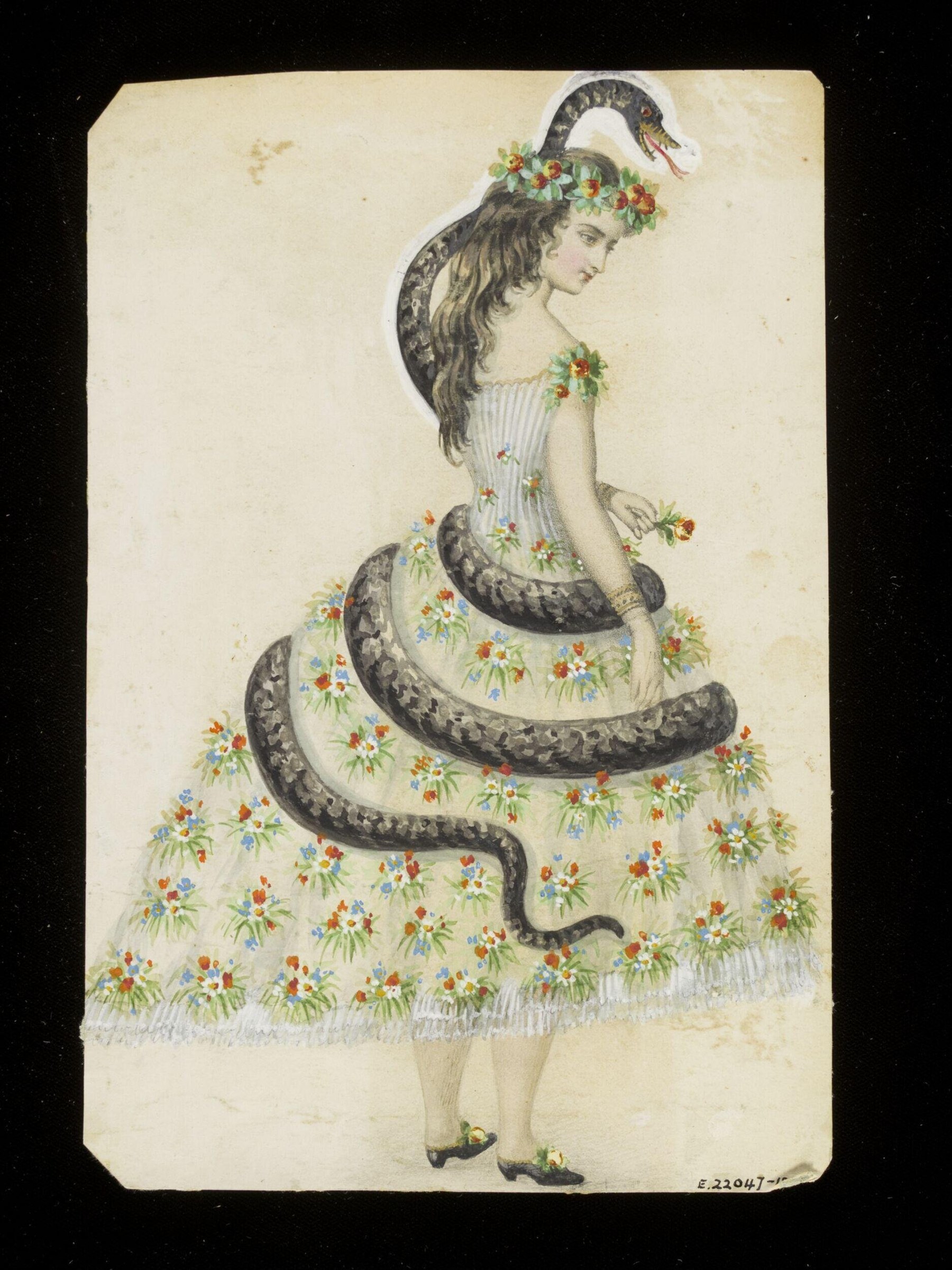
A young woman in fancy dress costume stands in profile against a pale background, her body curved in an S-bend silhouette characteristic of late-nineteenth-century fashion. She wears a pale blue or white pleated dress with a fitted bodice, the skirt decorated throughout with small sprays of red, orange, and blue flowers arranged in rows. A large serpent, rendered in dark gray and black with scaled detail, coils around her body—wrapping around her waist, across her torso, and curving upward to frame her head like a headdress, its forked tongue visible near her face. She wears a wreath or crown of similar small flowers on her head, and carries a sprig of flowers in her hand near her hip. Her legs are bare or in pale stockings, with dark shoes visible at the bottom. The composition is a vertical, full-length figure study against an unmodulated ground.
The dancing
A single standing female figure, not in motion. Her weight is evenly distributed on both legs, her body held in an elegant contrapposto with a subtle S-curve—head tilted slightly, torso gracefully bent. Her arms hang naturally, one holding flowers. The pose is static and decorative rather than kinetic, designed to display the costume and the serpent coiled around the body. The figure is turned three-quarter or profile to the viewer, a conventional presentation stance for costume design.
The dance depicted
This is a fancy dress costume design rather than a depiction of actual dance movement. The title 'Eve and the Serpent' indicates a theatrical or masquerade costume drawing on biblical and romantic subject matter. No recognisable dance idiom is present; the figure is posed as a model would be for fashion or theatrical design, not executing steps or gestures from any dance style. The work documents costume practice and visual fantasy rather than choreography or social dance.
How it was made
A hand-coloured engraving or lithograph on paper, as evidenced by the fine linear work, tonal modeling, and watercolour application. The technique allowed for precise rendering of the serpent's scales and the delicate floral sprays, and the coloured finish suggests a luxury object intended for a cultivated audience—likely a pattern for fancy dress makers or a collector's print. The work's medium and finish indicate circulation among the urban middle and upper classes interested in theatrical costume and masquerade.
About this work
This is a costume design drawing from the mid-nineteenth century, showing a single female figure posed to display an elaborate fancy dress outfit. The serpent and floral wreath reference the biblical Eve, but the work's primary purpose is sartorial: to show how the costume looks when worn, the silhouette it creates, and the ornamental effect of the serpent and flowers. It belongs in a gallery of dance in art because fancy dress, masquerade, and theatrical costume are inseparable from nineteenth-century social dance culture, and because costume designs were a major art form documenting how dancers and dancers-at-balls actually dressed and moved.
How to look at it
This is not a dance scene but a display of costume design. Look at how the serpent's curve echoes and amplifies the S-bend of the woman's body—the artist is using the ornament to enhance the silhouette rather than create movement. The flowers are placed to frame the figure and draw the eye along its contours. Notice the precision of the hand colouring and the fine engraved line underneath, which reveals the labour and cost of the original. The figure is deliberately static, posed as a fashion model or mannequin, because the purpose is to show how the costume looks, not how it moves.
The artist
Leon Sault (or Saul) is documented as a French fancy dress and theatrical costume designer active in the mid-nineteenth century. Little is widely known of his biography, but his surviving prints show consistent skill in rendering elaborate costumes, particularly women's fancy dress, with attention to silhouette, ornament, and narrative detail. His work circulated as commercial prints and pattern designs for dressmakers and consumers.
The period
The 1860s were the height of the fancy dress ball craze among European and American elites. These semi-theatrical entertainments required elaborate costumes that referenced mythology, history, literature, and fantasy—Eve and the Serpent are archetypal subjects. Simultaneously, the commercial fashion and theatrical costume industries were expanding, and hand-coloured engraved costume designs were a major product: they were sold as luxury prints, used as patterns by dressmakers, and collected by those planning their own costumes. The aesthetic emphasises the female silhouette, decorative surface detail, and narrative fantasy rather than movement or choreography.
Where it lives
Held as a fancy dress costume design in a collection of such prints (likely a fashion or theatre collection). The catalogue lists it as a source from 'va', possibly indicating a Virginia institution. The notation 'E.22047-i' appears to be an accession or reference number.
Questions about this work
Is this a picture of someone dancing?
No. This is a costume design—a working drawing or pattern print meant to show how a fancy dress outfit looks when worn. The figure is posed, not dancing. Costume designs like this were made to be studied by dressmakers, shown to potential wearers, and collected as luxury prints. They document what people wore to fancy dress balls and theatrical events, which is part of dance history even if the figure itself is not in motion.
What is the serpent for?
The serpent is a costume ornament that references the biblical story of Adam and Eve. It wraps around the woman's body as a visual and narrative element of the fancy dress outfit. In the 1860s, mythological and biblical references were favourite subjects for theatrical costume and masquerade. The serpent also serves a design function: its curves emphasise and exaggerate the S-bend silhouette of the woman's body, which was the fashionable shape of the period.
Who would wear something like this?
A woman attending a fancy dress ball, masquerade, or theatrical event. Fancy dress balls were social events where guests wore elaborate costumes and danced in character or as themed figures. These were common among middle- and upper-class urban elites in Europe and America. Some attendees might have made or adapted their own costumes using designs like this one; others would have hired dressmakers or rented costumes from theatrical suppliers.
Why is this printed and coloured by hand if it's just a design?
Hand-coloured engraved prints were luxury objects that served multiple purposes: they were sold to collectors, used as patterns by professional dressmakers, and bought by wealthy individuals planning their own costumes for fancy dress events. The fine engraving and careful hand-colouring show that this was an expensive product aimed at a cultivated audience. It was a combination of art print, pattern guide, and aspirational fashion image.
More dance artwork





