49 works in this view — arrow keys or swipe to move between them.
Dance in Art
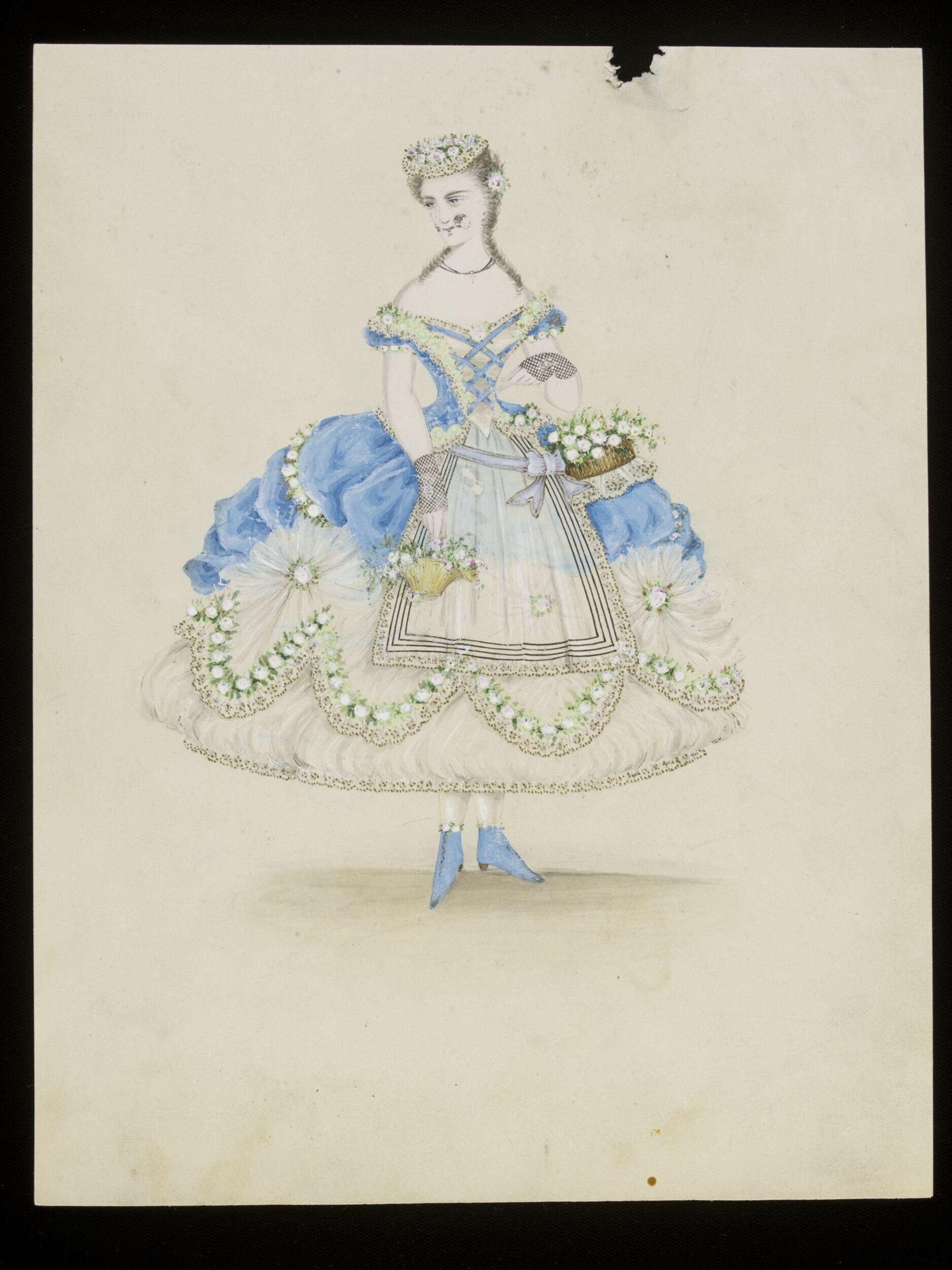
Fancy dress costume design
Charles Frederick Worth
- Collection:
- Fancy dress costume design
- Source:
- Victoria and Albert Museum
- Rights:
- Rights vary by item — check the source record before reusing this image. Source record ↗
- Recorded as:
- V&A — check rights per item
For historians of dance and costume, this drawing matters as evidence of what was actually worn to balls and masquerades in the 1860s—not idealized imagery, but a working design document. The obsessive floral decoration, the off-shoulder silhouette, the layered ruffling, and the theatrical volume are all features specific to the Second Empire aesthetic and to the formal evening dress in which social dancing occurred. Worth's name carries weight: he was the designer who essentially created the profession of haute couture, and his client base and influence mean that garments bearing his designs shaped how wealthy Europeans danced and moved through ballrooms.
What you are looking at
A young woman in elaborate fancy dress stands in a three-quarter pose against a plain ground, her body angled to display the costume fully. She wears a voluminous ball gown constructed from white silk or satin with blue silk draped in swags across the bodice and skirt. The skirt's hem is scalloped and deeply ruffled, each scallop edged with white lace and decorated with a white flower (likely lily of the valley) and green foliage. The bodice features a blue off-shoulder neckline with crossed blue ribbons, and white undersleeves. She holds a blue parasol in one hand and a basket of white flowers in the other. Her hair is dressed high and crowned with a wreath of small white flowers. The entire dress reads as a costume for a fancy-dress ball rather than daywear: the proportions are theatrical, the ornamentation excessive, the floral decoration consistent and obsessive. The figure is rendered with delicate hand-coloring in soft watercolor tones.
The dancing
The woman stands in a formal, display pose: her weight appears even, her body composed and still, her arms arranged to present the costume. There is no sense of movement, weight shift, or dance-like momentum. She does not gesture or reach; instead, her posture is that of a model on a dressmaker's stand. The pose is frontal and symmetrical in intention, though angled slightly to show the dress's silhouette. This is not a dancer captured in motion, but a figure arranged for a costume plate.
The dance depicted
This is not a depiction of dance, but a costume design for fancy-dress wear. While the gown is elaborate and theatrical in a way associated with costume balls and masquerades—occasions where dancing occurred—the figure herself is posed as a fashion illustration rather than a dancer. She exhibits no engagement with dance movement, no frame, no weight distribution or footwork that would indicate a specific dance style. The dress itself might have been worn to a ball, but the image documents costume design, not dance.
How it was made
This is a hand-colored drawing or watercolor on paper, likely a costume design or fashion plate. The execution is precise and delicate: the outline is drawn in fine black line (possibly pen or ink), and color has been applied selectively in soft washes—pale blue for the silk, touches of green for foliage, flesh tones for the face and neck. The technique allows for rich ornamental detail without the weight of oil paint; it was the standard medium for fashion and costume design in the mid-nineteenth century and suited both reproduction in print and presentation to a client or dressmaker. This medium and approach indicate the work was made for a professional purpose: designing or documenting a specific garment for an individual wearer or for publication.
About this work
This is a costume design drawing by Charles Frederick Worth, the founding figure of haute couture, dated 1860. It documents a fancy-dress costume—specifically a ball gown designed for masquerade or costume-ball wear. The image is not a dance scene, but it is a document of the dress cultures and social rituals in which dance took place. Worth's practice was to design and execute garments for wealthy clients, and costume designs were a significant part of his portfolio; this drawing would have served as a record of a commissioned work or as a design proposal. The work exemplifies the theatrical scale and ornamental excess that characterized mid-nineteenth-century ball dress and the visual language of fashion design in an era before photography dominated the field.
How to look at it
Look at the ornament: the lily-of-the-valley flowers are not a scattered accent, but a carefully deployed motif that defines and articulates the dress's structure. Each scallop of the hem carries a flower; flowers rise up the skirts in swags; they crown the head. This is the language of Worth's ornamental taste and also of the theatrical, almost costume-like aesthetic of mid-century ball dress. Observe the pose: the woman is still and frontal, arranged to display the costume rather than to suggest movement. This is how costume designs worked—they showed the garment fully and clearly, not the body in motion. Compare this to images of dancing in the same period: those show weight, reach, turning, the use of the floor. This work shows a dressed figure, not a dancer.
The artist
Charles Frederick Worth (1825–1895) was an English-born couturier who established his house in Paris in 1851 and became the most influential and successful dressmaker of the mid-to-late nineteenth century. He was instrumental in the emergence of haute couture as a profession and the concept of the fashion designer as an author with a name and a signature style. Worth designed for European nobility and wealthy bourgeoisie; his clients included Empress Eugénie and other prominent society women. He produced costume designs, ball gowns, and street dress, and was known for theatrical richness, elaborate ornamentation, and a sophisticated understanding of fabric, color, and silhouette. The house of Worth continued after his death and remained dominant into the early twentieth century. He left extensive records of his work, including design drawings.
The period
In 1860, ball dress in Europe had reached a peak of volume, ornamentation, and visual spectacle. The crinoline (or framework of steel hoops beneath the skirt) allowed for extreme width and silhouette; the fashion for showing expensive fabrics, lace, and decorative detail meant that ball gowns were layered, ruffled, and heavily ornamented. The Romantic-era taste for floral imagery and natural forms (evident here in the pervasive lily-of-the-valley decoration) persisted in design. Fancy-dress balls and masquerade balls were fashionable entertainments in aristocratic and wealthy urban circles; they provided occasions for spectacle, role-play, and theatrical display. The ball gown was central to female social life and display; dancing at formal balls was a key venue for courtship and social performance. In fashion documentation, the hand-colored costume plate was the standard medium before the widespread adoption of photography for fashion imagery.
Where it lives
The work is held in the collection of the Victoria and Albert Museum, London, one of the principal repositories of costume design and fashion history. It entered the museum's collection as a design record, part of the documentation of significant nineteenth-century dress and dressmakers.
Questions about this work
Did people actually wear dresses like this to dance?
Yes, but with crucial differences in how the dress functioned. A ball gown like this would have been worn to a formal ball or masquerade where dancing occurred, but the volume and weight—created by the crinoline and multiple layers of silk and ruffles—meant that movement was constrained. Dancers navigated within the dress rather than moving freely; the dress defined and limited possible gestures. This particular design, with its theatrical ornament, was likely a costume for a fancy-dress ball where the spectacle of the dress itself was part of the entertainment.
Why would a famous designer make a drawing like this?
Worth's design drawings served multiple purposes: they were records of commissions (so the house could document what had been made and for whom), proposals to show clients before execution, and archives of the designer's output. A drawing like this would be kept in the house's records and could be consulted if the client wanted a similar dress made again or if the house wanted to reference its past designs. Before photography, these drawings were the primary means of documenting and circulating fashion design.
How does this relate to dance?
This is a costume design, not a dance image, but it documents the material conditions of nineteenth-century ballroom dance. The dress's volume, weight, and structure shaped how a woman could move and what dances were physically possible. The fancy-dress costume also reveals how dance and theater were linked: fancy-dress balls mimicked theatrical spectacle, and costume was understood as a kind of performance.
More dance artwork





