49 works in this view — arrow keys or swipe to move between them.
Dance in Art
Athena
Jules Helleu
- Collection:
- Fancy dress costume design
- Source:
- Victoria and Albert Museum
- Rights:
- Rights vary by item — check the source record before reusing this image. Source record ↗
- Recorded as:
- V&A — check rights per item
This design reveals how dance and theater audiences of the 1860s understood classical bodies and mythological character—not through movement, but through costume, pose, and visual spectacle. It documents the continuity between 18th-century court masquerade and 19th-century theatrical fancy dress, a tradition in which costume and presentation were as central to performance as dancing itself.
What you are looking at
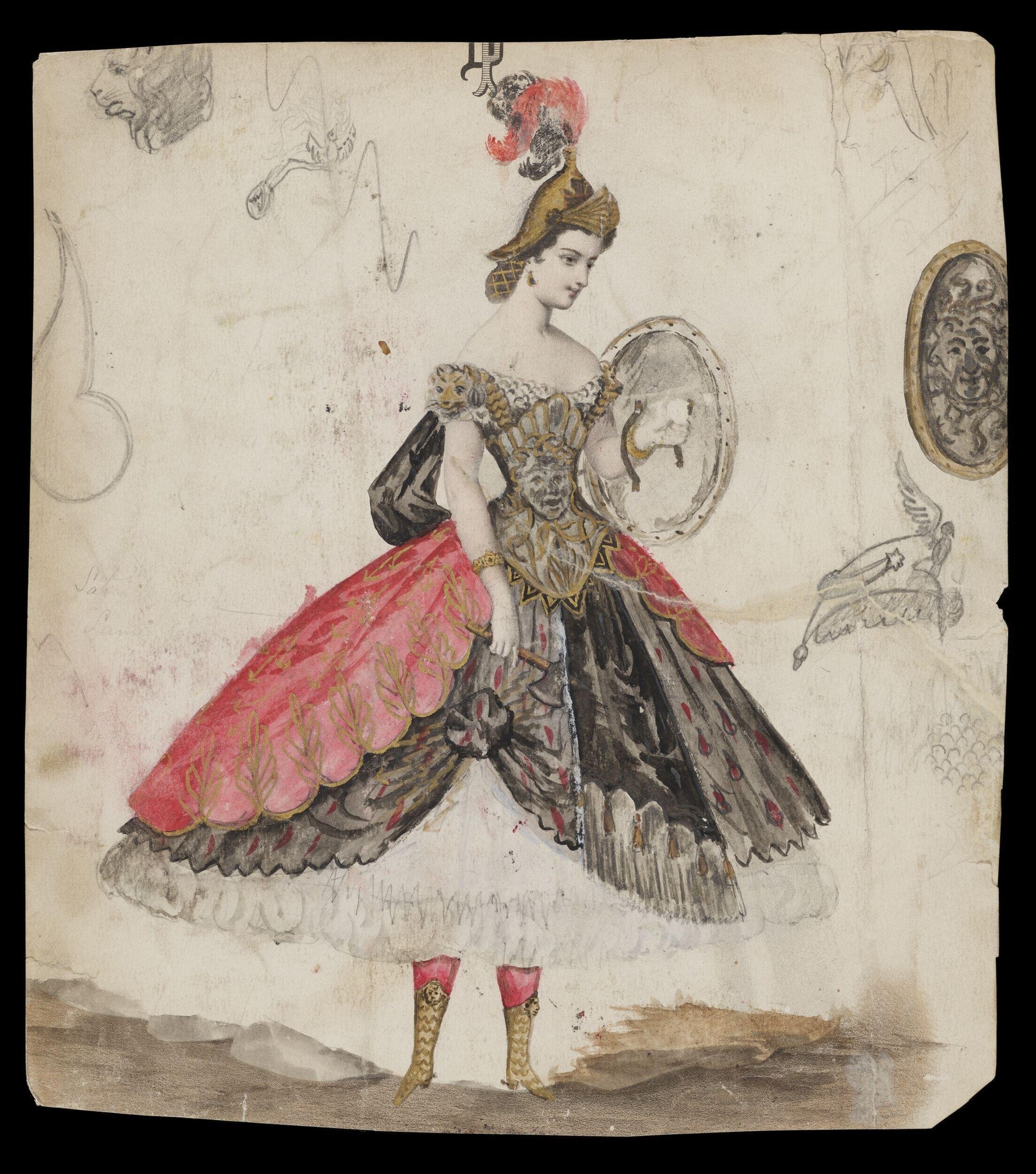
A woman in theatrical fancy dress stands alone against a plain background, posed in profile-frontal view. She wears an elaborate costume combining classical and theatrical elements: a tall golden headdress topped with red ostrich plumes, a corseted bodice decorated with ornate gold detailing featuring a lion's head motif at the center, and a dramatic skirt composed of layered wings in shades of pink, black, and cream with feathered edges. She holds a large circular mirror or shield in one hand and gestures expressively with the other. Her legs are clad in patterned stockings in cream and pink, and her posture is dynamic—the weight shifted, the torso turned, one arm raised. The composition includes scattered sketches in the margins: profile heads, decorative elements, and ornamental details. This is a costume design sheet rather than a depiction of actual dance in performance.
The dancing
A single female figure dominates the composition, viewed nearly frontally but with the body articulated in a three-quarter turn. The raised arm and extended gesture suggest theatrical presentation or a moment of display rather than active dancing. The posture is upright and statuesque, the weight concentrated rather than in motion; the figure is posed for effect rather than captured mid-movement. There is no partner, no ensemble, no spatial relationship to other bodies.
The dance depicted
This is not a depiction of dance in the conventional sense, but rather a costume design for theatrical masquerade or fancy dress, likely intended for performance at a ball or theatrical entertainment. The costume draws on classical mythology (the title 'Athena' and the owl-symbolism of the shield), operatic convention, and 19th-century theatrical fantasy. The pose is that of a performer presenting herself to an audience, but it shows posture and presentation rather than movement vocabulary. No specific dance style is evident.
How it was made
This appears to be a hand-colored drawing or watercolor on paper, executed in the manner of 19th-century theatrical costume design. The fine linework, carefully modulated washes of color (particularly in the delicate feathering and the graduated tones of the costume), and the marginal sketches are characteristic of working designs prepared for a costume maker or theater production. The technique allowed both precision in detail and the flexibility to indicate color and effect economically. This was a professional workshop product, circulated among theater personnel rather than a finished artwork for public exhibition.
About this work
This is a theatrical costume design by Jules Helleu, likely from the 1860s, depicting an elaborate fancy dress inspired by classical mythology and high theatrical tradition. It shows not a dancer but a performer in masquerade—a woman costumed as Athena, presented in a stationary pose of display rather than movement. The work belongs to a visual culture of theatrical entertainment, masquerade balls, and operatic fancy in the Gilded Age, when such designs circulated as working documents within theater and costume workshops. It records the aesthetic values and fantasy of mid-Victorian theatrical dress: the layering of classical reference with contemporary sensuality, the obsession with texture and ornament, and the theatricalization of the body as spectacle.
How to look at it
Observe the rendering of the costume itself: the feathering technique, the gold detailing, the way fabric is indicated by line and wash. Note the pose—not a dance position but a presentation stance, the body arranged for maximum visual effect. The marginal sketches reveal the designer's process, testing details and variations. The classical reference is evident but mediated through 19th-century theatrical fantasy; this is not historical accuracy but theatrical interpretation of mythology.
The artist
Jules Helleu (1821–1884) was a French artist and costume designer working in the mid-19th century. He was known for his theatrical and masquerade designs, which combined technical precision in rendering fabric and ornament with an eye for dramatic effect. His designs circulated among costume makers, theater companies, and wealthy patrons commissioning fancy dress for balls and entertainments. Helleu's work represents the professional illustrative tradition of theatrical design during the Second Empire.
The period
The 1860s saw a flowering of theatrical fancy dress and masquerade culture among the European upper classes, particularly in Paris. This coincided with the height of Romantic ballet—a tradition that, like masquerade, valued spectacle, fantasy, and the idealized female body. However, by the 1860s Romantic ballet itself was entering decline, and theatrical spectacle was increasingly channeled into opera, operetta, and the elaborate masquerade balls of the wealthy. Costume design as a professional discipline was becoming increasingly refined and specialized. Classical and mythological subjects remained fashionable for both high theatrical production and private entertainment.
Where it lives
Held as a fancy dress costume design in the Victoria & Albert Museum collection, London. The work is catalogued as a design sheet and reflects the museum's curatorial focus on theatrical design and applied arts.
Questions about this work
Is this actually a dancer or a dress design?
It is a costume design—a working drawing prepared for a theater or costumier. The figure is a model or presentation of how the costume should look when worn, not a record of an actual dance or performance. Such designs were practical documents in theater workshops.
Why is this in a dance collection if nobody is dancing?
Because costume design was integral to theatrical dance and masquerade entertainment. In the 19th century, the line between 'dance' and 'theatrical performance in elaborate costume' was fluid. Understanding how performers were dressed and how they presented themselves visually is essential to understanding how dance was experienced.
What is the reference to Athena?
The title and the imagery—the owl-head shield, the golden armor, the classical headdress—reference the Greek goddess. In 19th-century masquerade and theatrical convention, classical and mythological characters were stock roles, endlessly adapted and reinterpreted through contemporary fashion and fantasy.
More dance artwork





