49 works in this view — arrow keys or swipe to move between them.
Dance in Art
H Beard Print Collection
hogarth
- Collection:
- Source:
- Victoria and Albert Museum
- Rights:
- Rights vary by item — check the source record before reusing this image. Source record ↗
- Recorded as:
- V&A — check rights per item
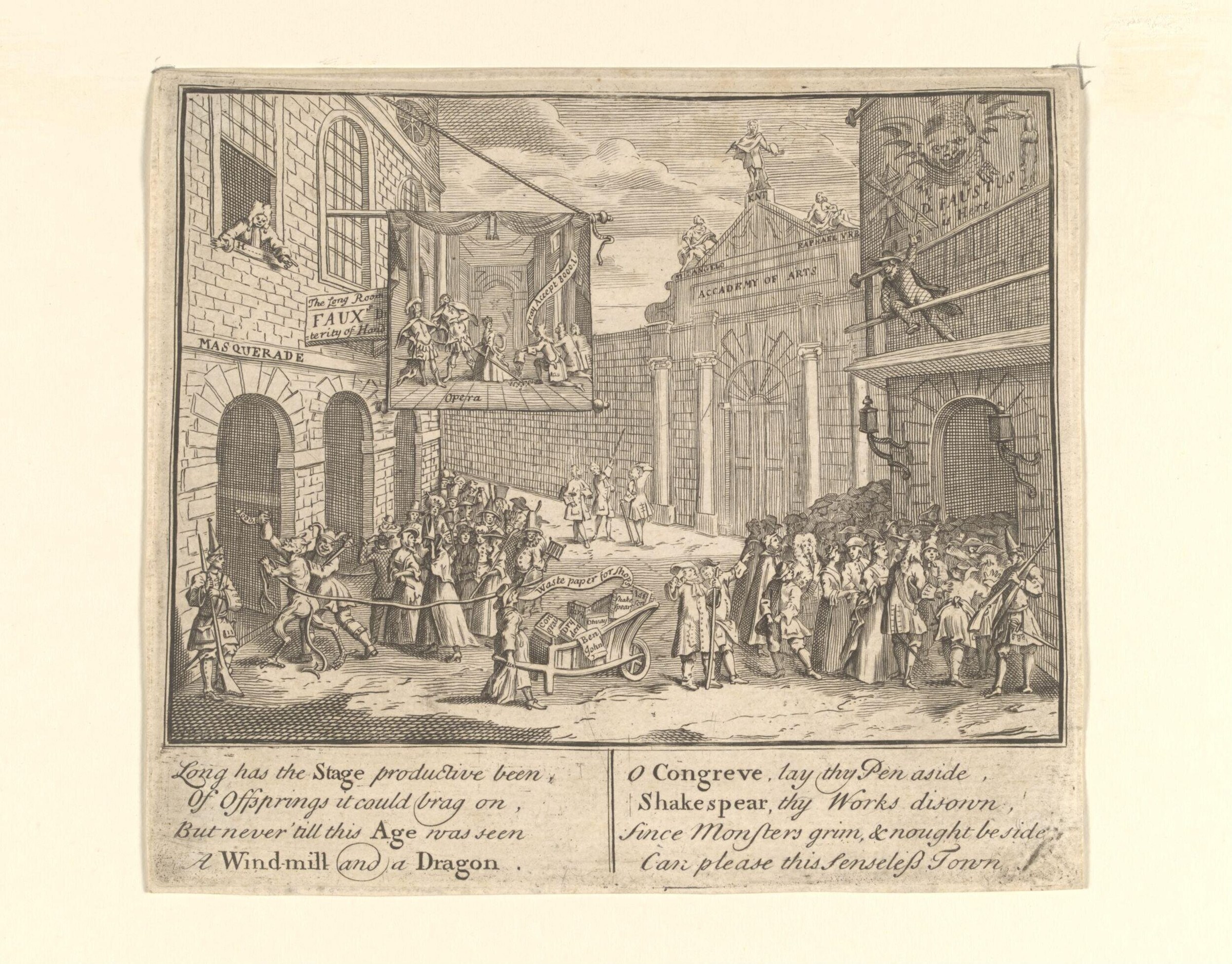
The print reveals the topography of entertainment in Hanoverian London—where masquerades, opera houses, and acrobatic spectacles were physically clustered and socially intertwined. For historians of dance and performance, it shows that "theatre" in this period encompassed aerial acrobatics, farce, and physical spectacle as well as music and formal dance. The very dismissal in the caption—the scorn for the crowd's appetite for "a Windmill and a Dragon"—indexes the tensions between elite theatrical taste and popular amusement that shaped dance culture.
What you are looking at
A dense urban plaza animated by a crowd of well-dressed figures arranged across stepped architectural planes. In the foreground, a large throng clusters near two massive arched doorways on the left; the crowd spills rightward into an open space, with figures standing in conversational clusters and small groups. Above and behind, the composition rises through architectural layers: a broad central square occupied by more pedestrians, then buildings labeled "FAUX" (Masquerade) and "OPÉRA" with figures gesturing from windows and rooflines. Dominating the upper center is a tall structure marked "ACADEMY OF ARTS" with an ornate sculptural group atop it. The perspective is vertiginous, pulling the eye backward and upward in a maze of receding streets and facades. A banner reading "The Siege of Troy" hangs at lower left. Figures throughout are rendered in the busy, satirical style of early 18th-century social engraving: miniature, individualized, often in exaggerated or ridiculous postures. The caption below dismisses the theatrical spectacle as a "Windmill and a Dragon" despite the ambitions labeled onscreen.
The dancing
No coherent dance formation is evident. The figures are scattered in attitudes of standing, strolling, gesturing, and animated conversation rather than organized movement or partnered dance. Some raise their arms in pointing or declamatory gestures; others stand in profile watching. The only figures in overtly acrobatic or performance postures are those scaling the buildings and architectural elements—figures climbing ropes, clinging to walls, suspended from the roof of the Academy. The composition prioritizes social chaos and theatrical artifice over ballroom propriety or courtly formation.
The dance depicted
This is not a dance image in the conventional sense. The scene depicts the circus-like bustle of a metropolitan theatrical culture—the crush of crowds around masquerades and opera, the acrobatic spectacle on display above street level. The caption's dismissal ("a Windmill and a Dragon") suggests Hogarth is mocking the theatrical and acrobatic pretensions of contemporary London entertainment. No social dance or ballroom genre is depicted. The acrobatic and aerial feats visible on the architecture are performance spectacle rather than dance proper.
How it was made
This is a copper engraving, executed with fine parallel hatching and cross-hatching to create tone and shadow. The technique allows for extensive detail and satirical annotation: individual faces are rendered with particularizing strokes, and the teeming composition is held legible through careful value gradation. The numbered references and inscribed labels embedded in the print are characteristic of Hogarth's practice of annotated social satire. As an engraving, this work was reproducible and likely circulated widely in printed form, making it an accessible medium for public commentary on London life.
About this work
This is a crowded metropolitan scene of early 18th-century theatrical and acrobatic spectacle, engraved in the satirical style of William Hogarth. The print captures the fever of theatrical entertainment in London—the masquerades, operas, and acrobatic displays that competed for public attention. Rather than depicting ballroom dance or concert entertainment, Hogarth presents the chaotic, overstimulating atmosphere of popular street culture and circus-like performance. The engraving belongs in a dance history collection not because it depicts dance itself, but because it documents the cultural and architectural contexts in which dance and spectacle competed for social space and audiences in the early 18th century. It is evidence of how acrobatic and aerial performance existed within the same entertainment ecosystem as social dance and ballroom culture.
How to look at it
This print rewards close, prolonged looking—it is packed with individual incident and satirical observation. Begin with the foreground crowds and trace upward through the architectural recessions to the Academy above. Notice the different registers of activity: street-level social crush, theatrical display in windows and doorways, and acrobatic performance on the heights. Observe the variety of individual postures and expressions—Hogarth particularizes every figure, avoiding type. The caption should be read last, as it provides Hogarth's own judgment on what the eye has seen. The engraving technique itself—the precise lines and subtle tonal graduations—creates an almost archaeological specificity, making the scene feel like a documented record of a real moment.
The artist
William Hogarth (1697–1764) was an English painter, printmaker, and social satirist. He pioneered the use of sequential narrative scenes and annotated engravings to critique contemporary manners, morality, and social pretension. His prints, issued in series and individually, circulated widely and afforded him a large middle-class audience. He combined fine draftsmanship with biting humor, particularizing individual figures and embedding labels, references, and pointed details that rewarded close looking. His work was shaped by the visual tradition of Flemish genre painting and the emergent culture of the English pleasure garden and public sphere.
The period
In the 1720s, London was experiencing explosive growth in commercial entertainment. Masquerades—elaborate fancy-dress assemblies—were fashionable among the gentry and newly wealthy, and were often held at purpose-built venues. Italian opera had recently arrived and was a status symbol for the aristocracy. Acrobatic performances, rope-dancing, and "wild beast" exhibitions were popular street attractions. Dance in this period was fragmenting into multiple registers: courtly minuet and country dance for the elite, popular country and tavern dance for working people, and theatrical dance spectacle. Hogarth's print captures this cultural ferment and the anxiety that theatrical novelty and sensational spectacle were displacing older social forms.
Where it lives
Held in the H. Beard Print Collection at the listed source. The collection designation and the print's record as a Hogarth work suggest it is part of a curator-assembled group of 18th-century social satirical prints.
Questions about this work
Is this a dance picture?
Not in the usual sense. It depicts a crowded urban scene of theatrical entertainment and acrobatic spectacle, not a ballroom, court, or concert performance. However, it is valuable for dance history because it documents the architectural and social infrastructure of performance in early 18th-century London, showing where acrobatic and theatrical spectacle competed for audiences and space.
What are the people doing?
They are clustered around masquerade and opera venues, watching street spectacle, and engaging in the social bustle of urban entertainment. The figures above are acrobats scaling buildings and performing aerial feats. The overall effect is of chaotic, overstimulating public amusement.
Why does Hogarth call it a 'Windmill and a Dragon'?
The caption is dismissive: it suggests the crowd's appetite for theatrical novelty (whether real or mere stage machinery) is vulgar and credulous. The print mocks both the theatrical producers and their audiences, capturing Hogarth's skeptical view of London's entertainment industry.
What techniques did Hogarth use?
This is a copper-plate engraving, made by incising lines into metal. Hogarth used fine parallel and cross-hatched lines to create tone and shadow. The technique allowed him to render extensive fine detail—individual faces, architectural specificity, and satirical annotations—and the print could be reproduced and sold widely.
More dance artwork





