49 works in this view — arrow keys or swipe to move between them.
Dance in Art
H Beard Print Collection
Hogarth, William
- Collection:
- Source:
- Victoria and Albert Museum
- Rights:
- Rights vary by item — check the source record before reusing this image. Source record ↗
- Recorded as:
- V&A — check rights per item
Hogarth's satirical prints document 18th-century public culture, including popular entertainment and street festivity. For dance historians, the work captures the informal, embodied joy of carnival atmosphere—the social dancing and movement that occurred outside formal theatrical spaces and existed alongside official cultural institutions.
What you are looking at
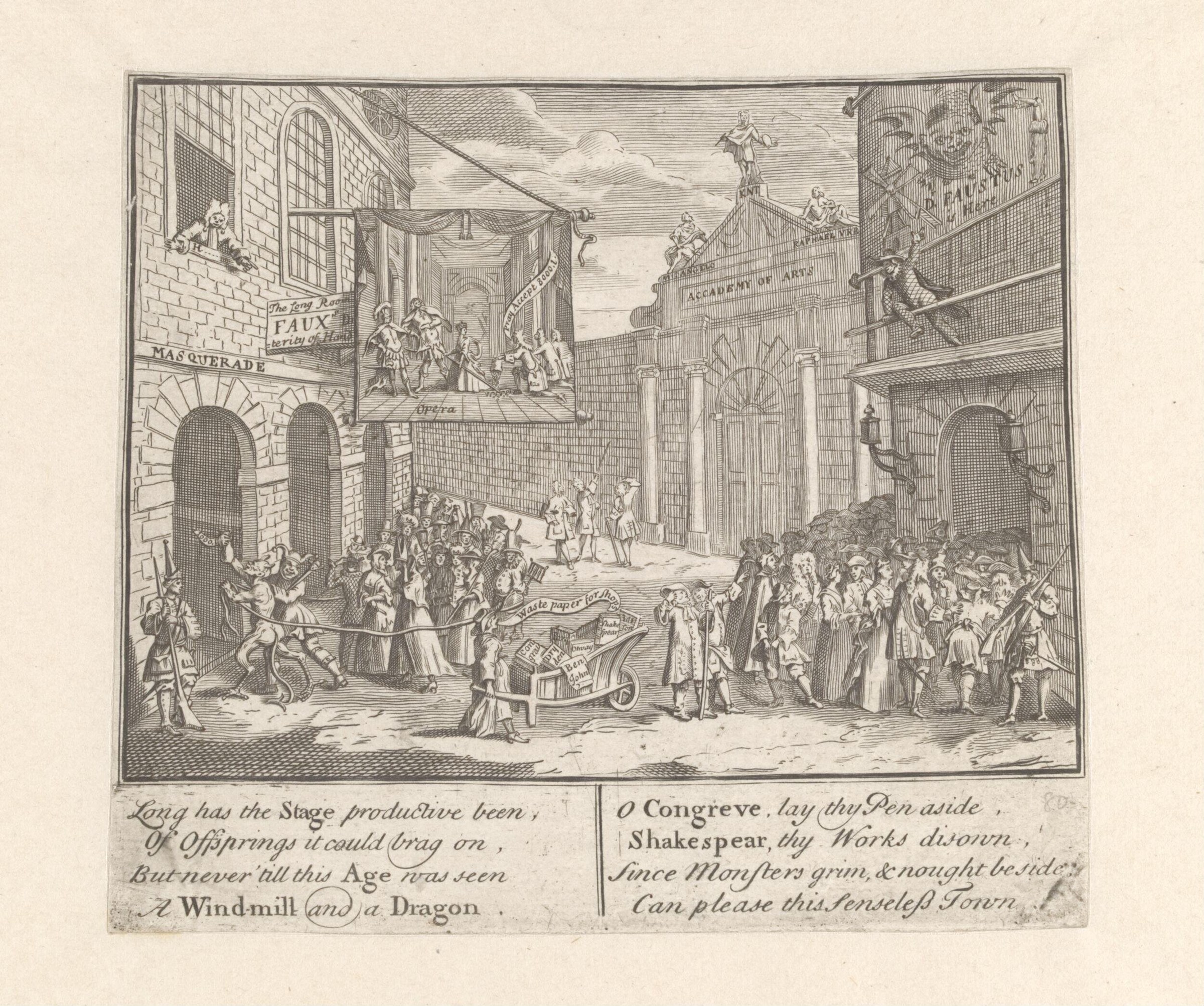
A crowded urban square in front of what appears to be a grand institutional building, labeled "Academy of Arts" with a domed cupola. The scene depicts a chaotic street celebration or performance, with figures in 18th-century dress filling the composition. On the left, a masquerade entrance is marked "Faux Masquerade." On the right, figures climb and gesticulate on the building's facade and roof. The center is packed with spectators, vendors with carts, and performers. Banners and placards flutter overhead. The sky contains clouds and flying figures. The print's lower panel contains two verses, the first reading "Long has the Stage productive been, / Of Offssprings it could brag on, / But never till this Age was seen / A Windmill (and) a Dragon." The second addresses Congréve: "lay thy Pen aside, / Shakespear, thy Works disown, / Since Monsieur grm & nought besides / Can please this senseless Town."
The dancing
The figures throughout are rendered in rapid, expressive postures: some wave arms aloft, others gesture in apparent conversation or mockery, many crowd together in clusters. Limbs are often angular and exaggerated. A few figures appear to dance or skip, though the press of the crowd and the print's satirical tone suggest performance and carnival behavior rather than formal choreography. The variety of poses—jumping, leaping, standing in groups—conveys excitement and disorder rather than synchronized movement.
The dance depicted
This is not primarily a dance scene but a satirical street carnival or public fair. However, scattered among the crowd are figures in motion that suggest folk celebration and informal social dancing typical of 18th-century street festivals. The verse references a "Windmill and a Dragon," likely referring to mechanical stage props or pageant figures rather than dances. The carnival atmosphere and the mixed crowd of spectators and performers suggest popular festival culture, but no specific dance form is identifiable. The scene satirizes public taste and theatrical fashion rather than depicting a coherent dance.
How it was made
This is an engraving, identifiable by the fine parallel lines (hatching) that model form and tone throughout, and the precise linear definition of architecture and figures. The technique allows dense detail and satirical clarity across a crowded composition. The inscribed verses at the bottom anchor the work as a political or cultural commentary, typical of 18th-century graphic satire. Engravings of this type circulated widely as prints and reached a broad urban audience.
About this work
This is an 18th-century engraved print depicting a chaotic street festival or fair centered on a grand public building. The scene combines performance, spectacle, and crowd behavior in a style consistent with Hogarth's satirical graphic practice. Although not a dance depiction in the strict sense, the work captures the energy and social character of popular carnival and street festivity, where informal movement and celebration blur into what might be called folk or social dancing. It belongs in a dance gallery as a historical record of how bodies moved in public celebration and as evidence of the street culture surrounding theatrical performance.
How to look at it
Attend to the scattered figures in motion throughout the square: notice the raised arms, the bent legs, the clustered groups, and the way certain figures seem to leap or spring. The artist has frozen a moment of peak excitement and disorder. Observe how the inscribed verses direct the viewer's attention to the satirical point—the work mocks both the spectacle on display and the crowd's appetite for novelty over substance. The architectural grandeur of the building frames the chaos of popular culture beneath it.
The artist
William Hogarth (1697–1764) was a printmaker and painter famous for moralistic and satirical series depicting 18th-century English life. His graphic works, especially his engraved prints, were widely circulated and often carried social or political commentary through packed, detailed compositions. His interest in human behavior and social excess made him a keen observer of public spectacle and crowd behavior.
The period
The early 18th century saw a flourishing of popular street entertainment, masquerade culture, and public fairs in London and other European cities. Theatrical performance was expanding beyond court and playhouse into public squares and streets. Hogarth's career coincided with a period of increased satirical graphic production targeting public taste, social pretension, and the competing claims of traditional and fashionable entertainments.
Where it lives
The work is recorded in the H Beard Print Collection, held as a print (engraving). The collection comprises historical prints; this piece exemplifies Hogarth's graphic satire of 18th-century public life.
Dance in this work
Questions about this work
Is this a real dance or a satirical fantasy?
The scene depicts a real type of public event—an 18th-century street fair or carnival—but the "Windmill and Dragon" referenced in the verses are likely mechanical props or pageant figures, not dances. The scene satirizes public taste by contrasting these spectacular novelties with high theatrical traditions. The movement shown is the excited, disordered crowd behavior typical of street festivals.
Why are there verses printed on the engraving?
Inscribed texts are characteristic of Hogarth's satirical prints. The verses anchor the social and political critique, attacking both the promoters of fashionable spectacle and the public appetite for novelty. They are essential to the work's meaning and typical of 18th-century graphic satire.
What does the building represent?
The labeled "Academy of Arts" suggests an institution of high culture, positioned above and apart from the carnival chaos below. This vertical contrast reinforces Hogarth's satire: legitimate art and learning are ignored in favor of sensational street entertainment.
More dance artwork





