49 works in this view — arrow keys or swipe to move between them.
Dance in Art
Figure
Willems, Joseph
- Collection:
- Figure
- Source:
- Victoria and Albert Museum
- Rights:
- Rights vary by item — check the source record before reusing this image. Source record ↗
- Recorded as:
- V&A — check rights per item
For dance historians, this figurine documents the thriving theatrical culture of the 18th century beyond ballet—the masked comedies, pastoral spectacles, and character dances that rivaled or exceeded ballet in popularity and cultural reach. It also shows how porcelain manufacturers translated theatrical performance into collectible art, revealing what courtly and urban audiences valued: costume, character, and narrative gesture over pure technique.
What you are looking at
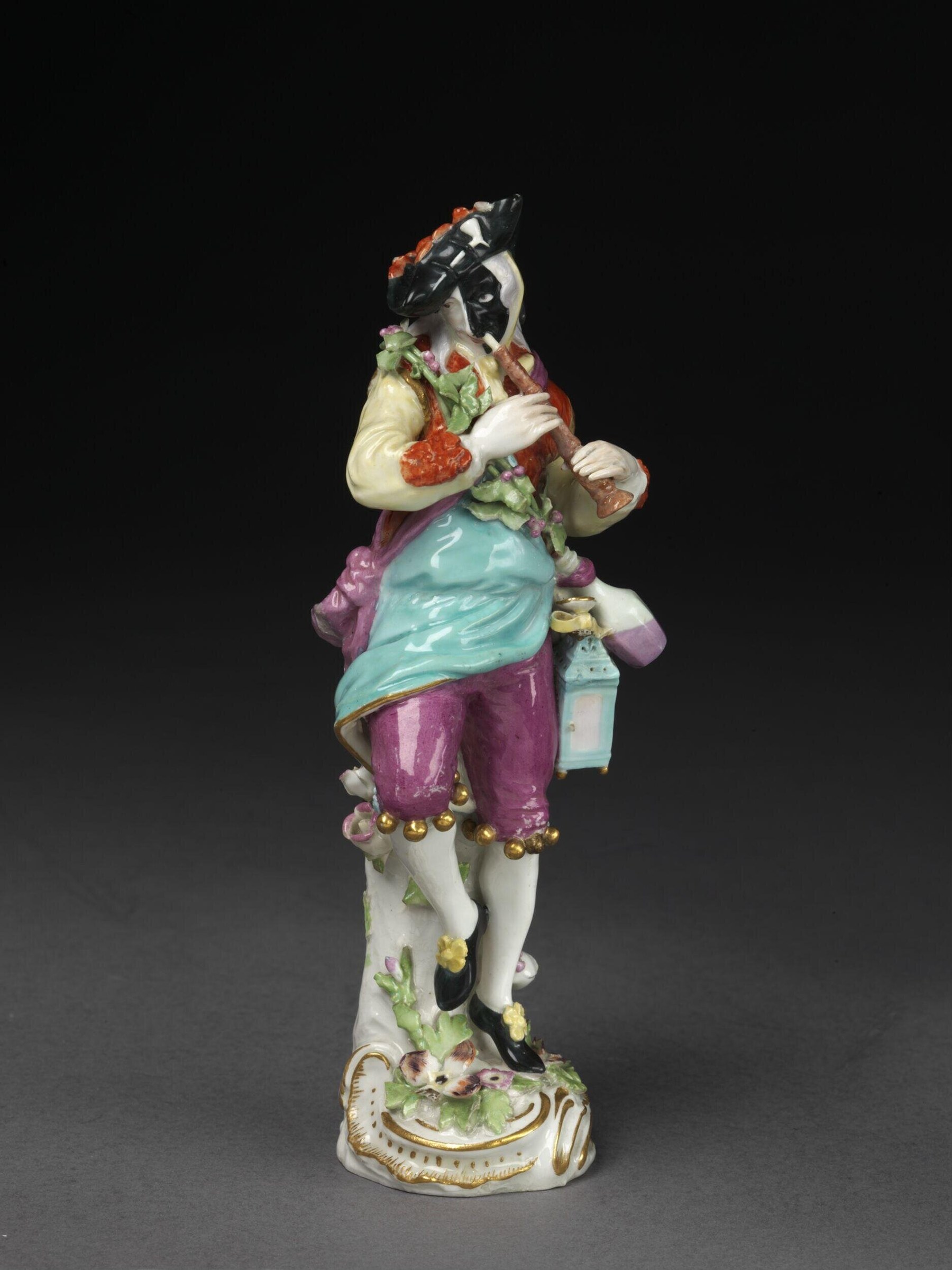
A porcelain figurine depicts a single dancer in three-quarter view against a plain dark background. The figure wears exotic stage costume: a black face mask or domino, orange-red curled hair or feathered headdress, cream silk jacket with gold trim, a turquoise overskirt draped asymmetrically, and magenta silk knee breeches with gold-beaded hem. White stockinged legs and black shoes complete the ensemble. The dancer holds strawberries and foliage in one hand and a small lantern in the other, standing on a scrolled white base decorated with floral sprays and gold rococo ornament. The pose is animated: the body leans back slightly, one leg extended, the free arm gestures outward—a moment of theatrical display rather than technical dance vocabulary. The figure's gaze is directed upward and to the side, adding to the sense of performance and spectacle.
The dancing
A single standing figure in a slightly off-balance pose that emphasizes showiness over structural control. The weight appears to rest primarily on one leg, the other extended or lightly flexed; the torso twists to open the body toward the viewer. The arms are asymmetrically disposed—one holding attributes, one free and gesturing. There is no suggestion of the turned-out positions, tight frame, or pulled-up carriage of ballet technique. The posture is more expressive and picturesque than balletic; it reads as a social or theatrical performer rather than a trained dancer.
The dance depicted
This figurine almost certainly depicts a character from commedia dell'arte or a related theatrical tradition, rather than classical ballet or a ballroom dance. The mask, exotic costume, and held attributes (fruit, lantern) suggest a named dramatic character—possibly a variant of theatrical stock types circulating in 18th-century court entertainments and masquerades. The pose suggests gesture and mime for dramatic effect rather than the codified technique of ballet. Without a title or inscription, the specific character cannot be identified with certainty, but the dress and props point to a player or dancer in a comedy or pastoral spectacle rather than a courtly ballet dancer.
How it was made
This is a hand-painted porcelain figurine, likely from a German manufactory such as Meissen, Höchst, or a comparable establishment. The technique involved casting in mold, hand-painting in enamel colors (the turquoise, magenta, cream, and gold are characteristic of mid-18th-century palette), and careful articulation of small details. Porcelain figurines of this scale and finish were luxury objects and collectibles, displayed on mantelpieces and in cabinets; their circulation was confined to wealthy households and courts. The medium allowed for fine modeling of costume detail and expressive gesture, but the small scale and fragility of the material mean the dancer's feet and lower limbs are somewhat simplified.
About this work
This is an 18th-century porcelain figurine of a masked theatrical character in exotic costume, posed in a gesture of display and entertainment. It exemplifies the taste of the German rococo for charming, decorative representations of theater, masquerade, and commedia dell'arte—modes of popular entertainment that coexisted alongside the development of classical ballet. The work sits at an intersection of theatrical and social dance culture: it captures not the technique of ballet, but the persona and costume of a performer in a more fluid, improvisational tradition. Such figurines were part of a widespread market in miniature theatrical and courtly scenes that allowed collectors to own and display the spectacle of performance.
How to look at it
Look first at the costume: the mask and exotic dress are the key to identifying what is being represented. The pose is theatrical rather than balletic—the body's twist, the upward gaze, the extended arm with objects held as props all point to a moment of character expression and narrative rather than movement or technique. Notice how the artist has articulated the silk fabrics (the way the overskirt falls, the sheen of the breeches) and the fine details of jewelry and ornament. The base—scrolled, decorated with naturalistic floral sprays—is typical of rococo porcelain and was itself a painted and glazed element. The whole object is small enough to hold in the hand; imagine it among a collector's cabinet of similar figures, each representing a different theatrical type.
The artist
Joseph Willems (documented 1748–c. 1766) was a sculptor who worked at the Höchst porcelain manufactory in the Rhineland during its early and most creatively ambitious period. Höchst was one of the major German porcelain factories and competed with Meissen for the patronage of German princes and the export market. Willems is documented as a modeler of figurines—the skilled artisan who created the original molds from which production pieces were cast. His work is characteristic of Höchst's strength in theatrical and character figurines; the factory was known for witty, detailed representations of commedia dell'arte players, musicians, and dancers in costume. Few pieces can be securely attributed to named modelers, so any documentation of Willems' hand is noteworthy.
The period
In the 1760s, when this figurine was made, ballet was undergoing transformation in France and Italy toward greater expressiveness and less rigid formality, but the theater of German courts remained eclectic. Masquerade and commedia dell'arte were fashionable entertainments; characters like Harlequin, Columbine, and various masked types appeared in spoken comedy, musical theater, and pantomime. The porcelain figurine industry flourished as courtly and mercantile elites acquired collections of tiny theatrical and domestic scenes—a form of conspicuous consumption and aesthetic display. German factories in particular catered to this taste, producing hundreds of character studies. Willems worked in this context: his models would have been appreciated by collectors as miniature documents of current fashionable entertainments.
Where it lives
The figurine is held in the V&A collection (the source is listed as "va"). The catalogue record is minimal; neither date, medium, dimensions, nor marks are fully recorded. Attribution to Willems appears in the collection documentation but cannot be verified from the image alone.
Questions about this work
Is this a ballet dancer?
No. The costume, mask, and pose suggest a character from commedia dell'arte or theatrical comedy, not classical ballet. The body's posture is expressive and gestural rather than aligned with the turned-out positions and formal technique of ballet. This reflects the broader 18th-century theatrical world, in which masked comedy, pastoral spectacle, and character dances were as popular as ballet.
What is the figure holding?
Strawberries (or similar red fruit) with green foliage in one hand, and what appears to be a small lantern or portable light in the other. These are theatrical properties—attributes of a named character—rather than items integral to dance movement. They signal that this is a representation of a player in a narrative performance, not a study of pure dance.
Why were porcelain figurines like this made?
Porcelain figurines were luxury collectibles for wealthy households and courts. Manufacturers like Höchst produced them in series to document fashionable entertainments—theater, masquerade, courtly life. They were displayed in cabinets and on mantelpieces, functioning as miniature theater pieces and conversation pieces. Collecting them was a mark of taste and cosmopolitan awareness.
Can I identify the specific character?
Not from the image alone without an inscription or title. The mask and exotic costume suggest a named stock character from commedia dell'arte or a related tradition, but without a title or maker's mark visible in the photograph, the specific role cannot be confirmed. The attributes—fruit and lantern—might narrow it further if the theatrical repertory of the 1760s Höchst circle were fully documented.
More dance artwork





