49 works in this view — arrow keys or swipe to move between them.
Dance in Art
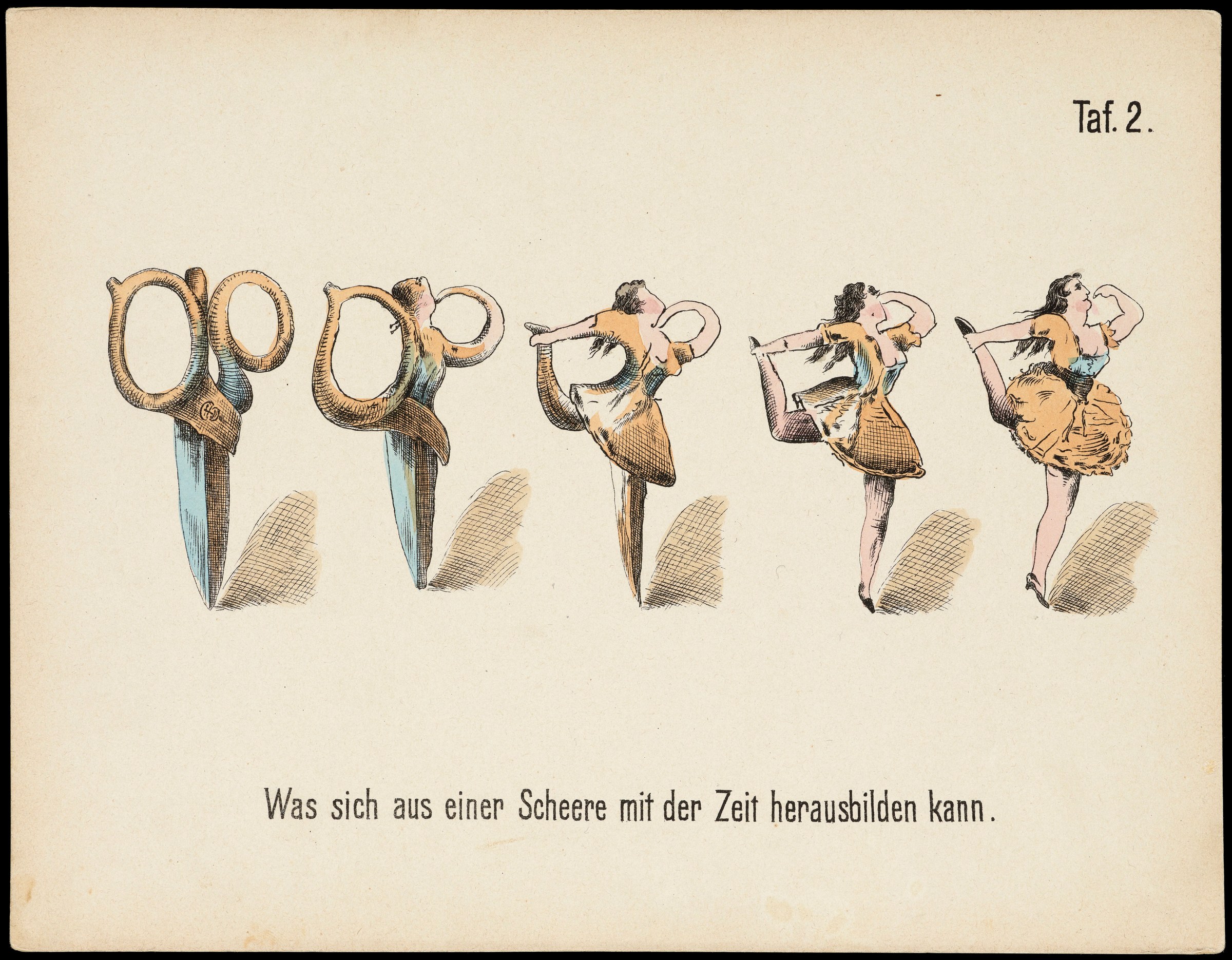
Evolution of household articles, animals etc. according to Darwin's doctrine. Colour lithographs by Fr. Schmidt, ca. 187-(?).
Unknown artist
- Source:
- Wellcome Collection
- Rights:
- Reusable with conditions: credit the creator; non-commercial use only. Source record ↗
- Recorded as:
- Attribution-NonCommercial 4.0 International (CC BY-NC 4.0)
This work reveals the satirical discourse surrounding evolution, female embodiment, and transformation in the late 19th century. Its absurdist reduction of womanhood to a tool—and the suggestion that tools could 'become' women—exposes period anxieties about women's bodies and their proper forms. For historians of dance and visual culture, it documents how the female body was treated as a site of ridicule and visual spectacle in popular prints.
What you are looking at
This lithograph presents a comic sequence showing the transformation of a woman over time, aligned with Darwinian evolutionary theory. Five stages progress from left to right: the first shows a woman whose body is composed of scissors—her torso formed by the open blades and handles, her limbs thin and blade-like. In each subsequent frame, the figure becomes progressively more human and feminine, the scissor-body gradually transforming into flesh, curves, and fashionable dress. By the final frame, a fully realized young woman in a belted dress and with curled hair stands in a confident pose. The background is plain cream, throwing all emphasis onto the figures. Each stage casts a subtle shadow, suggesting dimensionality. The German caption reads "Was sich aus einer Scheere mit der Zeit herausbilden kann"—"What can develop from a pair of scissors over time."
The dancing
The sequence shows a single figure undergoing metamorphosis rather than multiple dancers. In the early frames, the figure's posture is stiff and geometric, constrained by the scissor form. As the sequence progresses, the body becomes more articulated and capable of movement—the shoulders relax, the spine curves, the limbs gain volume and flexibility. By the final figure, the woman stands with weight on one leg, the other slightly bent, her arm raised in a gesture of ease or presentation. The progression suggests awakening physicality rather than any specific dance movement, though the final pose hints at the freedom of human motion.
The dance depicted
This is not a depiction of dance but rather a satirical commentary using the female form and the language of physical transformation. The work appears to mock or parody Darwinian evolutionary theory by suggesting that a woman is the 'evolution' of a pair of scissors—a nonsensical reduction that uses the logic of natural selection as the vehicle for the joke. The image relies on absurdist humor rather than dance content. No actual dance movement or style is represented; the progression is purely biological-comedic rather than choreographic.
How it was made
The work is a colour lithograph, a print technique that allowed for mass reproduction and circulation in the 19th century. Lithography permitted the artist to combine fine line work (visible in the scissor rendering and dress details) with hand-applied colour—the blue and flesh tones are added after printing. This technique suggests the work was intended for popular consumption, likely appearing in a satirical publication or broadsheet. The combination of sharp linear detail with soft colour modulation creates visual comedy: the geometric precision of the scissors contrasts with the soft, rounded forms of the evolved woman.
About this work
This is a satirical lithograph from the late 19th century that uses the language and logic of Darwinian evolution to make a visual joke about women and transformation. Rather than depicting dance, it presents a progressive sequence in which a woman's body is shown 'evolving' from a pair of scissors into a fully realized human form dressed in contemporary fashion. The work belongs in a gallery about dance primarily as an historical artifact of how the female body was represented and parodied during the period—it shows how the female form could be abstracted, commodified, and transformed for comic effect. While not depicting actual dance, it engages with bodily representation and the social anxieties surrounding women's embodiment that circulated in the same cultural moment as modern dance's emergence.
How to look at it
Read the sequence from left to right as a narrative of transformation. Notice how the artist uses the geometric rigidity of scissors to suggest an 'unfinished' or 'primitive' state, then gradually replaces hard lines with soft curves and fabric. Observe the final figure's pose—slightly more relaxed and confident than her scissor-bound predecessors—and the addition of fashionable details: the belted waist, the curled hair, the assured posture. The joke operates on multiple levels: it mocks both evolutionary theory (by suggesting an absurd evolutionary path) and contemporary ideas about woman's 'natural' form and purpose.
The artist
The lithograph is attributed to Fr. Schmidt in the catalogue record, but the artist's full identity, biographical details, and other works remain unconfirmed. The style and satirical approach suggest engagement with the popular print culture and scientific satire of the 1870s–1890s, when Darwin's theories were widely debated and frequently mocked in the popular press. The use of sequential transformation as a compositional strategy was not uncommon in satirical graphics of this period.
The period
The work dates to approximately the 1870s–1890s, a period of intense public debate over Darwinian evolution following the publication of *The Descent of Man* (1871). Evolutionary theory became a site of satire, anxiety, and cultural commentary. The representation of women's bodies and women's 'nature' was frequently addressed through grotesque or absurdist visual language in popular prints. This was also a period of significant change in women's dress, education, and social roles—anxieties about these shifts were often channeled through comic imagery of bodily transformation. The lithograph's treatment of the woman's dress as a marker of 'civilization' or 'progress' reflects period ideology about gender, refinement, and evolutionary advancement.
Where it lives
The work is held in the Wellcome Collection, a medical and scientific history institution, suggesting it was catalogued as a satirical response to scientific discourse rather than as a work of art history proper. The collection's focus on medical imagery and scientific satire contextualizes this as a cultural document of how evolutionary theory circulated in popular visual media.
Questions about this work
Is this actually about dance?
No. This is a satirical commentary on Darwinian evolution using the female body as its subject. It belongs in a dance gallery as a historical artifact showing how female embodiment was represented and ridiculed in the period when modern dance was emerging, and as an example of how the body itself could be treated as a site of visual comedy and transformation.
What does the German caption mean?
The caption reads 'What can develop from a pair of scissors over time,' and it is the setup for the visual joke. By treating scissors as the evolutionary 'ancestor' of a woman, the artist absurdly applies Darwinian logic to mock both the theory and contemporary ideas about women's nature and refinement.
Who was Fr. Schmidt?
The artist's full identity remains unconfirmed in available records. The initials and style suggest a German or Central European artist working in popular satirical lithography in the late 19th century, but no biographical details have been verified.
Why is this in a medical collection?
The Wellcome Collection holds objects related to the history of medicine, science, and the body. This satirical print documents how evolutionary and scientific theories were received, debated, and mocked in popular culture—making it a valuable record of scientific discourse and social anxiety.
More dance artwork





