49 works in this view — arrow keys or swipe to move between them.
Dance in Art
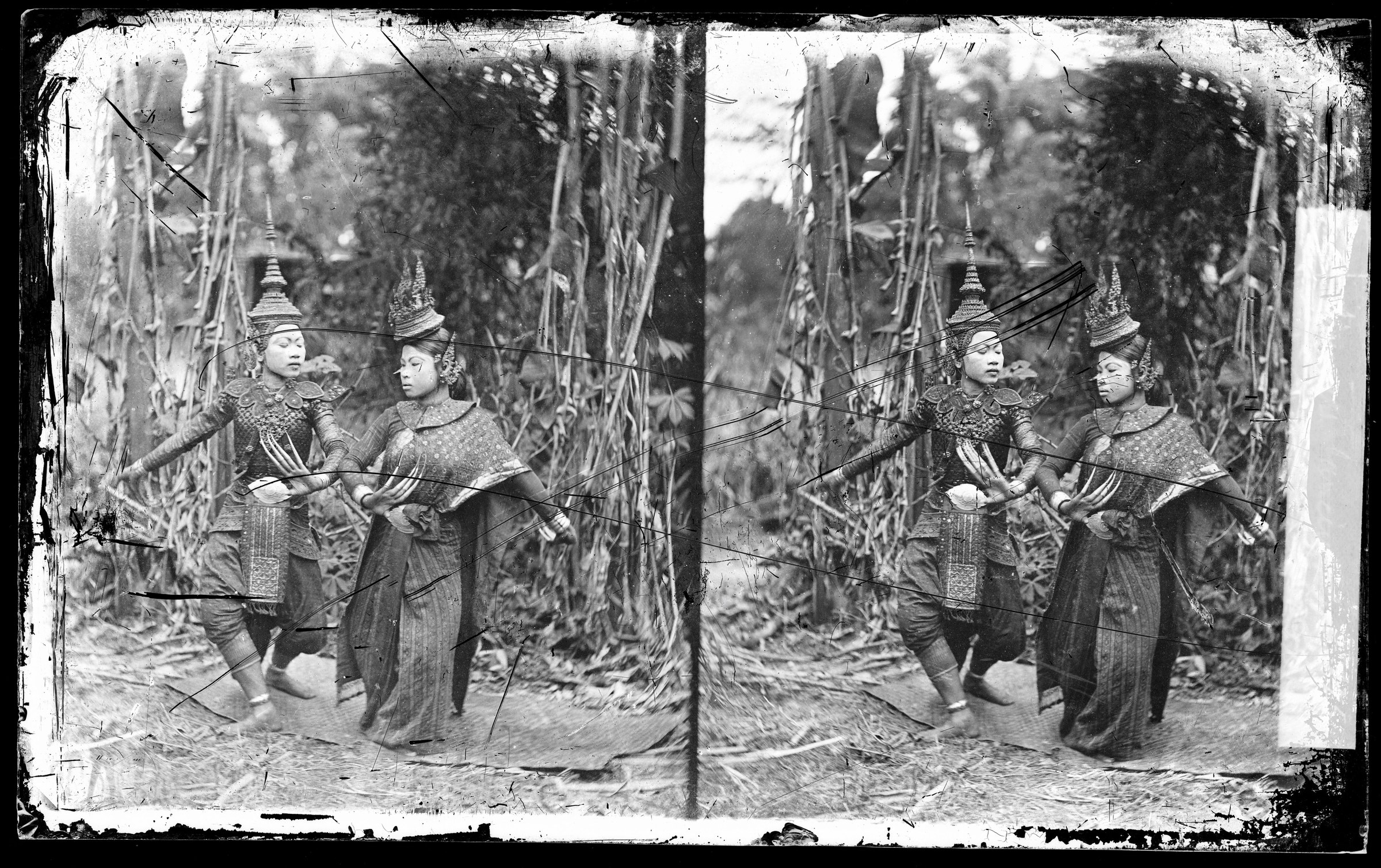
Siam (Thailand]): two dancers. Photograph by John Thomson, 1865.
Unknown artist
- Source:
- Wellcome Collection
- Rights:
- Public domain — free to use, share and adapt.
- Recorded as:
- Public Domain Mark
This work reveals the intersection of colonial-era photography, ethnographic documentation, and the Western appetite for exotic spectacle. For dance historians, it demonstrates how the formal, static medium of photography combined with the stereograph format fundamentally altered how non-Western dance was perceived and consumed in the West—reducing dynamic, codified movement vocabularies to picturesque costume display. Thomson's choice to pose rather than capture these dancers in motion raises essential questions about the relationship between photography and dance authenticity.
What you are looking at
A stereoscopic photograph shows two Thai dancers posed in a forest setting dense with tall trees and hanging vines. Both figures wear richly ornamented costumes: fitted jackets with intricate brocade patterns, and skirts that fall to just below the knee. Each wears a tall, pointed crown (likely a *chada* or similar Thai headdress) that rises dramatically above the head. The dancer on the left stands with arms extended and slightly bent at the elbows, palms open in a characteristic Thai gesture. The dancer on the right mirrors a similar arm position. Their bodies are upright and dignified, the poses formal and composed rather than caught mid-movement. The forest backdrop—dense with vertical tree trunks and naturalistic foliage—creates a theatrical frame. The photograph is mounted as a stereograph pair, indicating it was made for a stereoscope viewer, a popular form of three-dimensional domestic entertainment in the Victorian era.
The dancing
Both dancers stand in upright, frontal positions with a formal bearing. Their arms are raised at shoulder height with elbows slightly bent and palms turned outward or downward—a posture consistent with Thai classical dance codification. The weight appears evenly distributed through the legs; there is no visible weight shift, lunge, or asymmetry suggesting motion captured mid-phrase. The dancers do not touch or interact with each other, instead presenting parallel, mirror-like poses. The precision and symmetry of their positioning suggests this is a posed studio arrangement rather than documentary of performance or rehearsal.
The dance depicted
The dancers almost certainly represent *Khon*, Thai classical masked or unmasked court dance, or *Lakhon*, a related Thai theatrical form. The ornate pointed headdress, tight jacket, and formal arm geometry are consistent with Thai classical dance training and costume. However, this is not an action photograph; it is a posed studio portrait designed to display costume and formal posture to Western audiences unfamiliar with Thai dance. The image documents the visual appearance and formal aesthetic of Thai classical dance rather than its dynamic vocabulary—the continuous shifting of weight, intricate footwork, and fluid transitions that characterize actual performance.
How it was made
This is a stereoscopic photograph mounted as a stereograph card, a format mass-produced for the stereoscope, a optical viewing device that created an illusion of depth when paired images were viewed through a lens. The photograph shows the wear and damage typical of archival photography from this era: creasing, surface scratches, and age spots visible on the emulsion and card mounting. The image is printed as a salt print or albumen print (a common photographic emulsion of the 1860s) on card stock. Stereographs were a major medium of popular education and entertainment in Europe and North America during the mid-to-late 19th century, allowing middle-class homes to "travel" visually to distant lands. This format implies the image was made for Western domestic consumption rather than for Thai audiences.
About this work
This is a stereographic photograph of two Thai classical dancers posed in a forest studio setting, dated 1865 and attributed to the photographer John Thomson. The dancers wear elaborate court dress and formal headdresses characteristic of Thai classical dance forms such as Khon or Lakhon. The photograph is a posed studio portrait rather than a document of live performance or movement—both figures stand in formal, symmetrical positions designed to display costume and formal posture to Western viewers. As a stereograph, it is a product of Victorian optical entertainment and ethnographic curiosity, made for domestic viewing devices that created a three-dimensional visual experience. It belongs in a dance archive not as a record of Thai dance practice, but as evidence of how Thai dance was packaged, posed, and presented to 19th-century Western audiences.
How to look at it
Observe the formal, mirror-like symmetry of the two figures: this is not incidental but deliberate, designed to present Thai costume and formal posture as a visually balanced ethnographic specimen. Notice the studio backdrop of painted or constructed forest scenery—entirely artificial, yet presented as a "natural" setting to exoticize the dancers. Look at the arm positions closely: they are held aloft and relatively static, not in the midst of a movement phrase. The stereograph format itself—two nearly identical images side by side—was designed to be viewed through a special device that created a three-dimensional effect; understanding this viewing experience is essential to understanding how these images were actually consumed and what visual impression they created for their original audience.
The artist
John Thomson (1837–1921) was a pioneering Scottish photographer and traveller whose work in East Asia from the 1860s onwards became among the most widely circulated visual documentation of Asian peoples and landscapes available to Western audiences. Thomson worked in Thailand (then Siam), Cambodia, Vietnam, and China, producing thousands of photographs that were published as both stereographs for domestic consumption and in illustrated travel books. His work was influential in shaping Victorian European and American perceptions of Asia, though modern scholarship recognizes his images as constructed representations mediated by colonial perspective, studio practice, and the constraints of the photographic medium. Thomson's photographs were commercially successful and widely distributed through stereograph cards and books such as *The Straits of Malacca, Indo-China, and China* (1875).
The period
In 1865, when this photograph was made, the stereograph was at the peak of its popularity in Europe and North America; millions of stereograph cards were produced annually for home viewers. Thai classical dance—Khon and Lakhon—were court-centred practices in Bangkok during the Chakri Dynasty, refined over centuries and restricted largely to royal and noble contexts. The encounter between Thomson's camera and Thai dancers occurred during a period of intensified Western imperial interest in Southeast Asia and the consolidation of photographic technology as a tool of ethnographic representation. In the West, "exotic" Asian dance was known primarily through travel narratives, theatrical exotica, and reproduced photographs like this; live performance by Thai dancers in Europe was extremely rare.
Where it lives
The photograph is held by the Wellcome Collection, a major archive of medical and related historical imagery. It is catalogued within Thomson's extensive body of photographic work from Asia. The Wellcome Collection acquired photographs and negatives related to ethnography, travel, and visual culture; this image sits at the intersection of those collecting interests.
Dance in this work
Questions about this work
Is this a photograph of an actual Thai dance performance?
No. This is a posed studio photograph. Both dancers stand in formal, symmetrical positions rather than mid-movement, and the forest backdrop is constructed theatre scenery. The photograph was designed for a stereoscope viewer (a home optical device) and for Western audiences unfamiliar with Thai dance; it prioritizes visual exoticism and costume display over documentary of actual performance or movement practice.
What dance form are they performing?
The costumes, headdresses, and formal arm positions are consistent with *Khon* or *Lakhon*, Thai classical theatre forms. However, the static poses do not convey the codified movement vocabulary of these forms. The photograph shows how they were presented visually to Western audiences but does not document how the dances were actually executed.
Why is this a stereograph?
Stereographs were the dominant form of photographic entertainment and education in Victorian Europe and North America. A stereoscope—a hand-held optical device—combined two nearly identical images to create a three-dimensional visual effect. They were mass-produced and sold in the millions; this format made foreign lands and peoples visually accessible to middle-class home viewers without travel.
Who was John Thomson?
Thomson (1837–1921) was a Scottish photographer and travel documentarian. His work in Asia from the 1860s onwards was among the most widely seen visual representations of Asian peoples available to Western audiences. His photographs were distributed as stereographs, in illustrated books, and in exhibitions; they significantly shaped Victorian perceptions of Asia.
More dance artwork





