49 works in this view — arrow keys or swipe to move between them.
Dance in Art
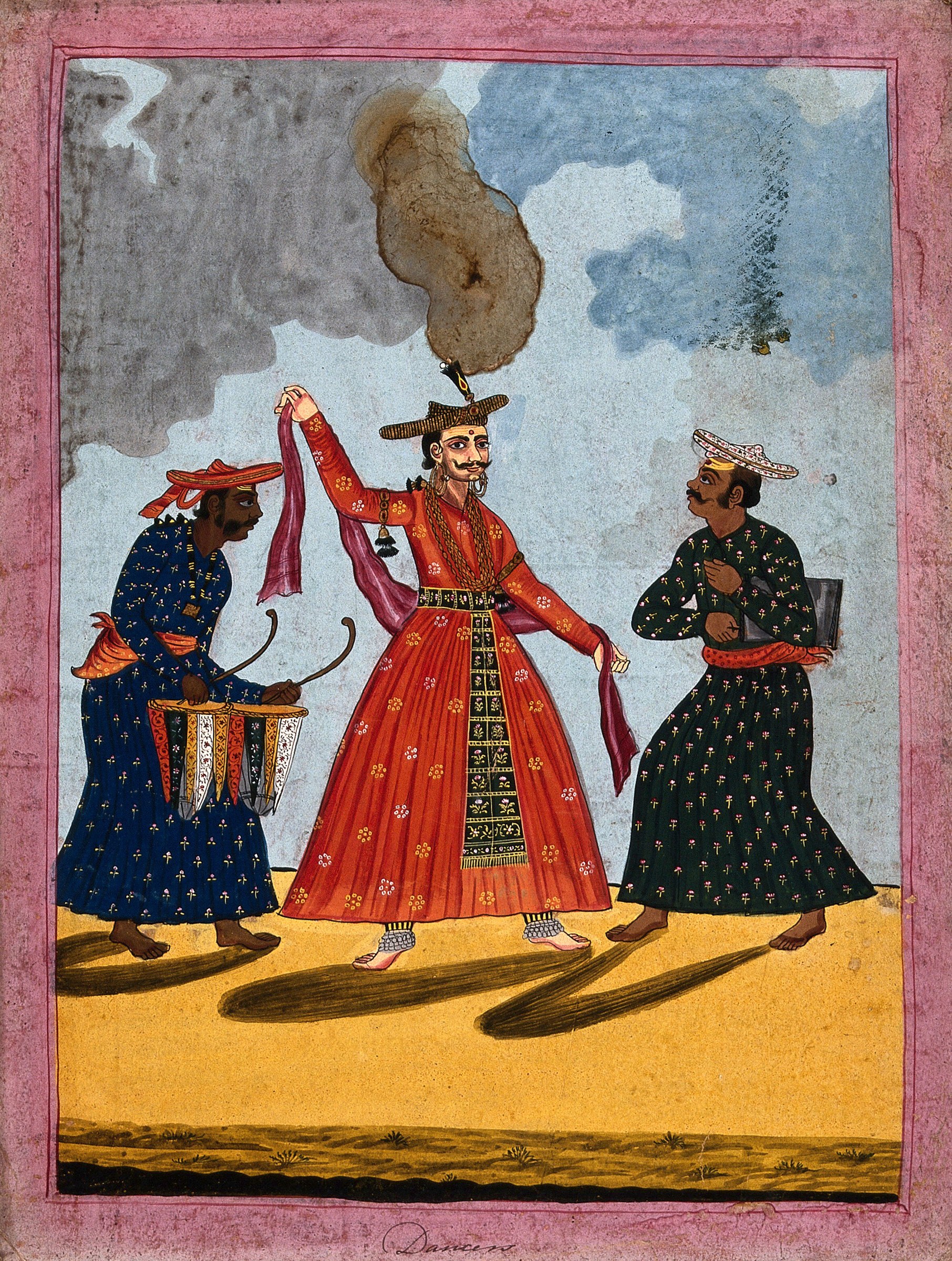
Dancers possibly Marathas. Gouache drawing.
Unknown artist
- Source:
- Wellcome Collection
- Rights:
- Public domain — free to use, share and adapt.
- Recorded as:
- Public Domain Mark
This work provides crucial visual evidence of Maratha or Mughal court dress and formal comportment in an era when such records are rare. For dance historians, it documents what formal, court-sanctioned bodily presentation looked like, and the costume traditions that shaped how courtly bodies moved—or were held still—in formal settings. The painting reveals the role of dress, ornament, and spatial arrangement in constructing courtly authority and ritual.
What you are looking at
Three figures in ornate dress stand on a golden ground against a pale sky. The central figure wears a striking red robe embroidered with floral patterns and a distinctive tall, branching headdress; long ribbons stream from the shoulders. To the left stands a figure in deep blue with gold star patterns, holding what appears to be a drum or ceremonial object and wearing a red turban. On the right, a figure in dark green with gold cross patterns wears a wide-brimmed hat. The composition suggests a formal, possibly courtly or ceremonial gathering. Above them floats a large, irregular brown form against clouds—possibly a parasol, banner, or architectural element. The work is rendered in gouache with precise outlines, in the style of Mughal or Indo-Persian manuscript painting, using a flattened perspective typical of that tradition.
The dancing
The three figures stand upright and stationary, their bodies frontal or in profile. The central figure's arms are held at shoulder height, one extended to display the flowing ribbon, the other positioned gracefully; the pose suggests ceremonial presentation rather than active movement. The flanking figures face inward toward the center, their bodies relaxed and observant rather than engaged in dancing. There is no weight transfer, no indication of stepping or turning. The arrangement is symmetrical and formal, arranged for visual display rather than kinetic action.
The dance depicted
This image does not depict an active dance in the sense of choreographed movement. The title suggests these may be Maratha people—the Marathas ruled regions of India from the 17th century onward—and the dress and setting are consistent with Maratha or Mughal court culture. The central figure's elaborate costume, the formal poses, and the ceremonial arrangement suggest this may document court dress, a processional moment, or a formal presentation rather than dance itself. The standing, frontal poses and lack of dynamic gesture indicate this is more likely a court scene, possibly a durbar or audience, than an active performance. If dance is present, it would be in the formal, composed movement of courtly comportment rather than in choreographed steps.
How it was made
This is a gouache drawing on paper, a technique well-suited to the vivid color and fine detail visible here. Gouache allowed the artist to layer opaque colors and create sharp outlines, which is used throughout to define the figures' contours, pattern details, and the architectural or decorative elements. The style and technique are consistent with Indo-Persian or Mughal court manuscript painting traditions, where gouache on paper was the standard medium for documenting court life, costumes, and formal occasions. The precision of the outlines and the flattened spatial perspective are hallmarks of this tradition. Such works were produced for court collections and wealthy patrons, circulating within elite circles rather than as mass-produced prints.
About this work
This gouache drawing presents three formally dressed figures in what appears to be a Mughal or Indo-Persian court setting, possibly Maratha in origin based on the title. The central figure's elaborate red robe, ornamental headdress, and ceremonial bearing are the focal point, flanked by two attendants or courtiers. While the catalogue suggests these figures may be dancers, the painting itself shows no active movement—the bodies are upright and still, arranged for formal presentation. The work documents court costume and ceremonial dress more than it depicts a dance performance. It belongs in a dance history collection not because it shows choreographed movement, but because it visually records the formal, composed movement of court life and the elaborate costume traditions of the period.
How to look at it
Focus first on the central figure: the headdress is the key to understanding rank and possibly role—it is unlike any standard Mughal crown and may indicate a specific courtly or ceremonial position. Notice the precise symmetry of the composition and the careful balance of color: the red robe dominates, framed by the blue and green of the attendants. The golden ground and pale sky create a timeless, formal space that emphasizes the figures' stillness and presentation. The mysterious form floating above—a parasol, banner, or canopy—may indicate rank or protection; its abstract, floating quality contrasts with the precise rendering of the figures. The painter has chosen a moment of absolute formal stillness, which is itself the image's meaning: authority expressed through composed, ornamented immobility.
The period
This work dates to an era of Mughal and Maratha court culture when elaborate costumes and formal court ceremonies were central to political power and aesthetic display. The Marathas rose as a military and political force in 17th–18th-century India, adopting and adapting Mughal court traditions while developing their own distinctive visual culture. The gouache-on-paper technique was standard in Mughal and Indo-Persian court workshops, where artists documented court life, ceremonies, and the dress of rulers, nobility, and attendants. Such paintings served both documentary and celebratory functions, recording the visual splendor and formal protocols of court life. The flattened perspective and decorative precision of this work place it within a long tradition of Indo-Persian painting that valued pattern, ornament, and the careful arrangement of figures.
Where it lives
The work is held by the Wellcome Collection, a major repository of images related to the history of medicine, science, and culture. It is likely catalogued within broader Wellcome holdings of Indo-Persian and South Asian visual materials. The gouache-on-paper format and style indicate it was originally a court or elite manuscript painting, later acquired as part of a broader collecting effort to document world cultures and visual traditions.
Questions about this work
Is this a dance scene?
The catalogue title suggests it may be, but the image itself shows no active dancing. The three figures stand in formal, static poses arranged for presentation. This may document ceremonial dress and formal court comportment—the composed, ornamented movement of court life—rather than choreographed dance steps. It is more accurately a court or durbar scene than a dance performance.
Who are the Marathas?
The Marathas were an Indian warrior group and later ruling power, strongest in the 17th–18th centuries, primarily in what is now Maharashtra and surrounding regions. They built a significant empire and adopted many Mughal court traditions while developing their own distinct culture and aesthetics. This painting may document Maratha court dress or Maratha participation in Indo-Persian court culture.
What is that floating form above the figures?
It is unclear from the image alone. It could be a parasol, a banner, a canopy, or an architectural element indicating rank or protection. In Indo-Persian court painting, such elements often signaled status or divine favor. Its abstract, floating quality and irregular shape distinguish it from the precisely rendered figures below.
What technique is this?
This is gouache (opaque watercolor) on paper, a standard medium for Indo-Persian and Mughal court manuscript painting. Gouache allowed artists to create vivid colors, sharp outlines, and precise decorative detail. The technique was well-suited to documenting court dress and ceremonies, and works like this circulated among court elites and wealthy collectors.
More dance artwork





