49 works in this view — arrow keys or swipe to move between them.
Dance in Art
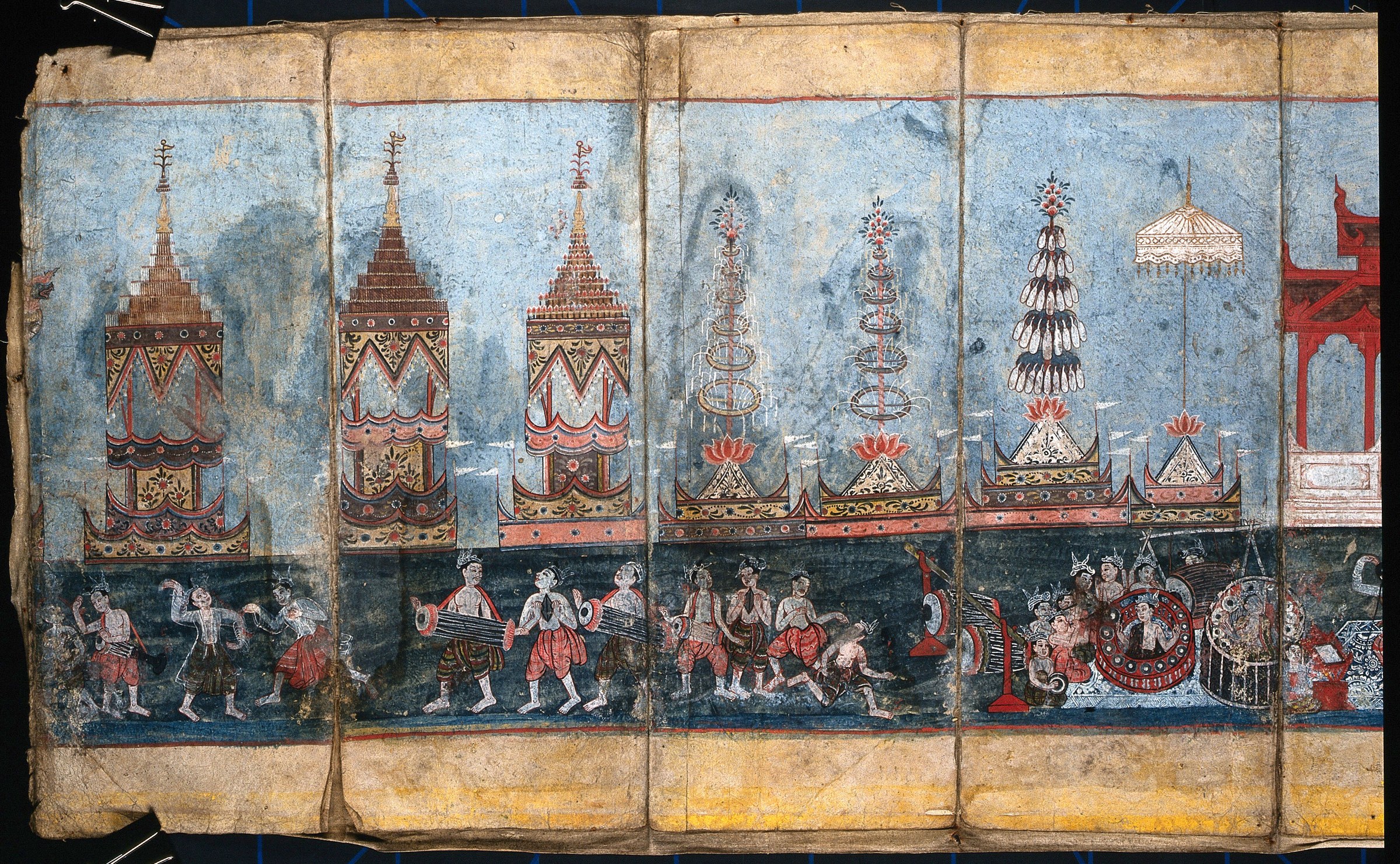
Burma: a sanctuary (?) with towers, temples, musicians and dancers. Gouache painting.
Unknown artist
- Source:
- Wellcome Collection
- Rights:
- Public domain — free to use, share and adapt.
- Recorded as:
- Public Domain Mark
This work documents the inseparability of dance and court ceremony in Southeast Asian royal practice, showing how dancers, musicians, and architectural space were orchestrated to express power and legitimacy. For historians of Southeast Asian dance, it is one of few surviving visual records of palace ritual from before colonial intervention radically altered those practices.
What you are looking at
A horizontal register divided into two zones shows an architectural fantasy above and a narrative scene below. The upper register presents seven ornate towers and temple structures in ascending order of complexity, each topped with elaborate finials and crowned spires, rendered in terracotta, cream, and gold against a pale blue sky. The lower register depicts figures in a dark ground: at left, bare-chested musicians and attendants; in the center-right, a procession of figures in short wrapped skirts moving with deliberate purpose; at far right, a seated ruler or dignitary on an ornate throne or palanquin, surrounded by attendants and what appears to be ceremonial regalia. The composition is divided into five vertical sections by scored lines, suggesting either a folded manuscript page or a structural division of a larger work.
The dancing
Figures in the lower register are small-scale and rendered in profile or three-quarter view. Bare-chested male musicians hold what appear to be wind or stringed instruments; adjacent figures stand in relaxed attendance. The central group moves in a linear formation with bent knees and forward-leaning posture, suggesting rhythmic movement rather than static positioning. At right, the seated figure dominates a scene of kneeling or bowing attendants, suggesting court ceremony. Bodies are schematic and silhouetted rather than anatomically detailed; the artist conveys motion through posture and arrangement rather than musculature.
The dance depicted
This appears to document a Southeast Asian court ceremony, most likely Burmese or Thai, in which music, dance, and formal court ritual are inseparable. The central group's bent-knee carriage, forward lean, and linear arrangement suggest a processional or votive dance accompanying court ceremony or religious rite. The presence of musicians, the hierarchical spatial arrangement, and the emphasis on the presiding dignitary indicate this is ceremonial dance in a palace or temple context rather than secular entertainment. The style of dress, architectural vocabulary, and compositional logic are consistent with 18th or 19th-century Southeast Asian court practice, though the schematic figural style makes precise identification of specific dance forms impossible.
How it was made
Gouache on what appears to be paper or cloth, likely mounted as a manuscript page or scroll section. The technique—opaque water-based pigment laid in flat colors with minimal modeling—is typical of Southeast Asian manuscript illumination and court painting. The palette of lapis blue, gold, terracotta, and white reflects expensive pigments associated with royal or religious patronage. The scored vertical divisions suggest the work may originally have been folded as a manuscript page or part of a longer narrative sequence. The medium's opacity and the flat color planes allowed rapid production while maintaining clear legibility of narrative and architectural detail across distance.
About this work
This is a gouache painting documenting court ceremony and ritual dance in a Southeast Asian palace, most likely Burmese, combining architectural fantasy with narrative scene. The upper register presents an idealized sequence of temple towers; the lower shows musicians and dancers in processional formation attending a presiding dignitary. The work combines the documentary impulse—recording actual court practice—with the iconic register typical of royal manuscripts, in which architecture and ceremony are presented as ordered, hierarchical, and divinely sanctioned. It belongs to a long Southeast Asian tradition of manuscript illumination recording the intersection of dance, music, and statecraft.
How to look at it
Attend to the two registers as separate narratives: the towers above represent the idealized architectural framework of power and spirituality, while the figures below show the human performance that activates that space. Notice how the artist uses linear arrangement, posture, and proximity to the enthroned figure to convey hierarchy and ritual function. The musicians at left are essential to the scene—this is not dance separated from music but dance as one element of a unified court performance. The bent knees and forward lean of the central figures distinguish them from the static postures of attendants, marking them as active performers in a ceremonial action.
The period
The work dates to an era when Southeast Asian courts—particularly in Burma, Siam (Thailand), and Cambodia—maintained elaborate systems of ritual dance, music, and court ceremony as instruments of governance and religious practice. The 18th and 19th centuries saw a flourishing of manuscript production documenting these ceremonies, often commissioned by royal patrons to record ideal court practice. The architectural style and figural conventions suggest this was produced in a court workshop, where such documentation served both documentary and propagandistic functions, presenting the court as an orderly, sacred space.
Where it lives
The work is held in the Wellcome Collection, a London-based archive primarily focused on medical history and anthropology, suggesting it entered a Western collection as ethnographic or documentary material rather than as fine art. The Wellcome's acquisition patterns indicate the work was likely collected in the 19th or early 20th century as a document of 'Oriental' court practice.
Dance in this work
Questions about this work
What country is this from?
The catalogue notes Burma tentatively; the architectural style, figural conventions, and compositional structure are consistent with Burmese court manuscripts from the 18th or 19th century. However, similar practices and visual conventions were shared across Southeast Asian courts, and the work could originate from Siam (Thailand) or another regional court. Without inscriptions or secure provenance, definitive attribution is not possible from the image alone.
Are these dancers or ceremonial attendants?
The distinction is not sharp in court ceremony. The figures in the center-right, with their forward lean and bent-knee posture, are engaged in movement that is simultaneously ritual, ceremonial, and choreographed. In Southeast Asian court practice, such movement was often not distinguished from dance as a separate category—it was part of an integrated system of court performance.
What is being celebrated or commemorated?
The scene may document a royal audience, religious rite, or festival ceremony. The presence of an enthroned figure, musicians, and performers in formal procession suggests an occasion of state significance. Without text or secure historical context, the specific event cannot be determined.
Why is this in a medical history collection?
The Wellcome Collection was assembled by Henry Wellcome as a broad archive of human practice and material culture, not exclusively medical. Works like this were collected as ethnographic documents recording non-Western cultures, reflecting late 19th and early 20th-century collecting practices that often treated art, ritual, and anthropology as a single field.
More dance artwork





