49 works in this view — arrow keys or swipe to move between them.
Dance in Art
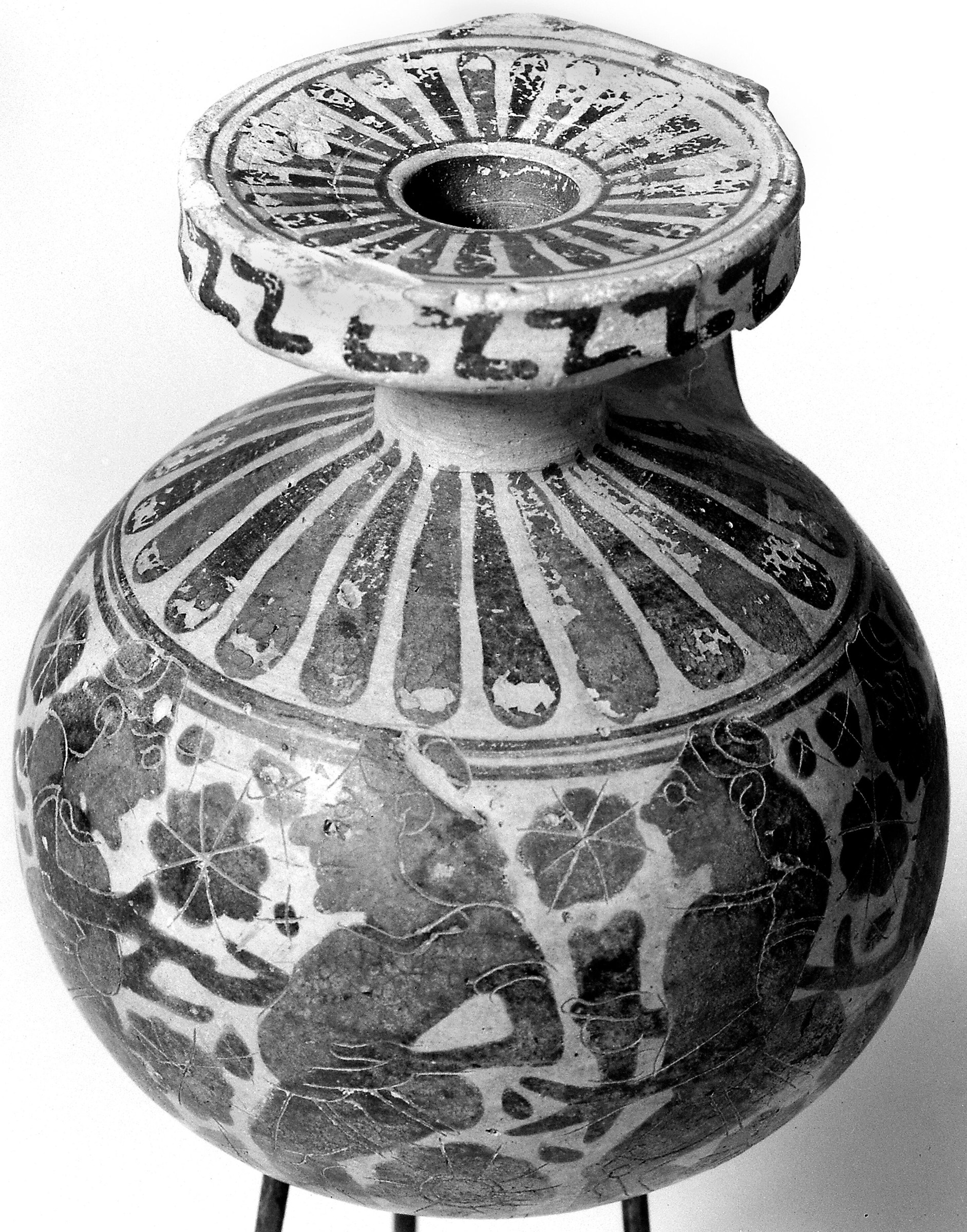
M0018096: Round aryballos, late Corinthian, showing 6 padded dancers and a siren
Unknown artist
- Source:
- Wellcome Collection
- Rights:
- Reusable with conditions: credit the creator. Source record ↗
- Recorded as:
- Attribution 4.0 International (CC BY 4.0)
Padded dancers represent one of the oldest documented forms of comedic and ritual performance in Western art history, and this vessel is direct visual evidence of their costume, movement vocabulary, and social context. For scholars of ancient Greek theater, ritual, and dance history, padded dancer imagery is among the few surviving visual records of pre-Classical performance practices. The work demonstrates that ancient cultures valued the documentation of performance on portable, durable objects meant to circulate and be discussed.
What you are looking at
A round aryballos (small ceramic vessel) decorated with two registers of figures in the Late Corinthian style. The neck features a wide flared rim with radiating fluted sections and geometric patterns around the collar. The main body is a globular form displaying six human figures in profile, shown wearing padded costumes characteristic of ancient komasts or padded dancers. The figures are rendered in the red-figure technique against the darker clay ground. Among them is a siren—a mythological hybrid creature. The figures are depicted in dynamic poses suggesting movement and revelry. The vessel's surface shows the characteristic wear and patina of ancient Greek ceramics.
The dancing
The six dancers wear distinctive padded suits that create exaggerated silhouettes around the torso and limbs, a costume type associated with satirical or ritual performances in ancient Greece. Their postures vary: some appear to lean forward, others stand more upright, and at least one seems to be in mid-stride. The padding emphasizes the belly and chest, creating a comic or grotesque effect. The siren figure is identifiable by its hybrid form. The dancers occupy the full height of the body zone, arranged in a processional or frieze-like composition around the vessel's circumference, with no clear hierarchical arrangement.
The dance depicted
These are padded dancers (komasts), a type of performer documented in ancient Greek art from the Archaic through Classical periods. Padded dancers typically performed in processions, fertility rituals, and symposium entertainments, often with satirical or comedic intent. The exaggerated costume and dynamic poses suggest vigorous, uninhibited movement. The inclusion of a siren indicates a mythological or ritual context rather than everyday social dancing. The Late Corinthian period (c. 540–500 BCE) was a major moment for this imagery, appearing frequently on vessels likely used in symposium or ceremonial contexts. The specific style of padding and the composition suggest this represents komoi—raucous processions often associated with Dionysian celebration.
How it was made
This is a ceramic vessel formed on the wheel and decorated in the red-figure technique, where figures are rendered in the warm clay color against a darker glazed ground, the reverse of earlier black-figure pottery. The fluted neck is hand-modeled or tooled after the vessel was thrown, creating a sculptural three-dimensional quality. Red-figure technique allowed finer detail and more dynamic linear work than black-figure, enabling the artist to suggest movement, musculature, and costume texture through line alone. The vessel's small size and refined execution suggest it was a luxury object for an educated symposium audience, where it would have served a functional purpose while displaying artistic sophistication.
About this work
This Late Corinthian aryballos is a small luxury ceramic vessel decorated with a lively scene of padded dancers and a siren, rendered in the red-figure technique that flourished in the 6th century BCE. The padded dancer (komastes) was a recognizable performer type in ancient Greek culture, associated with Dionysian processions, ritual fertility performances, and symposium entertainment. The vessel's decoration served both to amuse and to communicate the owner's taste and cultural knowledge to fellow symposium participants. The image survives as one of our primary visual sources for understanding how ancient Greeks depicted, understood, and valued comic and ritual bodily movement. The vessel belongs to the Wellcome Collection and exemplifies the way ancient pottery combined functional form with sophisticated narrative imagery.
How to look at it
Observe the costumes first: the bulging padding creates a silhouette that is deliberately comic and exaggerated, meant to amuse and provoke. Notice how the artist has varied the poses around the vessel—some figures lean, others stride—creating a sense of continuous movement as you rotate the object. The inclusion of the siren among human dancers suggests this is a supernatural or mythological scene rather than a literal performance. Pay attention to the fluted neck: this architectural detail creates a visual frame and demonstrates the ceramic artist's control of three-dimensional form. The repetitive arrangement around the vessel's body echoes the way these performers would have moved in procession.
The artist
The artist is unknown, as is typical for most ancient Greek pottery. Late Corinthian wares were produced in the city of Corinth, which was a major pottery production and export center in the 6th century BCE. The quality of execution and the sophisticated composition suggest a skilled workshop hand, probably working within Corinthian conventions and responding to demand from a symposium clientele. The use of red-figure technique places this vessel in the later phase of Corinthian production, as the technique was adopted gradually during the late Archaic period.
The period
The Late Corinthian period (c. 540–500 BCE) was a time of stylistic transition in Greek pottery, as the dominant red-figure technique gradually replaced black-figure decoration. Corinth remained a major cultural and trade power, and its pottery was exported across the Mediterranean. This was also the period of early Greek theater development, and images of performers—padded dancers, satyrs, and mythological figures—became increasingly popular on symposium vessels. Padded dancers in particular appear frequently in Corinthian and Athenian art from the 6th century onwards, suggesting they were familiar and valued entertainers. The inclusion of a siren reflects the Greek fascination with hybridized mythological bodies and the boundaries between human and animal, civilization and wildness.
Where it lives
The vessel is held in the Wellcome Collection, a major resource for the history of science, medicine, and material culture. It was likely acquired as an example of ancient Greek ceramics and performance imagery rather than as a medical or scientific object, reflecting the Wellcome Collection's broad remit for culturally significant objects.
Dance in this work
Questions about this work
What were padded dancers?
Padded dancers (komasts) were entertainers in ancient Greece who wore exaggerated padded costumes emphasizing the belly, buttocks, and genitals. They performed in processional rituals, fertility ceremonies, and symposium entertainments, often with comic or obscene intent. They appear frequently in Greek art from the Archaic period onwards and are thought to be ancestors of later Greek theatrical comedy.
What is red-figure pottery?
Red-figure technique is a method of ceramic decoration developed in ancient Greece around 530 BCE in which figures are left in the warm color of the clay and the background is glazed dark. This reversal of earlier black-figure technique allowed artists to render finer details, more dynamic poses, and subtler modeling. It remained the dominant technique in Greek pottery for centuries.
What is an aryballos?
An aryballos is a small globular vessel with a wide mouth, typically used in ancient Greece for storing and dispensing oil, perfume, or other liquids. Despite its functional purpose, aryballoi were often richly decorated and given as gifts or used in symposium contexts, making them objects of both utility and display.
Why is there a siren on this vessel?
The siren—a hybrid of human and bird—appears here alongside human dancers, suggesting a mythological or ritual context rather than a documentary scene. Sirens represented the boundary between civilization and wildness, human and animal. Their presence on a performance scene may indicate supernatural or ecstatic dancing, or simply reflect the Greek artistic interest in mixing human and mythological figures.
More dance artwork





