49 works in this view — arrow keys or swipe to move between them.
Dance in Art
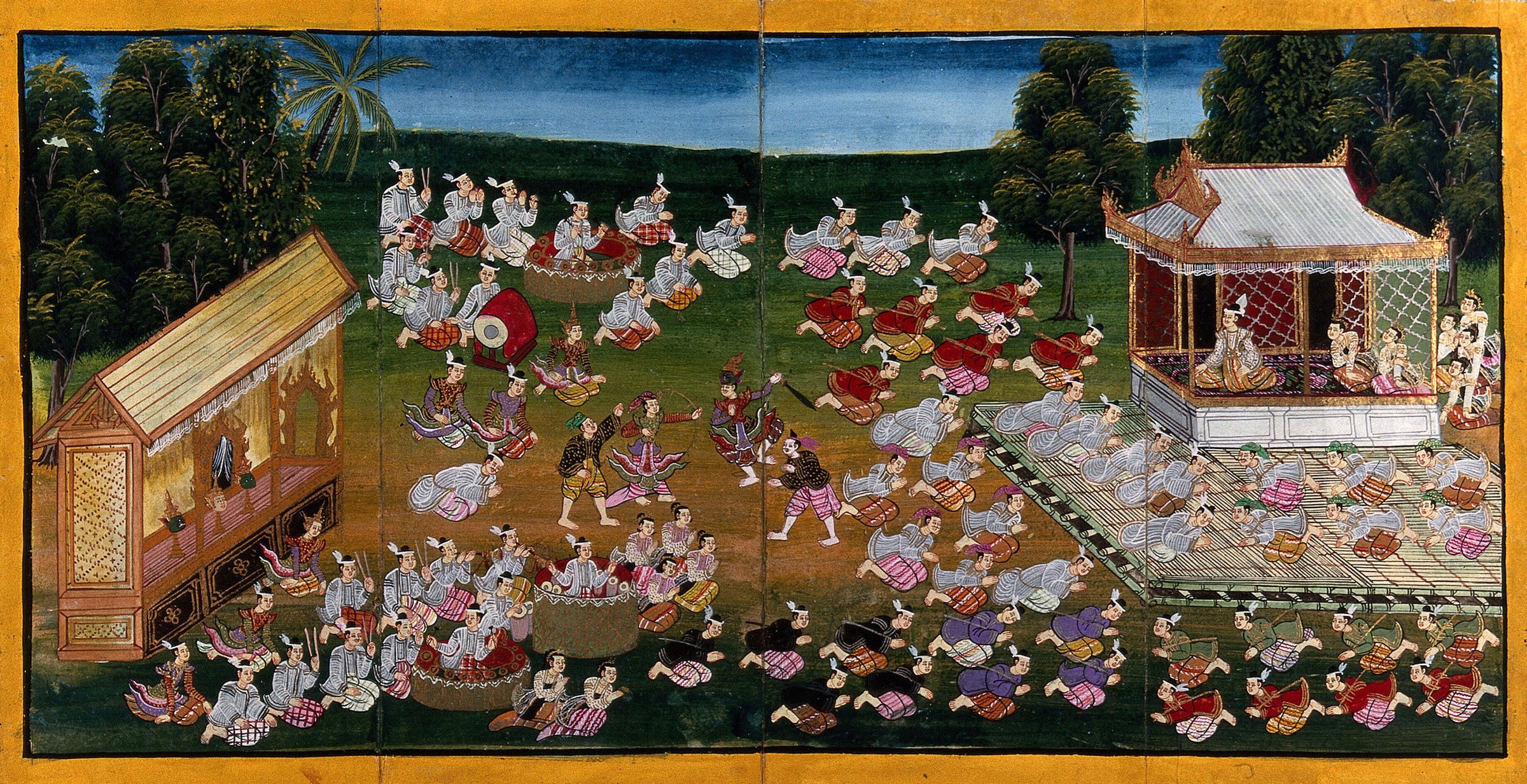
Burma: musicians and dancers perform while courtiers pay homage to a king. Gouache painting.
Unknown artist
- Source:
- Wellcome Collection
- Rights:
- Public domain — free to use, share and adapt.
- Recorded as:
- Public Domain Mark
This is visual evidence of court dance practice in Southeast Asia before colonial documentation became systematic. It shows the movement aesthetic, costume, and ceremonial context of a performance tradition that is still practiced today in modified form, making it valuable for understanding continuity and change in Burmese classical dance. For art historians, it exemplifies the conventions of Southeast Asian court manuscript painting and the relationship between visual representation and state ceremony.
What you are looking at
This gouache painting depicts a ceremonial scene at a Southeast Asian court, likely Burmese, organized around two architectural focal points: a multi-story pavilion on the left with a sloped roof and ornamental details, and an elevated platform pavilion on the right with similar architectural features and what appears to be a royal or high-status figure within. Between and around these structures, dozens of figures in colorful dress—predominantly reds, pinks, whites, and earth tones—are arranged across a green ground. The composition is densely populated and organized with some hierarchical spacing: courtiers and attendants cluster near the pavilions, while musicians and dancers occupy the middle ground and foreground. The background shows a dark green landscape or garden with stylized trees, and the sky above is a flat pale blue. The overall effect is of a well-planned ceremonial gathering or festival, with multiple activities occurring simultaneously—some figures appear to be dancing, others seated or standing in formal poses, and some engaged in what may be musical performance. The painting style employs flat perspective, bold outlines, and decorative patterning on fabrics, characteristic of Southeast Asian court painting traditions.
The dancing
The figures are rendered in a consistent, flattened style typical of Burmese manuscript and court painting conventions. Many dancers and performers are shown in crouched or low-level positions with bent knees, suggesting either a seated performance style or movements close to the ground. Groups of figures are clustered together, some appearing to move in coordinated formation. The bodies show minimal three-dimensional modeling; instead, the artist has conveyed identity and status through dress—the patterns, colors, and apparent rank of clothing differ noticeably between what appear to be musicians, dancers, and higher-status courtiers. Arm positions vary: some figures have arms extended or raised, others drawn in to their sides. The overall impression is of stylized, formal movement rather than naturalistic gesture—consistent with court ceremonial dancing rather than folk or social forms.
The dance depicted
This appears to depict a royal or courtly ceremonial gathering in Burma (Myanmar), probably from the 18th or 19th century. The performers engaged in dance-like activities are shown in postures consistent with Southeast Asian classical court performance traditions, particularly those associated with Burmese royal courts. The low, ground-hugging positions visible in many figures suggest the characteristic bent-knee, low-center-of-gravity movement style of classical Burmese dance or the related tradition of Ramayana-based court performance (similar to Thai Khon but in Burmese context). However, without inscriptions or more specific costume details (headdresses, masks, or weapons that would indicate Ramayana performance), the specific dance form cannot be identified with certainty. The presence of musicians, the formal hierarchical arrangement, and the architectural setting all indicate this is a state occasion—possibly a festival, coronation ceremony, or religious observance—where dance and music were integral ceremonial elements.
How it was made
This is a gouache painting on paper, executed in the style of Burmese court manuscript tradition, likely 18th or 19th century. Gouache—opaque water-based pigment—allowed the artist to build up rich, saturated colors (particularly the reds, pinks, and golds visible in the fabrics) and to create precise outlines and flat color fields. The technique supports the flat, decorative aesthetic visible here: the artist worked without perspective depth, using color and compositional placement to indicate spatial relationships and status. The paper substrate and the format suggest this may have been part of a larger manuscript or a single illustrative page, as was common for Burmese royal chronicles and religious texts. The style and materials indicate a work of court or court-adjacent production, created for a patron of substantial means, and likely intended to document or commemorate a specific ceremonial occasion.
About this work
This is a ceremonial scene from a Southeast Asian court—almost certainly Burmese—showing a formal gathering with dancers, musicians, and courtiers arranged around royal pavilions. The artist has used gouache to create a densely populated, flattened composition in which dozens of figures in brilliant dress perform or observe what appears to be a state occasion. The dancers occupy low, ground-oriented positions characteristic of classical Southeast Asian court traditions. The work documents both the visual appearance of a royal ceremony and the role of dance within formal court ritual—showing dancers and musicians as essential participants in the pageantry of power, not as entertainment but as ceremonial function.
How to look at it
Notice the two architectural pavilions as the organizational centers of the composition—they establish the hierarchy and formality of the occasion. Look at how the artist has positioned the dancers: nearly all are in a low, bent-knee stance, suggesting this is the normative posture of the dance form being performed rather than a momentary movement within a sequence. Observe how color and textile pattern carry information about status and role—the dancers wear relatively plain dress compared to the figures inside or near the pavilions. The dense clustering and repetitive arrangement of similar figures reflects not individual naturalism but the formal, coordinated movement of a ceremonial performance. The artist has chosen a moment of full ceremony—not movement caught mid-gesture, but the complete formal arrangement of all participants.
The period
This work dates to the era of traditional Southeast Asian court cultures before intensive European colonial presence. In Burma, the 18th and 19th centuries saw the development and refinement of court ceremonial practices, including formalized dance performance associated with the royal court and Buddhist religious occasions. Court painting in this period served documentary and commemorative functions, recording important events and ceremonies in a visual language that prioritized symbolic clarity and hierarchical composition over naturalistic representation. This tradition of manuscript painting was practiced by court artists or artists working under court commission, and the works often accompanied written chronicles of reigns or significant historical events.
Where it lives
The source is listed as the Wellcome Collection, a major repository of historical manuscripts and visual documentation of non-Western cultures. Works of this type in the Wellcome Collection typically entered as part of broader acquisitions of Asian manuscripts and illustrated texts, often collected by colonial-era travelers or obtained through dealers specializing in Eastern manuscripts.
Dance in this work
Questions about this work
What country is this from?
The architectural style, costume details, and painting conventions all point to Burma (modern Myanmar). The multi-tiered roofs with characteristic upturned eaves, the style of dress, and the artistic conventions visible in the painting are consistent with Burmese court art traditions of the 18th or 19th century. The Wellcome Collection's cataloguing as Burma provides additional confirmation.
Are these dancers or just people at a ceremony?
They are both. In Southeast Asian court culture, ceremonial dancing was not separate entertainment but integral to formal state occasions. The figures shown in low, bent-knee positions are performing a formal movement sequence—a dance—as part of the ceremony. Their movement style is distinctive and appears coordinated, which distinguishes them from attendants and courtiers shown in static poses.
What is the building on the right?
This appears to be a royal pavilion or throne hall, shown as the primary focus of the ceremony. The figure visible inside it, elevated above the other performers, likely represents the king or another high-status individual for whom the ceremony is being conducted. Such pavilions were standard settings for royal audiences and ceremonies in Southeast Asian courts.
When was this painted?
The style and technique are consistent with Burmese court painting of the 18th or 19th century, but the catalogue record does not provide a specific date. The absence of European influence in the style and the traditional manuscript painting technique suggest pre-colonial production, most likely before the mid-19th century.
More dance artwork





