49 works in this view — arrow keys or swipe to move between them.
Dance in Art
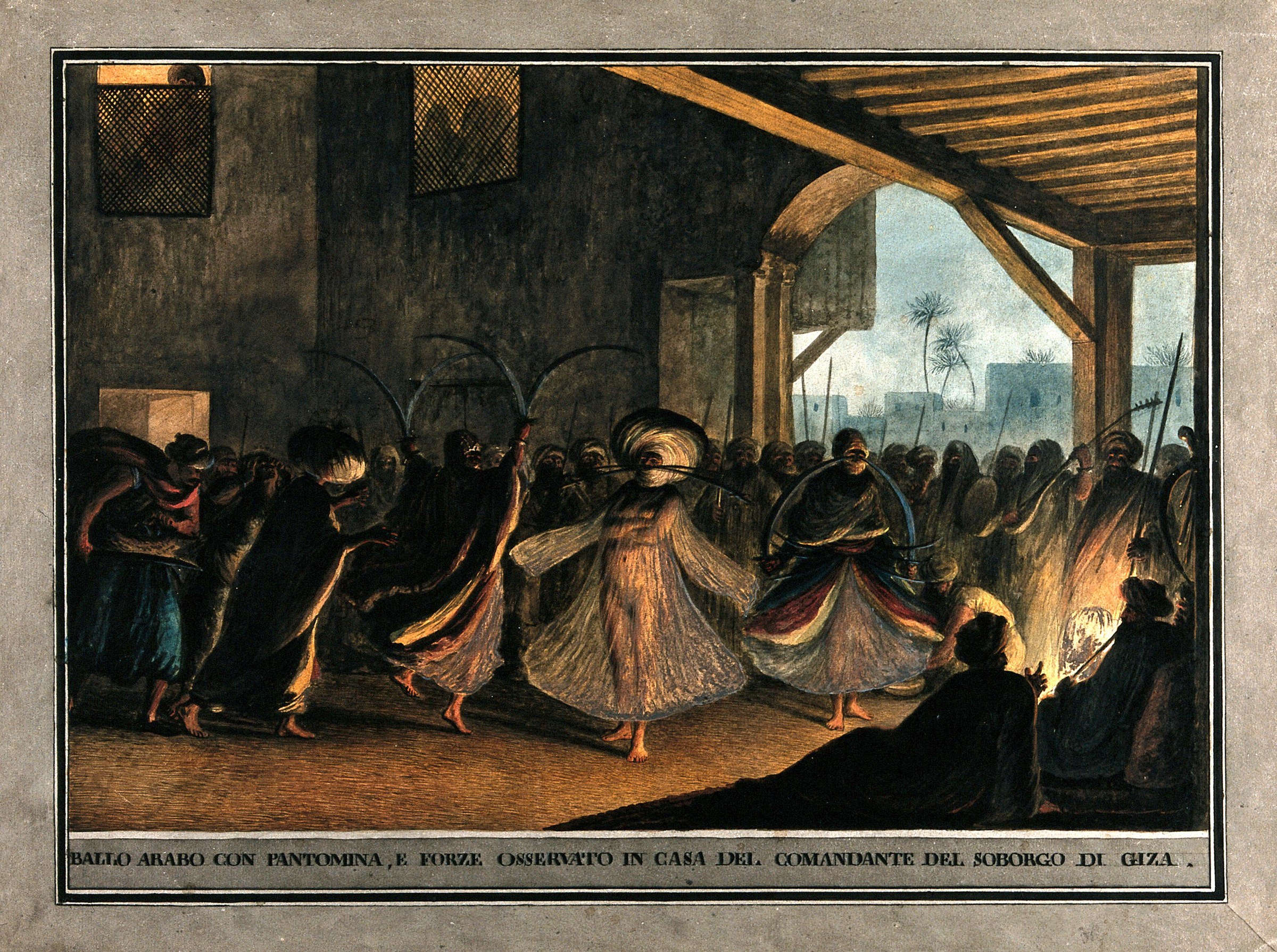
Giza, Egypt: a dance by sword dancers in the commandant's house. Watercolour by Luigi Mayer, 17--.
Unknown artist
- Source:
- Wellcome Collection
- Rights:
- Public domain — free to use, share and adapt.
- Recorded as:
- Public Domain Mark
The image is one of the few European visual records of Arab dance performance from the 18th century, offering rare evidence of female performers, their costume, and the social setting of dance in the eastern Mediterranean. For historians of dance and of the Ottoman Levant, it provides concrete detail about how dancing bodies moved and what dancers wore, free from the mediation of later romantic or exotic reinterpretation. The work also documents how European artists approached the task of rendering unfamiliar movement—the question of whether the artist understood the dance, or merely rendered what seemed visually striking to an outsider, remains productive and open.
What you are looking at
A crowded interior scene set in what appears to be a substantial stone building—the commandant's house in Gaza. The space is defined by a vaulted ceiling with exposed wooden beams and small high windows with latticed screens. In the foreground, a central female dancer in a flowing, translucent garment with wide sleeves executes a dramatic spin or turn, her dress billowing outward in an expansive arc. She is flanked by at least two other female figures in similar diaphanous dress, also mid-movement. The surrounding crowd—perhaps thirty to fifty figures—fills the shadowed interior, many wearing darker robes and headdresses typical of late 18th-century Levantine dress. Some spectators hold curved swords or sabres, and the posture of several suggests active participation or imminent movement. The composition draws the eye toward the luminous central dancer through careful use of light and shadow; the open archway at the right admits pale exterior light, framing palm trees and distant fortifications, anchoring the scene in Egypt. The watercolour technique renders the interior in warm ochres and deep browns, with selective washes of pigment creating an atmosphere of intimate, contained energy.
The dancing
The principal dancer occupies a near-frontal stance with knees bent and torso engaged in a vigorous rotational movement; both arms are held high and spread, with hands delicate and fingertips extended, creating width and extension through the arms. The dress—apparently a long, lightweight cotton or linen robe—catches and flares dramatically, suggesting rapid, continuous spinning motion. Two companion dancers visible to either side of her adopt similar arm positions and appear to be turning in synchrony or call-and-response. The spectators surrounding them are densely clustered, many in profile, their body weight settled, observing rather than dancing. Several figures in the crowd hold curved sabres at various angles, raising the question of whether this is sword dancing, sword-accompanied dancing, or armed spectators attending a dance.
The dance depicted
The title refers to this as a dance by sword dancers (balletto arabo con pantomina), yet the image shows primarily female performers in whirling motion rather than the martial footwork typically associated with male sword dancing in the Levant. The scene may represent a gendered variant, a social celebration incorporating both dance and armed display, or a moment of female solo or group spinning within a mixed gathering. The rapid rotational movement, extended arms, and weightless appearance of the dress are consistent with Levantine or North African spinning dances such as those performed in celebration or festivity. Without clearer evidence of bladework or formal choreography, the precise style cannot be determined, though the setting and dress suggest a late 18th-century Arab cultural practice.
How it was made
This is a watercolour on paper, likely hand-tinted or fully painted in transparent glazes. The medium allows for the subtle gradations of shadow in the stone vault and the luminous quality of the dancer's dress caught in motion. The technique conveys atmosphere and depth effectively—the cool tones of the distant view through the arch contrast with the warm interior, and the selective use of bright pigment on the central figures draws focus. Watercolour's immediacy and the artist's sure hand with the brush suggest this was either a careful record made on site or a studied composition based on field notes. The medium was typical of travel art and documentary practice in the late 18th century, suggesting this work was intended for a educated European audience with interest in Near Eastern customs.
About this work
This watercolour documents a dance performance witnessed in Gaza during the late 18th century, executed by the artist Luigi Mayer, a prolific recorder of Ottoman and Levantine scenes. It captures a moment of social and cultural practice—a gathering in the residence of a military commander where female dancers perform a vigorous spinning dance before a mixed audience that includes armed men. The work sits at the intersection of orientalist documentation, travel art, and dance ethnography; it preserves a visual record of performance practice that would otherwise be known only through written accounts. The painting is significant both as evidence of late 18th-century Levantine dance and as an example of how European artists of the period approached the representation of non-Western cultural practices—with attentiveness to architectural setting, costume, and crowd dynamics, though filtered through the visual conventions and assumptions of the time.
How to look at it
Attend to the moment of the spin—the artist has frozen the movement at the instant of maximum extension, when the dress is fully flared and the dancer's arms are extended. This is not a static pose but a captured instant of rapid motion, conveyed through the billowing fabric and the sense of centrifugal force. Notice how the artist uses light to distinguish the dancers from the crowd: the spectators are rendered in warm shadow, while the central dancer's dress is lit from within, almost luminous. The curved sabres in the crowd are not obscured but displayed—they are integral to the scene's composition and meaning, whether as props, as signals of male participation or authority, or as symbols of the occasion. The architectural frame—the vault, the archway, the distant view—positions the viewer as an external observer entering a closed, intimate space, a compositional strategy typical of orientalist art but here used to establish the specificity of place.
The artist
Luigi Mayer (c. 1755–1803) was an Italian painter and draughtsman known for his travels through the Ottoman Empire and Egypt. He worked as a court painter and topographical artist, producing hundreds of watercolours documenting architecture, landscapes, and scenes of daily life across the Levant, Egypt, and Greece. His work was widely circulated in Europe through engravings and publications; he was a skilled recorder of both monuments and human activity, and his images were valued as accurate documentation by his contemporaries. Mayer's practice exemplifies late 18th-century travel art—combining aesthetic skill with antiquarian and ethnographic interest.
The period
The late 18th century saw growing European interest in the Ottoman Empire and Egypt, accelerated by Napoleon's campaign (1798–1801) and the broader orientalist movement in art and literature. Dance in the Levant and Egypt was rarely depicted by European artists; most knowledge was filtered through written travel accounts. Female performers in public or semi-public settings were a subject of particular fascination and anxiety for European observers, who often interpreted what they saw through the lens of harem culture and exoticism. The architectural and military details in Mayer's composition—the fortified residence, the vaulted stone building, the armed men—reflect the political reality of late Ottoman Gaza, a strategic garrison town. In Europe during this period, dance was increasingly being documented, classified, and aestheticized through engraving and publication; Mayer's watercolours fed into this broader appetite for visual knowledge of distant lands.
Where it lives
The work is held in the Wellcome Collection, which acquired it as part of its holdings of travel art, antiquarian prints, and medical and scientific illustration. Wellcome's collecting practice emphasizes documentary and ethnographic material; the inclusion of this dance scene reflects the collection's broad interest in recording human practice and cultural difference across time and geography.
Dance in this work
Questions about this work
Is this a 'belly dance' or raqs sharqi?
The image does not show the hip-centric movement or stationary upper body characteristic of raqs sharqi. The vigorous spinning, extended arms, and weightless torso suggest a different dance form—possibly a celebratory or social spinning dance. The presence of what appears to be multiple dancers moving in synchrony also differs from the solo or hierarchical structure of raqs sharqi performance. Without additional documentation, the specific form cannot be named.
What is the role of the swords in this image?
The catalogue title refers to 'sword dancers,' yet the visible sword-bearers appear to be spectators rather than dancers. They may be military men attending the gathering, may be dancers preparing to perform, or may have participated in a prior or subsequent performance. The swords' presence underscores the military and male-dominated context—this is not purely a female entertainment but a gathering that affirms male authority and armed power. Whether the dancers themselves wielded swords at any point is unclear from the image alone.
Where exactly is Gaza in this period?
Gaza in the late 18th century was a garrison town and administrative center within the Ottoman Empire, controlling trade routes and military access to the Sinai and Egypt. The fortifications visible through the archway and the presence of a military commandant's residence reflect its strategic importance. The town was economically important but politically unstable, passing between Ottoman, French, and British control during and after Napoleon's campaigns.
How reliable is Mayer as a recorder of this dance?
Mayer was skilled at topographical and architectural rendering, as evidenced by the precise detail of the vaulted interior. Whether he understood the choreography, cultural meaning, or technical skill of the dancers is less certain. The image captures visual effect—the spinning, the dress, the crowd—but may prioritize the exotic or visually dramatic over structural or cultural accuracy. It is most useful as evidence of what the dance looked like to a foreign observer in that moment, rather than as a complete ethnographic document.
More dance artwork





