49 works in this view — arrow keys or swipe to move between them.
Dance in Art
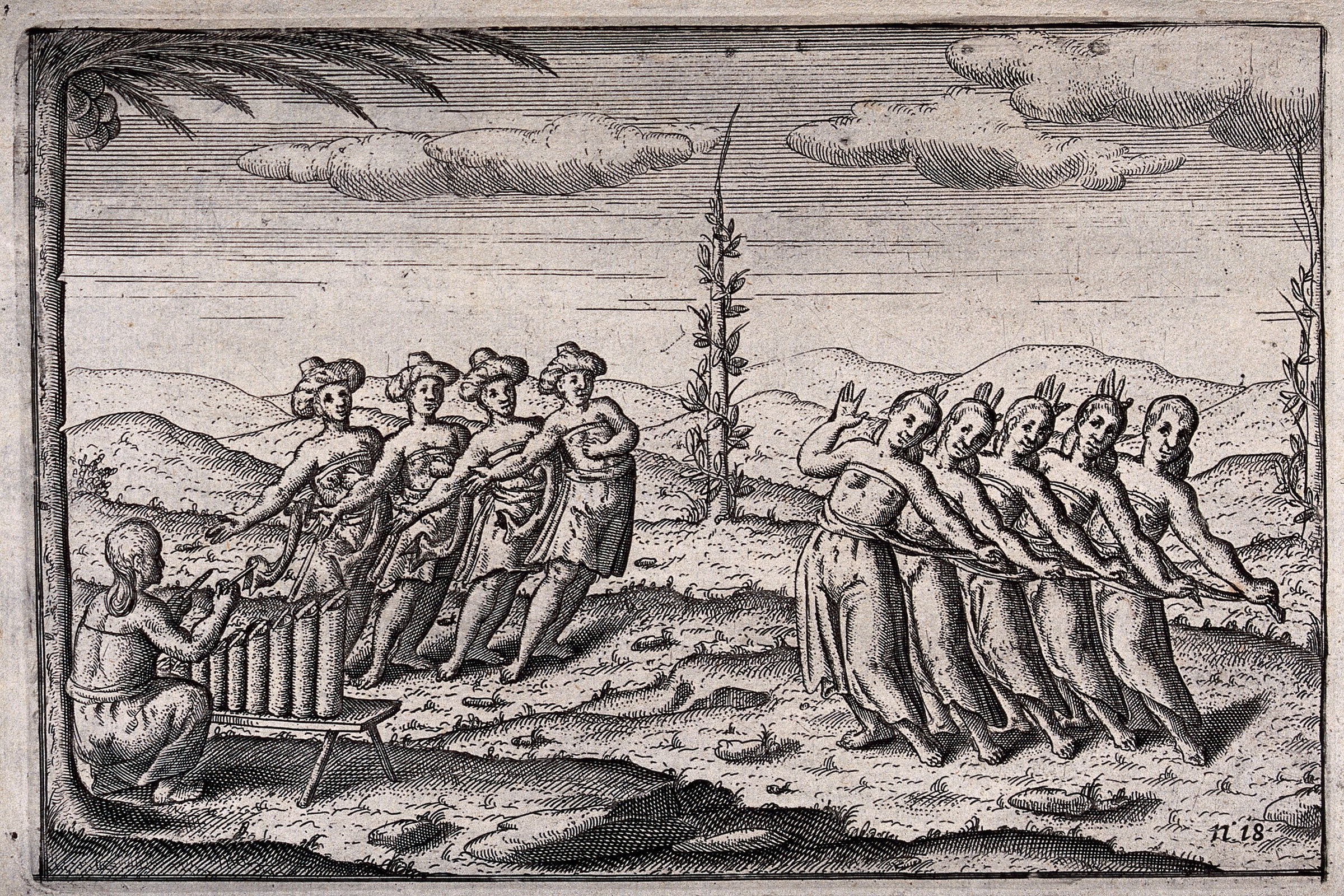
Javanese dancers, with men on the left and women on the right, accompanied by a musician. Engraving by T. de Bry.
Unknown artist
- Source:
- Wellcome Collection
- Rights:
- Public domain — free to use, share and adapt.
- Recorded as:
- Public Domain Mark
This is one of the earliest European visual records of Javanese dance, predating photography by centuries and offering evidence of movement quality, gender roles, and performance context that would otherwise be lost. The engraving demonstrates how dance was understood and represented at a moment when European knowledge of Southeast Asia was fragmentary and mediated through print culture; the work shaped European perceptions of non-European dance and bodies for generations.
What you are looking at
An engraving depicting two groups of figures arranged symmetrically across a bare landscape. On the left, four figures in classical dress stand together, attended by a seated musician playing a stringed instrument; on the right, six figures in flowing robes or drapery are shown in animated motion. The figures occupy the middle ground of a shallow composition; a tall plant or flowering stem rises between the two groups, creating a central axis. The sky above is rendered with horizontal lines suggesting clouds; the foreground is bare earth with minimal landscape detail. The entire scene is enclosed in a rectangular frame. The style and technique indicate a sixteenth-century or early seventeenth-century European engraving.
The dancing
The left group stands relatively still in upright posture, their bodies composed and frontal. The right group is distinctly active: the figures lean forward, their bodies bent at the hips, arms raised and extended as though engaged in vigorous movement. The poses suggest rhythmic unison or near-unison motion—multiple bodies performing the same action simultaneously. No closed holds are visible; the dancers are spaced apart yet oriented toward shared action. The distinction between the standing, observant left group and the moving right group suggests a division between musicians or accompanists and active dancers.
The dance depicted
This is most likely a representation of a Southeast Asian court or ceremonial dance, specifically of Javanese tradition, performed for a European audience or in a European engraving tradition. The catalogue identifies the figures as 'Javanese dancers.' The animated posture and forward lean of the right-hand group is consistent with many Southeast Asian dance styles in which the torso flexes and the weight shifts forward in undulating motion. The gender separation noted in the catalogue (men on left, women on right) was typical of court dance hierarchies in early modern Java. The musician seated on the left and the plant between the groups suggest a staged or formal performance context rather than spontaneous movement.
How it was made
This is an engraving—a relief print made by incising lines into a metal plate. The fine parallel hatching used to create shadow and volume, the precise linear definition of drapery folds, and the characteristic burin marks all confirm engraving technique. The attribution to T. de Bry (Theodore de Bry, 1528–98, or his studio/successors) places this in a major center of European engraving and exotic imagery production. Engravings were disseminated widely and relatively cheaply, making them the primary medium through which sixteenth- and seventeenth-century European audiences encountered depictions of non-European peoples and practices. This technique allowed precise documentary detail but also invited stylization and European compositional conventions.
About this work
This engraving records a Javanese dance performance as rendered by a sixteenth-century European printmaker, likely for a broader audience seeking knowledge of distant lands and peoples. The work sits at the intersection of dance documentation and ethnographic curiosity—it is both a record of how Javanese dancers moved and a European artist's interpretation of that movement through the lens of classical composition and print-making convention. The symmetrical arrangement, the separation of musicians from dancers, and the emphasis on the unified forward-lean of the dancing figures all reflect both authentic observation and European aesthetic principles. For historians of Southeast Asian dance, the image provides rare visual evidence of movement vocabulary before modern recording; for art historians, it exemplifies the exotic subject matter and compositional strategies of Renaissance and early modern prints.
How to look at it
Focus on the posture and energy of the right-hand group: the forward-leaning torso, the raised arms, and the apparent synchronization of movement among multiple bodies. This differs markedly from the upright, static posture of the left group, signaling the artist's awareness that these are two different types of participants. The tall plant in the center serves as a visual hinge, suggesting the formality and staged nature of the performance. The engraver has chosen to freeze the dancers in mid-motion, with bodies bent and animated rather than upright—a choice that conveys kinetic energy even in a still image. Note the fine detail of drapery and the attention to the musician's instrument, suggesting the engraver understood that sound and movement were linked in this performance.
The artist
The de Bry family workshop (Theodore de Bry and his sons and grandsons) dominated European engraving of exotic and natural subjects in the late sixteenth and early seventeenth centuries. They are best known for the Grands Voyages and Petits Voyages—massive encyclopedic collections of engravings documenting the New World, the East Indies, and other distant regions. The de Bry engravings combined careful observation with European classical conventions of composition and anatomy; they were widely copied, translated, and reissued, making them the primary visual source through which educated Europeans encountered the wider world. The workshop's output was neither purely documentary nor purely imaginative, but a hybrid form shaped by market demand for both accuracy and aesthetic appeal.
The period
The late sixteenth century saw an explosion of European interest in dance from distant lands, driven by travel narratives, merchant reports, and the court's appetite for exotic entertainments and knowledge. At the same time, Renaissance Europe was developing its own formalized dance vocabulary—the court dances of Italy, France, and Spain were being codified in dance manuals. The visual representation of dance in prints reflected both genuine ethnographic interest and a desire to understand foreign movement through the grid of European aesthetic categories (symmetry, proportion, classical pose). In Southeast Asia, Javanese court dance was undergoing its own refinement and systematization in palace contexts; the encounter recorded here—if it is based on observation—captures a moment of cross-cultural visibility.
Where it lives
The work is held in the Wellcome Collection, a major library of medical, scientific, and ethnographic images and texts. It is catalogued as an engraving but the catalogue record is minimal and does not include a date, attribution confirmation, or accession number. The Wellcome's extensive collection of de Bry prints and related material has made it a primary source for the study of early modern European knowledge of non-European peoples.
Dance in this work
Questions about this work
Is this based on an actual observation of Javanese dancers?
Possibly, but the image is filtered through European print-making conventions and aesthetics. The de Bry workshop did employ eyewitness accounts and traveller reports, but they also adapted compositions to European taste. The symmetrical arrangement and the separation of musicians from dancers may reflect Javanese practice, or they may reflect European ideas of order and formality. Without additional documentation, we cannot know how much is observation and how much is artistic invention.
What do the postures tell us about how Javanese dancers moved?
The forward-leaning torso and raised arms suggest a style of movement quite different from the upright, balletic posture of European court dance. The repeated posture across multiple bodies implies synchronized or unison movement. The angle of the spine and the apparent bend at the hips are consistent with many Southeast Asian dance traditions in which the torso is flexible and the center of movement is lower than in European forms. However, the engraver's stylization means we should be cautious about reading anatomical precision from the image.
Why are the men and women separated?
In early modern Javanese court dance, gender separation was common, and men and women often had distinct roles—men as performers of martial or formal dances, women as performers of more lyrical or ceremonial forms. The catalogue notes men on the left and women on the right, suggesting the engraver was aware of this distinction. The separation also reflects European compositional habits of symmetry and order.
What was the audience for prints like this?
Engravings by the de Bry workshop were purchased by educated merchants, scholars, collectors, and courtiers—people interested in geography, natural history, and exotic cultures. The prints were bound into books, displayed as individual sheets, and copied and reissued many times. They shaped European understanding of distant lands and peoples for over a century, making them far more influential than written descriptions alone.
More dance artwork





