49 works in this view — arrow keys or swipe to move between them.
Dance in Art
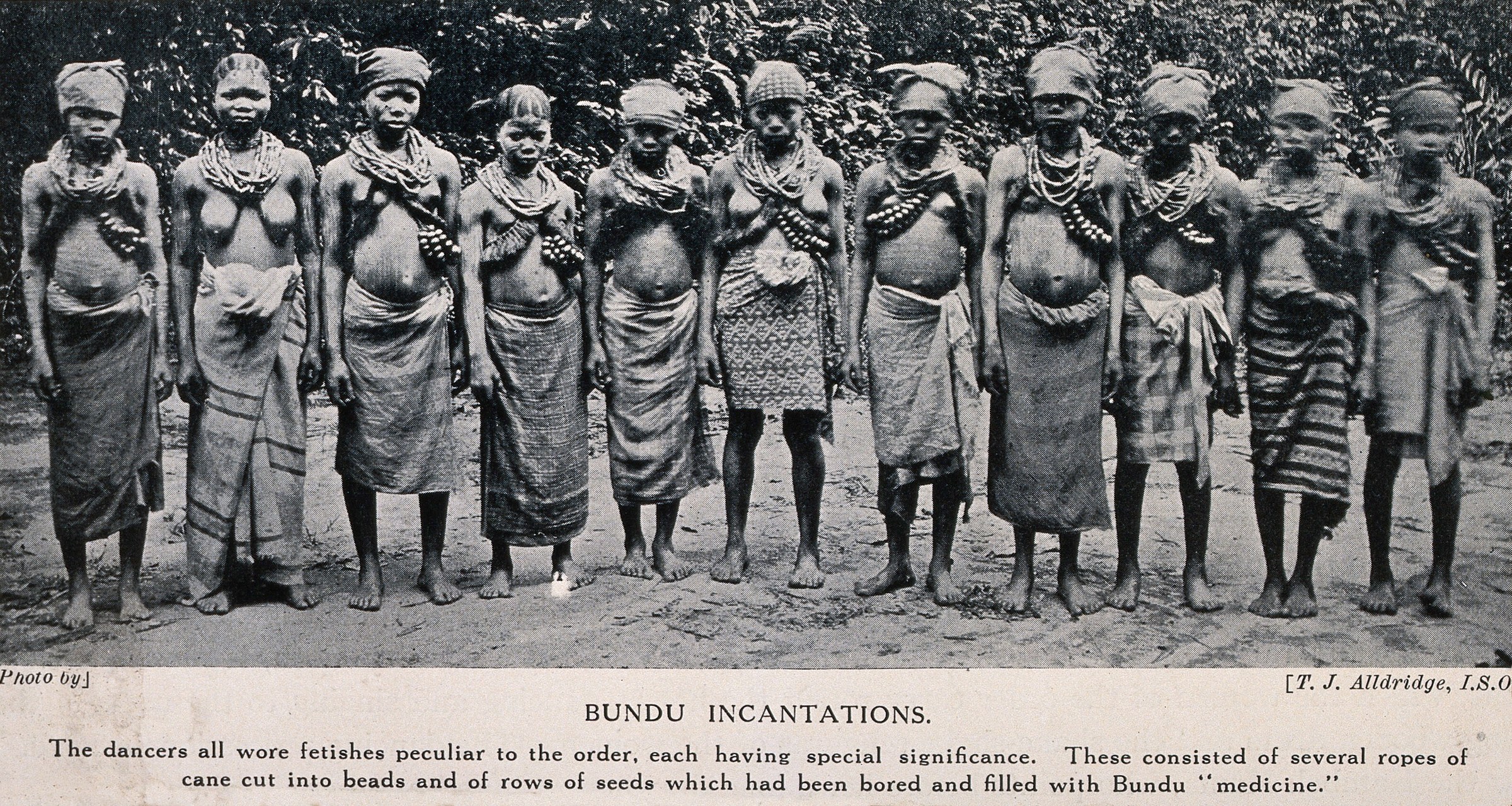
A group of Bundu female dancers all wearing necklaces of beads which are filled with medicines. Halftone after a photograph by T.J. Alldridge.
Unknown artist
- Source:
- Wellcome Collection
- Rights:
- Public domain — free to use, share and adapt.
- Recorded as:
- Public Domain Mark
The Bundu society was a powerful institution of female governance, initiation, and spiritual practice; the beaded regalia and medicines shown here were central to its authority and the transformation of initiates. For dancers and historians interested in African ritual, initiation, and the role of adornment in performance, this image is primary evidence of how a non-theatrical ceremonial society used material culture and the body to mark status and community membership. The photograph also exemplifies how early ethnographic images, despite their colonial context, sometimes preserve otherwise undocumented aspects of African cultural practice.
What you are looking at
Twelve figures stand in a frontal line against a densely vegetated background, arranged in order of apparent age from left to right. All are women or girls of the Bundu people, wearing minimal clothing—wrapped skirts or cloths at the hip—and extensive beaded ornaments. The most striking feature is the profusion of necklaces: each figure wears multiple strands of large beads arranged in graduating rows down the torso, many of them appearing thick and substantial. Some also wear beaded arm ornaments. The photograph is a formal documentation of dress and adornment, with even spacing and direct facing toward the camera. The halftone reproduction is clear but shows the expected grain and loss of detail in deep shadow (the background vegetation reads almost black). The figures cast no visible shadows, suggesting overcast or diffused light. There is no movement or narrative action: this is a still record of people in ceremonial dress.
The dancing
All figures stand upright and stationary, frontal to the camera, with arms at their sides or resting naturally. There is no dance posture, no weight shift, no frame or hold between figures. The stance is neutral and documentary—consistent with a posed photograph rather than a captured moment of performance. Spacing is even; the figures are arranged as in a formal group portrait.
The dance depicted
This is not a depiction of dance in the kinetic sense. The caption identifies these as 'Bundu incantations' and notes that the beaded necklaces worn by all figures are 'fetishes peculiar to the order, each having special significance' and were 'filled with Bundu medicine.' The Bundu (or Sande) is a women's initiation and political society with roots in Sierra Leone and surrounding West African regions, and the photograph documents regalia associated with ritual and ceremonial status rather than a choreographed dance form. However, the Bundu society involved performance and movement as part of its rituals, and the photograph may relate to a ceremonial context in which dance occurred, even if none is visible here.
How it was made
This is a halftone reproduction after a photograph by T.J. Alldridge (identified in the credit line). The halftone process—using a screened dot pattern to simulate tonal gradation—was standard for reproducing photographs in print from the late 19th century onward. The technique allowed photographic documentation to circulate in publications and archives, but at a cost in fine detail and contrast. The original photograph was likely taken in the field in Sierra Leone in the late 19th or early 20th century. Alldridge was a British colonial administrator and ethnographer active in Sierra Leone, and images like this appeared in travel narratives and ethnographic literature of the period.
About this work
This halftone print documents a formal group of Bundu women and girls arranged to display the beaded regalia associated with initiation into the Bundu (Sande) society. The photograph is not a dance image in the conventional sense—the figures are stationary and posed—but it records the material culture and adornment of a society that incorporated ritual performance and movement. The work belongs in a gallery of dance in art because the Bundu society was deeply involved in ceremonial and performative practice, and because ethnographic photography of this era is one of the few visual records of non-Western ritual traditions available to historians and dancers seeking to understand African cultural forms.
The image sits within the broader archive of late colonial ethnographic photography, a body of work that documented African societies for European audiences often with implicit hierarchies of representation. The photograph's clarity and formal arrangement reflect the conventions of ethnographic documentation—the desire to record, classify, and make visible. Yet it also preserves evidence of African women's ritual authority, dress practices, and ceremonial identity that would otherwise be lost.
How to look at it
View this image as a formal record of ceremonial dress and adornment rather than a snapshot of movement. Attend to the graduated arrangement of beads on each figure—the necklaces increase in number and apparent weight from head to hip, creating a visual emphasis on the torso and chest. Notice the consistency in pose and the even spacing: this is documentary photography, not candid capture. The halftone reproduction loses some fine detail in the beadwork itself, but the overall silhouette and scale of the regalia remain clear. The background vegetation, rendered nearly black, throws the figures forward and emphasizes their status as the subject of record.
The artist
T.J. Alldridge (1839–1910) was a British colonial official and ethnographer who spent much of his career in Sierra Leone. He served as administrator, explorer, and collector, and produced written accounts and photographs documenting West African peoples and cultures. His images and writings were influential in shaping European knowledge of Sierra Leone, though like all ethnographic work of the period, they were inflected by the power relations and assumptions of colonialism. Alldridge's photographs are held in several archives and continue to be studied as historical documents.
The period
This photograph dates to the height of European ethnographic photography, when colonial and scientific expeditions produced thousands of images intended to document 'native' peoples and customs for Western audiences. In the late 19th and early 20th centuries, such photographs appeared in travel narratives, scholarly publications, and museum collections. The Bundu society itself has a long documented history in Sierra Leone and adjacent regions, with origins tracing back centuries; by the colonial period, it remained a central institution despite European pressure. The photograph captures a moment when African ritual and ceremonial life were being intensely documented by outsiders, often without consent or understanding of the society's internal meanings.
Where it lives
This halftone print comes from the Wellcome Collection, a major archive of medical, scientific, and ethnographic images. The image is credited to T.J. Alldridge and identified as a photograph; the halftone process suggests it appeared in print in a publication or institutional setting, likely in the late 19th or early 20th century.
Dance in this work
Questions about this work
What is the Bundu and why does it matter for dance history?
The Bundu (also called Sande) is a women's initiation society found in Sierra Leone and surrounding West African regions, with deep historical roots and continuing practice today. It is a site of female knowledge, governance, and spiritual authority. Initiation involved ritual, performance, music, and dance; the society used these practices to transmit knowledge, mark transitions, and maintain social power. Understanding the Bundu is essential for African dance historians because it demonstrates how dance and ceremonial movement were embedded in institutions of female leadership and cultural reproduction.
Is this a dance photograph?
Not directly. The figures are posed and stationary, not captured in movement. However, the regalia shown—especially the beaded necklaces—were worn during Bundu rituals and performances that included dance and music. The photograph documents material culture associated with a ceremonial and performative society, so it is an indirect but important record of a context in which dance occurred.
Who was T.J. Alldridge and what was his role?
Alldridge was a British colonial administrator and ethnographer who worked in Sierra Leone for decades. He produced photographs and written accounts that shaped European understanding of West African peoples. While his work is historically valuable, it is important to understand it within the context of colonialism: he documented African societies from a position of colonial authority and for European audiences, which inevitably influenced what he chose to record and how he represented it.
What are the beads and 'medicines' mentioned in the caption?
The beaded necklaces and ornaments were not merely decorative; they were understood within the Bundu as powerful objects (often called 'medicines' or spiritual substances in ethnographic terminology) that held significance for protection, status, and spiritual efficacy. Each woman's regalia reflected her role and rank within the society. The specific meanings and compositions of these objects were—and are—known to Bundu members; ethnographic captions often use reductive language that obscures this internal knowledge.
More dance artwork





