49 works in this view — arrow keys or swipe to move between them.
Dance in Art
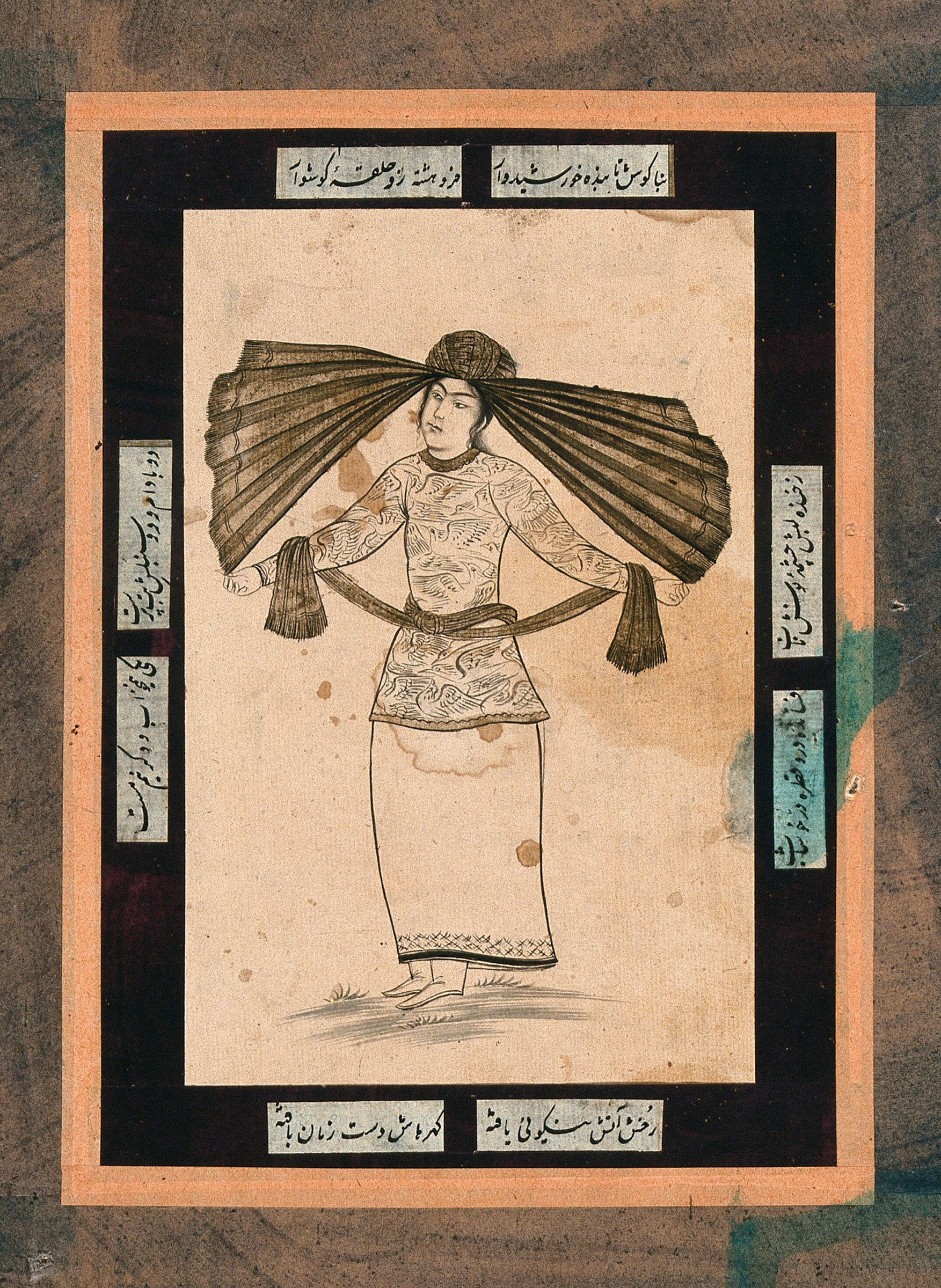
A Persian court dancer. Gouache painting by a Persian artist, Isfahan style, ca. 1690.
Unknown artist
- Source:
- Wellcome Collection
- Rights:
- Public domain — free to use, share and adapt.
- Recorded as:
- Public Domain Mark
This is one of the few surviving visual records of Safavid court dance in its original courtly context. It shows that elaborate choreographic costume—wings, emblematic patterns, formal heraldic presentation—was integral to high-status court performance, and that such performances were documented with the same care given to textual and architectural records. The work reveals an entirely different dance tradition from the European court dances of the same era, expanding our understanding of what 'court dance' meant across cultures.
What you are looking at
A single figure stands frontally against a plain cream background, wearing Persian court dress of approximately the late 17th century. The dancer wears a fitted tunic with elaborate decorative patterning (birds, possibly phoenixes, rendered in fine detail), a plain belt at the waist, and a long skirt that extends to the ankles with a patterned hem. Most striking is the costume's upper element: an enormous fan-like wing or cape structure extends horizontally from the shoulders, rendered in parallel lines suggesting pleated or gathered silk, creating a wingspan nearly as wide as the figure is tall. The garment ends in heavy tassels or fringes at the sides. The figure wears a small rounded cap. Four rectangular cartouches in Persian script appear on the black border surrounding the image—two at top, two at bottom—suggesting this is a documented courtly figure or dance type. The drawing is in ink on paper, with careful linear hatching used to define volume and texture, rendered in the Isfahan style characteristic of Safavid manuscript illustration.
The dancing
The figure stands in a frontal pose with both arms extended outward at roughly shoulder height, palms facing forward, creating a symmetrical, presentational stance. The body is upright and still, with weight centered. The posture is formal and composed rather than captured mid-movement; this is a portrait-stance rather than a kinetic moment. The enormous wing or cape element dominates the composition and appears to be integral to the costume and its display rather than a depiction of active movement.
The dance depicted
This appears to be a court dance from the Safavid Persian court, likely 17th century. The costume—particularly the elaborate patterned tunic and the dramatic wing or cape structure—suggests a formal courtly dance or entertainment role performed for the shah. The wings may represent a bird dance, given the phoenix imagery on the tunic, or they may be an architectural or theatrical costume element worn during court performances. The formal, heraldic quality of the pose and the documentary cartouches suggest this depicts a named dance role or courtier dancer known to the court. Without access to the Persian inscriptions, the specific identity of this dance or role cannot be definitively established, but the visual language indicates a high-status, theatrical courtly practice rather than folk or social dance.
How it was made
This is a gouache painting on paper in the Isfahan style of Safavid manuscript illustration, executed in the late 17th century (circa 1690 based on the record). Gouache allows for both fine linear detail—visible in the hatching that defines the tunic's decorative patterning and the wing's pleating—and flat areas of color and pattern. The medium was typical for court manuscript illustration and suggests this work was part of a larger documentary or celebratory manuscript, possibly a court chronicle or dance manual. The formality of the composition and the presence of identifying inscriptions suggest the work was made for court circulation among the educated and elite rather than for popular consumption.
About this work
This is a portrait of a Persian courtier dancer from the Safavid court, depicted in full formal costume including an extraordinary ceremonial wing or cape element. The work documents both the costume and the role, preserving visual evidence of a specific dance or entertainment form performed in one of the Islamic world's most sophisticated artistic courts. The gouache technique and Isfahan style place it within a tradition of courtly manuscript illustration that recorded and celebrated the court's aesthetic achievements and personnel. The work sits at the intersection of dance documentation, courtly portraiture, and theatrical costume history, showing how performance and formal dress were integrated into court ceremony and record-keeping. For a dance historian, it is invaluable evidence of Persian court dance practice; for an art historian, it demonstrates the integration of performance into courtly documentary arts.
How to look at it
Attend first to the enormous wing or cape structure, which dominates the composition and is likely the key to understanding this dance. Its geometric, almost heraldic presentation suggests it was a fixed, costume element rather than a prop manipulated in movement. Look at the precise patterning on the tunic—the birds and decorative motifs may carry symbolic meaning (phoenixes suggest immortality or renewal in Persian tradition). The frontal, formally posed stance suggests this is a documentation of a courtly role or a moment of presentation rather than a capture of active movement. The four cartouches are the key to identification; if translated, they would likely name the dance or the dancer depicted.
The artist
The artist is not recorded, but the style and execution indicate a trained court illustrator working in the Isfahan workshops that produced the Safavid court's manuscripts. The level of technical skill—the precise patterning, the subtle use of gouache, the careful composition—indicates a professional court atelier rather than a single named artist, which was typical of Persian manuscript production. The work was likely one of many such documentary illustrations, now lost or scattered.
The period
This work dates to the late Safavid period (late 17th century), a time when the Persian court maintained one of the Islamic world's most sophisticated artistic and courtly cultures. Court entertainment, including music, poetry, and dance, was a central element of royal ceremony and cultural prestige. In Europe, this era saw the codification of baroque court dances and the emergence of ballet as a distinct form; in Persia, court dance followed different aesthetic and formal principles rooted in Islamic aesthetics and Persian poetic traditions. The use of elaborate costume and wings for courtly entertainment parallels theatrical practices in Mughal India and Ottoman courts, suggesting a shared Islamic world practice of spectacular courtly performance.
Where it lives
The work comes from the Wellcome Collection, a major repository of medical, scientific, and historical manuscripts. This suggests it may have entered a Western collection as part of a larger Safavid manuscript or collection. The collection history prior to Wellcome is not recorded.
Dance in this work
Questions about this work
What are the wings or cape?
They appear to be a ceremonial costume element integral to this court dance or role. Their enormous size and formal geometric rendering suggest they were a fixed, architecturally significant part of the dancer's costume, possibly representing a bird (given the phoenix imagery on the tunic) or serving as a heraldic or symbolic element. Whether they moved or were static during performance cannot be determined from the image alone.
Why is this a dance and not just a portrait of a courtier in costume?
The formal pose and costume are presented as evidence of a specific dance role or performance type performed at court. The documentary cartouches suggest this is a catalog or record of courtly dances or dancers. In Safavid courtly culture, the distinction between ceremonial role, courtly dress, and performed dance was often blurred; this figure embodies all three.
How does this compare to European court dance of the same period?
European baroque court dances of this era emphasized social partnering and floor patterns, with elaborate steps codified in manuals. This Persian court dance appears more focused on individual presentation, costume spectacle, and symbolic display. The styles reflect different court cultures and aesthetic traditions: European baroque valued social order and geometric patterns of movement; Safavid court valued symbolic costume, heraldic presentation, and poetic imagery.
What would the cartouches say?
Without translation, it is impossible to know, but they likely identify the dance by name, the dancer by title or name, or both. They transform the image from a generic depiction into a specific documentary record, much as a curator's note or label would in a modern collection. Translation of these inscriptions would greatly expand what this work can tell us.
More dance artwork





