49 works in this view — arrow keys or swipe to move between them.
Dance in Art
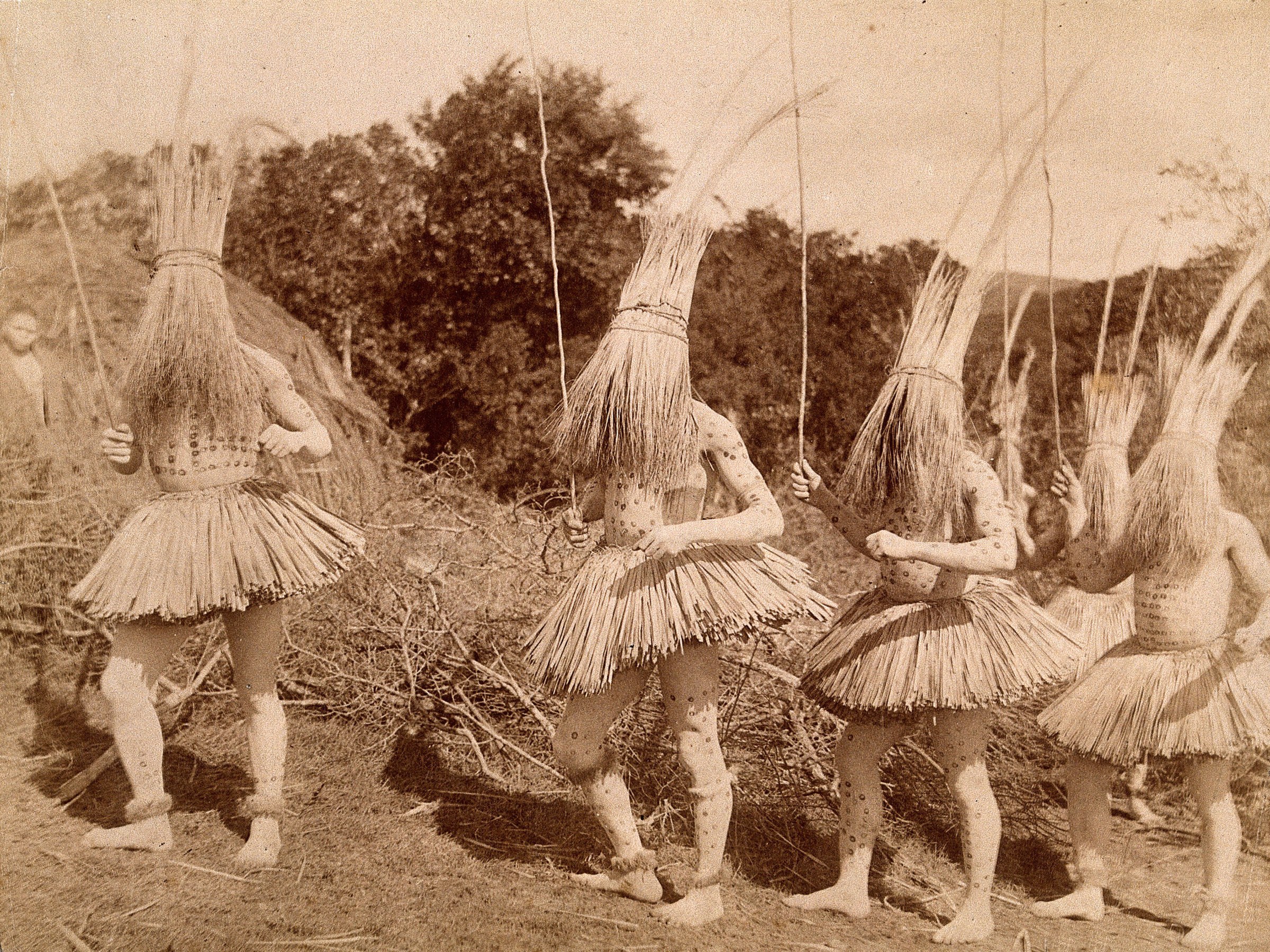
Ceremonial dance or war dance. Albumen print.
Unknown artist
- Source:
- Wellcome Collection
- Rights:
- Public domain — free to use, share and adapt.
- Recorded as:
- Public Domain Mark
This is an early visual archive of an Indigenous performance tradition from a region whose dance histories were little recorded in print or image. The photograph shows not just costume but the formal ritual stance and use of objects, information that survives in few other sources. It is also a document of the photographic encounter itself: how Indigenous ceremonies were translated into the still image for Western consumption in an era before film.
What you are looking at
Five or six figures stand in a semicircle on bare earth against a dense backdrop of tropical foliage. Each wears an elaborate costume: a skirt or kilt of bundled palm or raffia fibres spreads wide from the waist, and each head is crowned with a tall cylindrical headdress of the same material, bound at intervals with cord. The figures are bare-chested and appear unclothed below the waist except for body ornament. They hold long poles or staffs vertically, some angled slightly. The photograph is sepia-toned and shows the softness of an albumen print; the foliage behind is out of focus, emphasising the figures. The composition is frontal and formal, almost processional. The light falls from the left, casting subtle shadows. This is a posed photograph, not a caught moment—the figures are arranged for the camera's view.
The dancing
The dancers stand upright with weight evenly distributed, bodies still rather than in motion. Each holds a vertical pole or rod in both hands at roughly waist height. The posture is formal and restrained; there is no dynamic lean, hop, or weight shift visible. The arms are extended but not raised or swept. This stance suggests either a moment of rest within a performance sequence or a pose specifically adopted for documentation. The spacing is even; the figures do not cluster or relate through proximity or directedness of gaze.
The dance depicted
This is a ceremony of a Pacific or Southeast Asian people, most likely from what is now Papua New Guinea, Indonesia, or the Solomon Islands, to judge by the architectural style of the headdress and the palm-fibre costume. The catalogue calls it a war dance or ceremonial dance. The vertical poles and formal stance suggest a structured ritual performance rather than a kinetic, flowing movement style. Without ethnographic context or provenance, the specific dance form cannot be identified with confidence. The photograph documents a moment of stillness within what was almost certainly a dynamic performance, but the image does not show the movement itself.
How it was made
An albumen print, a photographic process dominant from the 1850s to the 1890s, created by coating paper with egg white and light-sensitive silver salts, then contact-printed from a negative. Albumen prints are recognisable by their glossy surface and characteristic cool-brown or golden tone. The softness of focus in the background and the slight flattening of tonality across the figures are typical of period photography with simple optics. The albumen process was slow and expensive; its use here suggests serious documentary intent, likely by a missionary, colonial administrator, or ethnographer with resources and institutional backing.
About this work
This albumen photograph documents a ceremonial or war dance of a Pacific or Southeast Asian Indigenous people, captured in the colonial era when such documentation was becoming common practice. The five or six dancers wear elaborate headdresses and skirts of bundled plant fibre and hold vertical poles, posed in a formal semicircle. The image is frozen in stillness and frontality; it shows dress and apparatus rather than motion. It is a visual record made for circulation to Western audiences who would have had no other way to see such performances, and it sits in the complex history of ethnographic photography—documentation that was both genuinely informative and deeply shaped by colonial hierarchies of seeing.
How to look at it
Look first at the costume and its construction: each element—the bundled fibres, the binding cords, the arrangement of the skirt—is precisely made and speaks to technical knowledge and aesthetic intention. Note the verticality of the poles: they are not weapons or tools in active use but ritual objects held in a formal pose. Observe the stillness of the bodies and the even spacing: the photographer has arranged the dancers for maximum visibility of costume and form, not for the capture of movement. This stillness is the condition of photography at the time, but it is also the condition of the pose as a mode of display. The image shows not the dance as it moves but the dancer as a figure to be seen.
The artist
Unknown. The photograph comes from the Wellcome Collection, which holds a vast archive of ethnographic and medical photography assembled in the late 19th and early 20th centuries. Such images often lack individual authorship in the record; they were made by unnamed photographers working for colonial surveys, missionary societies, or collecting institutions, and were valued as documents rather than as authored works.
The period
The albumen print process dates the image to approximately 1860–1900. This was the era of intensive European ethnographic documentation of colonised peoples, driven by scientific interest and imperial expansion. Photography was seen as an objective record, though it was in fact shaped by the photographer's eye, the subject's willingness or coercion, and the Western conventions of composition and display. In the same decades, Western audiences were encountering non-European performance forms through photographs, museum exhibitions, and world's fairs, often for the first time.
Where it lives
The photograph is held in the Wellcome Collection, a major archive of historical images of medicine, science, and ethnography. The Wellcome acquired many such photographs as part of its systematic collection of visual documentation, and the source of this particular image may not have been recorded in detail.
Dance in this work
Questions about this work
What region is this dance from?
The costume and headdress style suggest a Pacific or Southeast Asian origin, likely from Papua New Guinea, Indonesia, or the Solomon Islands, but the photograph does not record the specific people or place. The Wellcome Collection's records may contain more information about provenance, but it is not captured in the current catalogue entry.
Why are the dancers standing still?
Photography in the albumen era required long exposures; significant motion would blur the image. The photographer posed the dancers in stillness to show the costume clearly. This means the image documents the visual appearance of dress and objects, but not the movement vocabulary of the dance itself.
Is this a war dance?
The catalogue record calls it a war dance or ceremonial dance, which reflects how such performances were often categorised by colonial observers. Without ethnographic context, it is not possible to confirm the function of the dance. The vertical poles and formal stance are consistent with ritual or ceremonial use, but the specific meaning and performance context are not preserved in the image.
More dance artwork





