49 works in this view — arrow keys or swipe to move between them.
Dance in Art
The dance of death. Lithograph.
Unknown artist
- Source:
- Wellcome Collection
- Rights:
- Public domain — free to use, share and adapt.
- Recorded as:
- Public Domain Mark
The *Danse Macabre* is one of the most significant allegorical dance images in European art, and this Lübeck print is among its most influential exemplars. For dance historians, the work shows how 'dance' could function as metaphor and moral teaching, not just physical practice—and how a non-realistic, symbolic register of movement could carry profound cultural meaning. For art historians and medievalists, the *Totentanz* is a key text for understanding late medieval and Renaissance anxieties about death, plague, social order, and the power of visual narrative.
What you are looking at
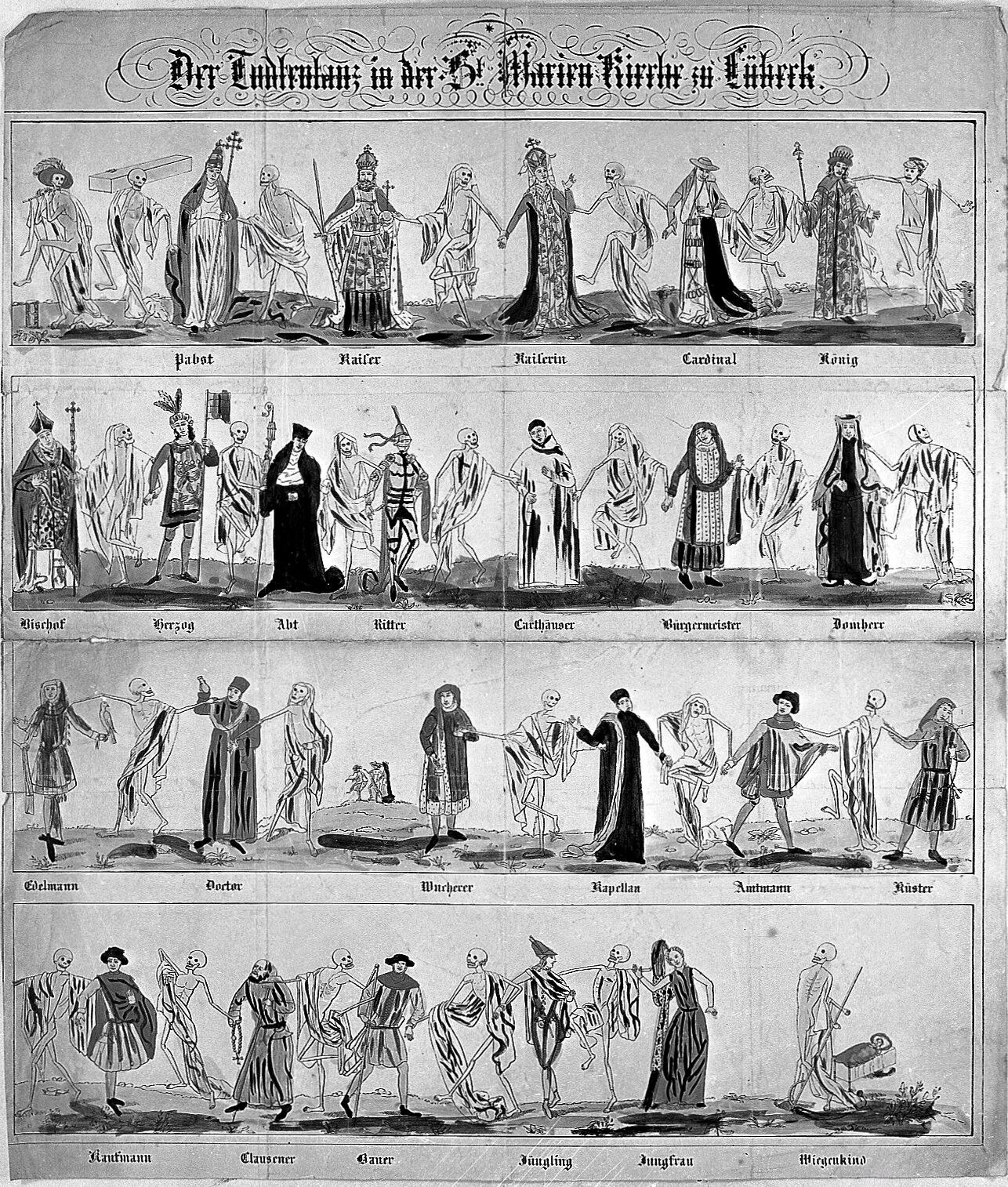
This is a German-language broadsheet print titled *Der Totentanz in der St. Marien Kirche zu Lübeck* (The Dance of Death in St. Mary's Church, Lübeck), presented as five horizontal registers of allegorical figures. The composition depicts the medieval *danse macabre* tradition: a procession in which skeletal Death—personified as a cadaver or dancing skeleton—leads representatives of every social rank toward the grave. The figures are rendered in a characteristic late medieval or early Renaissance print style, with fine linear hatching and precise anatomical detail. Each register shows a sequence of paired encounters between Death and living figures: Pope, Emperor, and King in the first row; Bishop, Duke, and other nobility in the second; followed by Merchant, Burgher, Peasant, and laboring figures. The figures wear the formal dress of their station—ecclesiastical vestments, crowns, robes, and working clothes. Death appears variously as a skeletal dancer or cadaver, sometimes grasping the hands of the living in a macabre partnered gesture. The setting is minimal and symbolic rather than naturalistic: the figures stand against bare ground with no architectural frame, emphasizing the procession's eternal, timeless character. The mood is didactic and sobering rather than celebratory: this is a moral allegory about the inevitability of death and the equality of all ranks before it.
The dancing
The bodies are arranged in linear procession across each register, alternating between living figures (shown upright, sometimes in frontal stance) and Death (skeletal, often in a contrapposto pose suggesting movement). The partnered encounters show Death grasping or leading the living by the hand or arm—a closed or semi-closed partner connection suggesting a forced dance. Some living figures appear to recoil or resist; others seem passive or resigned. The gesture is formal and symbolic rather than naturalistic: the print captures a conceptual moment (the meeting of the living and the dead) rather than realistic dancing bodies. Posture varies by rank: ecclesiastical figures are sometimes kneeling or in gestures of prayer; nobles stand in dignified (if doomed) poses; laborers and common folk are shown in standing positions befitting their station.
The dance depicted
This is a visual representation of the *Danse Macabre* or *Totentanz*, a late medieval and Renaissance allegorical tradition that existed in both literature and visual art. The work does not depict actual dance technique or performance, but rather a choreographed procession of death: a conceptual narrative in which every social rank, from Pope to peasant, is led in a final dance by Death itself. The *Totentanz* tradition emphasized the leveling power of death and served a memento mori function in ecclesiastical and civic contexts. This particular print references a specific example—the wall paintings in the St. Mary's Church (Marienkirche) in Lübeck, Germany, which were among the most famous and influential *Totentanz* cycles of the period. The 'dance' here is not steps or rhythms but encounter and procession: a grimly ordered sequence in which Death partners each figure in an inescapable final movement.
How it was made
The catalogue record identifies this as a lithograph, though the image's characteristics (the linear hatching, the precise black line, the formal registers, the German-language labels) are consistent with a woodcut or engraving from the 15th to 17th century rather than a lithograph (a technology that emerged in the late 18th century). The fine linear detail and the method of reproduction suggest this may be a 19th-century re-engraving or reproduction of an earlier *Totentanz* image, or the record's medium attribution may be imprecise. The technique—whether original engraving or later lithographic copy—supported wide circulation among the educated and pious publics of northern Europe. The print format allowed this moral allegory to reach parish churches, civic halls, and private collections as a portable, reproducible meditation on mortality.
About this work
This is a *Danse Macabre* broadsheet, a visual sermon in which Death partners each rank of society in an inexorable procession toward the grave. The work is part of a northern European tradition—especially strong in the German-speaking lands and reflected in the famous Lübeck cycle—that turned death into a democratizing force and a didactic spectacle. The 'dance' is allegorical: not a representation of actual choreography, but a conceptual ordered sequence that asserts the futility of rank and worldly status. The print was both a work of art and a devotional tool, circulated widely to churches and homes as a visual reminder of human mortality and the need for spiritual preparation. Its legacy influenced both the visual arts and popular culture for centuries, becoming one of the most enduring images in European visual tradition.
How to look at it
Attend to the procession structure: the way each figure is positioned in relation to Death, and how the repetition of the pairing creates a rhythm of inevitability. Note the detail of dress and attribute that marks each social rank, and observe how Death is rendered identically (or nearly so) across all encounters—the point is that Death is indifferent to rank. The artist has chosen the moment of approach or grasping, not actual bodily movement: this is a conceptual rather than kinetic image. The linear register format, borrowed from narrative art and from the structure of religious cycles, creates a didactic reading sequence that guides the eye from high to low social station, emphasizing the universal application of the moral.
The artist
The artist is not recorded in the catalogue. The composition and style suggest a northern European origin, likely German or Low Countries, and the specific reference to Lübeck suggests the work may derive from or respond to the famous mural cycle in St. Mary's Church. The *Totentanz* tradition was sustained by multiple artists and printmakers over centuries; this may be an anonymous work by a skilled engraver or lithographer working in the tradition, or a direct copy after an earlier design.
The period
The *Danse Macabre* tradition emerged in the 14th and 15th centuries, especially after the Black Death (1347–51), which devastated European populations and intensified memento mori piety. The tradition flourished in the 15th and 16th centuries, with famous cycles painted in churches and reproduced in prints across northern Europe—the Lübeck cycle is dated to the early 15th century, though it was frequently copied and reinterpreted. By the time this print was made (if it is indeed a later reproduction or lithograph), the *Totentanz* had become a canonical image of European moral and religious culture, adapted and redrawn by successive generations. The allegorical pairing of social ranks with Death also reflects Renaissance and Reformation anxieties about hierarchy, mortality, and the equality of souls before God.
Where it lives
The work is held in the Wellcome Collection, a London-based library and museum focused on the history of medicine and life sciences. The accession and date are not recorded in the catalogue provided. The *Totentanz* tradition has been of sustained interest to collectors of religious art, popular prints, and medieval cultural history.
Dance in this work
Questions about this work
Is this actually a dance?
Not in the sense of choreography or physical technique. The *Danse Macabre* is an allegorical procession in which Death 'partners' each social rank in a symbolic final movement toward the grave. The 'dance' is a metaphor for the inevitability and democracy of death. It served a moral and religious function, not an entertainment or artistic performance one.
What is the Lübeck connection?
St. Mary's Church (Marienkirche) in Lübeck, Germany, contains one of the most famous and influential *Totentanz* mural cycles, dated to the early 15th century. This print either reproduces that cycle or derives from it. The Lübeck *Totentanz* became a canonical reference for the entire tradition in northern Europe and inspired countless copies and adaptations.
Why did this image matter so much?
The *Danse Macabre* emerged after the Black Death and spoke to universal anxieties about mortality, plague, and the ultimate equality of all people. It was displayed in churches and public spaces as a devotional and didactic image, a visual sermon that prepared the soul for death. Its power lay in combining allegory, social satire, and religious instruction into a single memorable form.
Is the lithograph attribution correct?
The style and detail of this print suggest it may be a woodcut or engraving from an earlier period, or a 19th-century reproduction of one, rather than an original lithograph. Lithography did not exist before the late 18th century, and the technique here appears earlier. The catalogue attribution may need verification.
More dance artwork





