49 works in this view — arrow keys or swipe to move between them.
Dance in Art
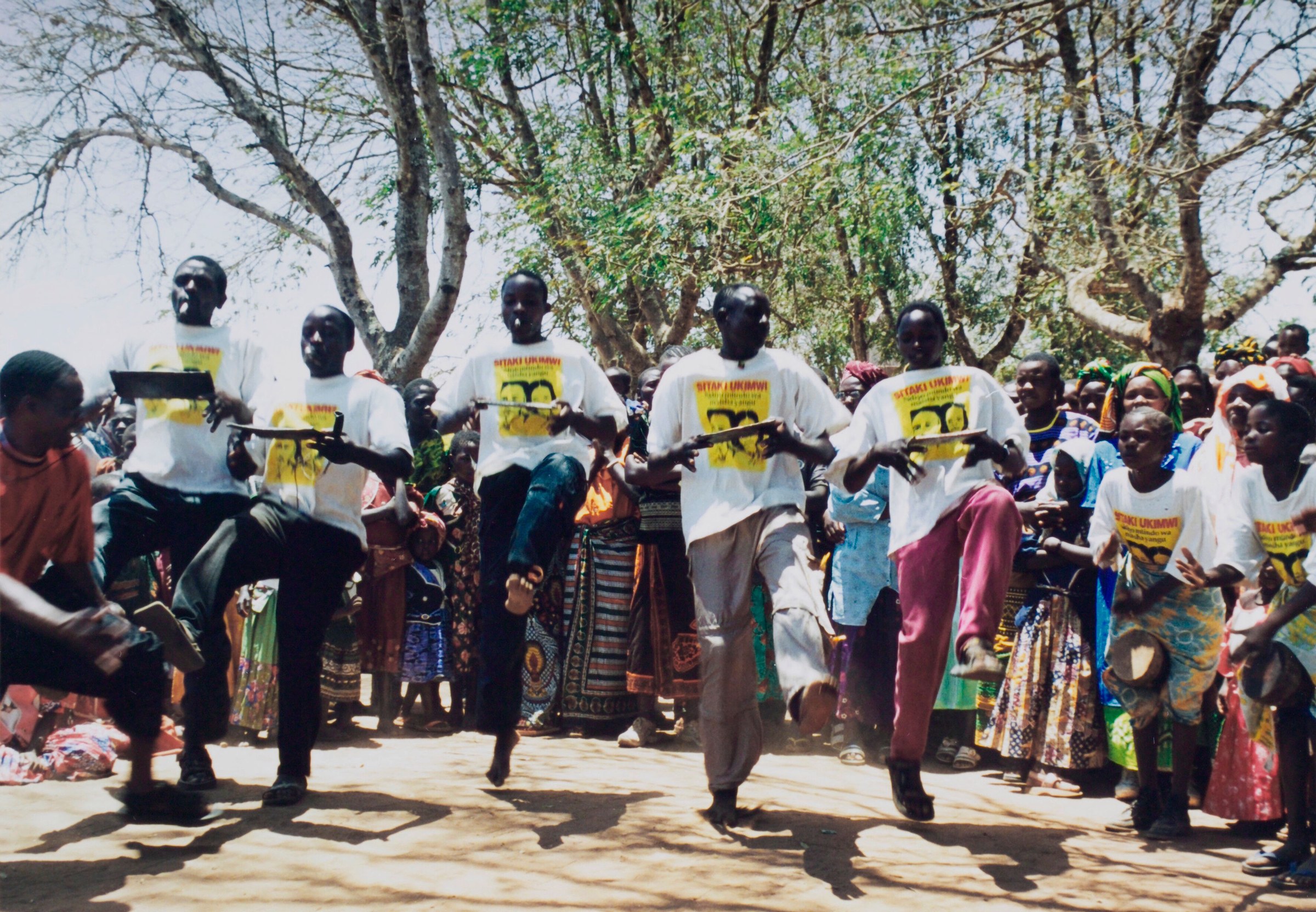
Health promotion through dance, Tanzania
Unknown artist
- Source:
- Wellcome Collection
- Rights:
- Reusable with conditions: credit the creator; non-commercial use only. Source record ↗
- Recorded as:
- Attribution-NonCommercial 4.0 International (CC BY-NC 4.0)
This photograph documents a little-studied intersection: the use of dance as a vector for public health messaging in late 20th-century Africa. It shows how dance was mobilized not as entertainment or ritual, but as pedagogy—a trusted, participatory mode of learning and behavior change. For dancers and historians, it raises questions about the politics of using traditional or popular dance forms in development work, and about who controls the narrative when dance becomes a tool of external intervention.
What you are looking at
A large outdoor gathering under mature trees in what appears to be a rural or semi-rural African setting. In the center, five or six men wearing matching white t-shirts with yellow printed graphics (legible as "SITAJI LIMUMYI" or similar health messaging) stand in a loose line or formation facing a crowd of perhaps fifty or more community members arranged in a semicircle around them. The ground is bare earth. The spectators—men, women, and children—wear bright patterned fabrics in blues, reds, greens, and earth tones; several women are dressed in traditional wrap skirts and prints. The daylight is strong and overhead, casting sharp shadows. The men in white shirts appear to be demonstrating or performing; their body language suggests movement or instruction rather than static presentation. This is clearly a public health or community education event using dance or physical movement as the medium.
The dancing
The five or six men in white shirts stand in an open formation with knees slightly bent and arms extended or gesturing outward, suggesting an active, energetic moment mid-movement. Their weight appears to be forward, and their posture is upright and engaged rather than relaxed. The assembled crowd stands close, watching intently; several people in the immediate foreground have their gaze fixed on the demonstrators. There is no visible closed-hold partnering or formal ballroom frame. The movement appears to be led by the men in matching shirts, with the crowd as audience rather than participants, though the setting and informality suggest this may invite participation.
The dance depicted
This appears to be a community health promotion dance or movement workshop, most likely in Tanzania as the caption states. The matching t-shirts bearing health messaging (readable printing suggests a public health campaign) indicate this is an organized intervention using dance or rhythmic movement as a vehicle for health education—a well-documented practice in sub-Saharan African public health. The specific dance style cannot be identified with certainty from the image alone: the open formation, energetic posture, and community setting are consistent with folk or social dance traditions, but without visible footwork, drums, or other cultural markers, the particular regional or ethnic style remains unclear. The format—demonstrators teaching or performing for a seated/standing audience—is typical of health promotion campaigns that use local dance forms as trusted and engaging modes of instruction.
How it was made
This is a photograph, likely color slide film or transparency given the saturation and color palette (typical of Kodachrome or Ektachrome stock from mid-to-late 20th century). The photographic medium allows documentary capture of a transient moment and community gathering at life scale, and the composition—from ground level, capturing both demonstrators and audience in a single frame—suggests this was taken by someone embedded in or observing the event itself. The quality and color rendering suggest professional or institutional documentation rather than casual snapshot. The Wellcome Collection source indicates this was acquired as part of medical or public health documentation.
About this work
This is a documentary photograph of a health promotion event in Tanzania in which dance or rhythmic movement was used as a teaching tool. Five or six men wearing matching campaign t-shirts demonstrate movement to a gathered crowd of community members in an outdoor setting. The image documents a specific moment of public health practice—the use of culturally familiar forms of embodied knowledge (dance) to communicate health messages. It is a record of both a dance moment and a moment in the history of development and health communication in Africa.
How to look at it
Note the careful matching of the demonstrators' clothing—the white shirts with printed text create visual unity and immediately signal 'official' or 'campaign' status. Observe the posture and energy of the men in white compared to the seated and standing crowd: the demonstrators are clearly in motion or about to move, while the crowd is static and attentive. The composition places the demonstrators at human scale, neither elevated nor distant, which suggests the intent is accessibility and participation rather than performance from a stage. The outdoor, daytime setting under trees is significant: this is not a theatrical or formal venue, but rather community space where people gather.
The period
This photograph dates to an era (likely 1980s–1990s based on color and style) when African governments and international health organizations increasingly deployed community-based health education campaigns, often drawing on local cultural forms including music and dance. The Tanzanian context is significant: Tanzania under Julius Nyerere and afterward prioritized public health and community mobilization, and the nation was a site of extensive development work by bilateral and multilateral agencies. The use of dance for health promotion reflects broader trends in public health communication away from top-down messaging toward participatory, culturally grounded approaches.
Where it lives
The photograph is held in the Wellcome Collection, a major archive of medical history and scientific practice. Its presence there indicates it was collected as documentation of a health intervention, development project, or medical anthropological study rather than as art or cultural heritage documentation.
Dance in this work
Questions about this work
What is the health message on the t-shirts?
The text on the white shirts is legible in the photograph but not fully clear in reproduction; the caption indicates this is a 'health promotion through dance' initiative in Tanzania. The matching shirts serve to identify the demonstrators as official educators or health workers.
Is this dance part of a local tradition or created for the campaign?
The image alone cannot answer this. The open formation and community setting suggest the movement may be rooted in local dance culture, but the campaign context means the specific choreography could be a new creation designed to carry health messages, or an adaptation of existing forms. Historical research on the campaign would be needed to determine this.
When and where was this taken?
The catalogue states Tanzania; the photographic materials and color suggest this dates to the 1980s or 1990s, but the exact date and location are not recorded in the available metadata.
Why is this in a dance archive rather than a medical or development collection?
Because dance—even when deployed as a tool for health communication—is still dance. This image documents real bodies moving in real time, a specific moment in the history of dance as pedagogy and public practice, distinct from theatrical or ritual contexts.
More dance artwork





